Fortrea Brand Guidelines
A new name on a lineage that runs back to 1968.
Aa
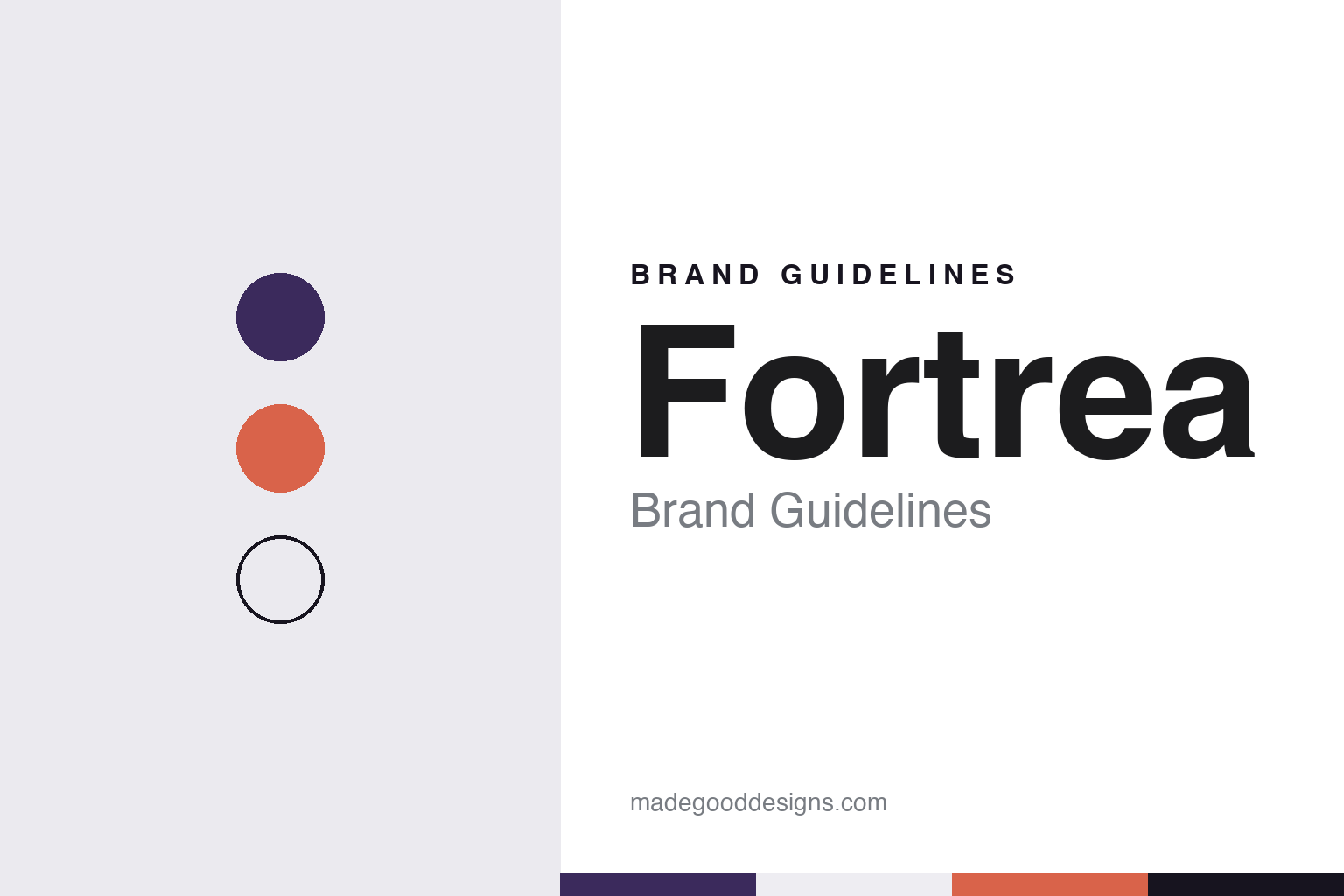
Two constants: a violet, coral and mist palette and a forward sans register. Abstract homage — not a Fortrea asset or mark; no logo or wordmark is reproduced.
Hazleton to Covance
A Seattle equipment maker’s long lineage.
Fortrea is a new name on an old business. English Wikipedia traces it to Environmental Sciences Corporation, set up in Seattle in 1968 to make equipment for laboratory animals. In 1972 it bought Hazleton Laboratories, a contract laboratory doing toxicology testing, and took its name. Corning took a stake in Hazleton in 1977 and bought the rest in 1987, the encyclopedia says; Hazleton tested drugs, cosmetics, pesticides and industrial chemicals on animals, and sold its equipment-making unit in the mid-1980s.
Corning then assembled a drug-development group. In 1989 it bought G.H. Besselaar Associates, which ran clinical trials for drug approvals; SciCor followed in 1991 and the Philadelphia Association of Clinical Trials in 1992. The businesses were combined under Corning Lab Services and then Corning Pharmaceutical Services, and in 1997 Corning spun off its pharmaceutical-services business as a separate public company, Covance, at the same time as its clinical-testing arm became Quest Diagnostics. Fortrea’s own timeline calls the 1997 spin-off the formation of “one of the first CROs.”
As Covance, the company grew for nearly two decades. English Wikipedia records a central laboratory in Singapore opened in 2000, a laboratory in Shanghai in 2007, a campus in Greenfield, Indiana, bought from Eli Lilly in 2008, and sites in France and the United Kingdom taken over from Sanofi-Aventis under an outsourcing partnership in 2010.
Colour
The Labcorp years and a 2023 spin-off.
In February 2015 the diagnostics company Labcorp bought Covance, English Wikipedia says. Under Labcorp it added Chiltern, a specialty CRO, in 2017; Endpoint Clinical the same year, which Fortrea’s timeline says brought randomisation and clinical-supply management systems; RCRI, a device-focused CRO, in 2019, which the timeline marks as its entry into medical technology; and, in 2020, the mobile-nursing business GlobalCare and technology for remote trial participation. In June 2021 Covance was renamed Labcorp Drug Development.
On 28 July 2022 Labcorp announced that it would spin off its clinical-development business, Applied Clinical Trials reported. Labcorp would keep its routine and esoteric testing, its central and early-development research laboratories and its laboratory network; the new company would offer Phase I–IV clinical trial management, market access and technology. The new name, Fortrea, came in February 2023, according to English Wikipedia. The company’s vision statement spells out where it comes from: “driving FORward clinical TRials with EAse.”
Labcorp said on 3 July 2023 that the spin-off had been completed at 11:59 p.m. on 30 June 2023, with each Labcorp stockholder receiving one Fortrea share for every Labcorp share held, and that Fortrea would begin trading that morning on the Nasdaq under the symbol FTRE. Fortrea is headquartered in Durham, North Carolina.
Typography
Design and documentation.
Contract research organisations sell a service rather than a product. Drug, biotechnology and medical-device companies hire them to plan and run clinical trials, to test compounds before they reach people, to manage laboratories and to collect and analyse the data that regulators review. Because what they sell is largely invisible, their public image is built from people, places and numbers.
The pictures tend to repeat. Corporate sites and annual reports in the category often show clinicians and patients of different ages and backgrounds talking in calm, well-lit consulting rooms; scientists in lab coats working with pipettes and sample plates; and world maps dotted with the countries and sites where studies run. Data dashboards, charts and screens are common too, reflecting how much of the work is now about managing information as well as patients.
Colour follows the same caution. Blues and greens, from deep navy to soft teal, are frequent choices in health care and research branding, usually set against plenty of white, with a clean sans for names and headings. The aim is to look steady and trustworthy rather than playful, and names are often short, sometimes initials or a single coined word, partly because many of these companies are the product of mergers.
The industry also meets in person. Large gatherings such as the DIA Global Annual Meeting and the SCOPE Summit for clinical-operations staff bring sponsors, research organisations and technology suppliers together, and exhibition stands, panels and presentation slides there are another place where these identities are on show. This guide sets out what can be checked about each company’s history and ownership, and treats every colour and typeface here as our own interpretation.
Aa
A forward-leaning sans register. (Specimen set in Plus Jakarta Sans, a sans STAND-IN; NOT the Fortrea logo.)
Fortrea
A clinical CRO, rebuilt for early phase.
Fortrea has since narrowed and then rebuilt. In June 2024, English Wikipedia says, it sold Endpoint Clinical and its patient-access business to Arsenal Capital Partners; its own timeline describes 2024 as the year it focused on “core CRO services” by spinning off FortreaRx, patient access services and Endpoint Clinical. Then, on 20 October 2026, Fortrea announced that it had completed the purchase of the Early Phase Services division of Worldwide Clinical Trials: a 200-bed clinical research unit in San Antonio, a bioanalytical laboratory in Austin and a biospecimen-storage site in Pflugerville, Texas, which it said brought its early-phase capacity to more than 570 beds worldwide.
Today its website groups the work into clinical pharmacology, including Phase I units and human ADME studies; clinical development and trial management; consulting on market access, regulatory strategy and patient-centred endpoints; and a functional service provider model, in which it supplies teams for sponsors’ own studies. English Wikipedia says it works in about 100 countries and lists oncology, central-nervous-system and neurodegenerative diseases, rare diseases and cell and gene therapies among its focus areas.
The company brands its technology too. The website gathers its digital tools under the name Fortrea Intelligent Technology, or FIT, split into lifecycle, foresight and companion solutions; lists a multiphase research unit in Leeds, England, among its clinical sites; and names a Fortrea Site Advisory Board among its services for the research sites that run trials. The website is published in eight languages, from Spanish and German to Japanese, Korean and simplified Chinese, and its headline promise is “raising CRO standards.”
The lineage also carries the record of the Hazleton and Covance animal laboratories. English Wikipedia describes undercover filming at a Covance primate facility in Münster, Germany, shown on German television in 2003, and at a laboratory in Vienna, Virginia, in 2004–2005, after which the company agreed a settlement with US regulators and later dropped a lawsuit against the animal-rights group involved; it also records US Department of Agriculture citations in 2011 and 2012 and a fine under the Animal Welfare Act over events in 2014. When Labcorp separated the businesses, it kept the early-development research laboratories, Applied Clinical Trials reported in 2022.
For a design guide, Fortrea shows how a spin-off can coin its name from its own mission statement while carrying a lineage of more than half a century. Compare Labcorp, its former parent, and Parexel, another clinical CRO in this series. For this guide we use a deep violet, a coral and a pale mist with a sans, an unofficial interpretation; no product or logo is reproduced.
Explore & save
Keep Fortrea’s identity on hand — save it to a board in the Made Good inspiration library.
Fortrea identity set
Pin the Fortrea violet, coral and mist palette and the forward sans register to your own board.