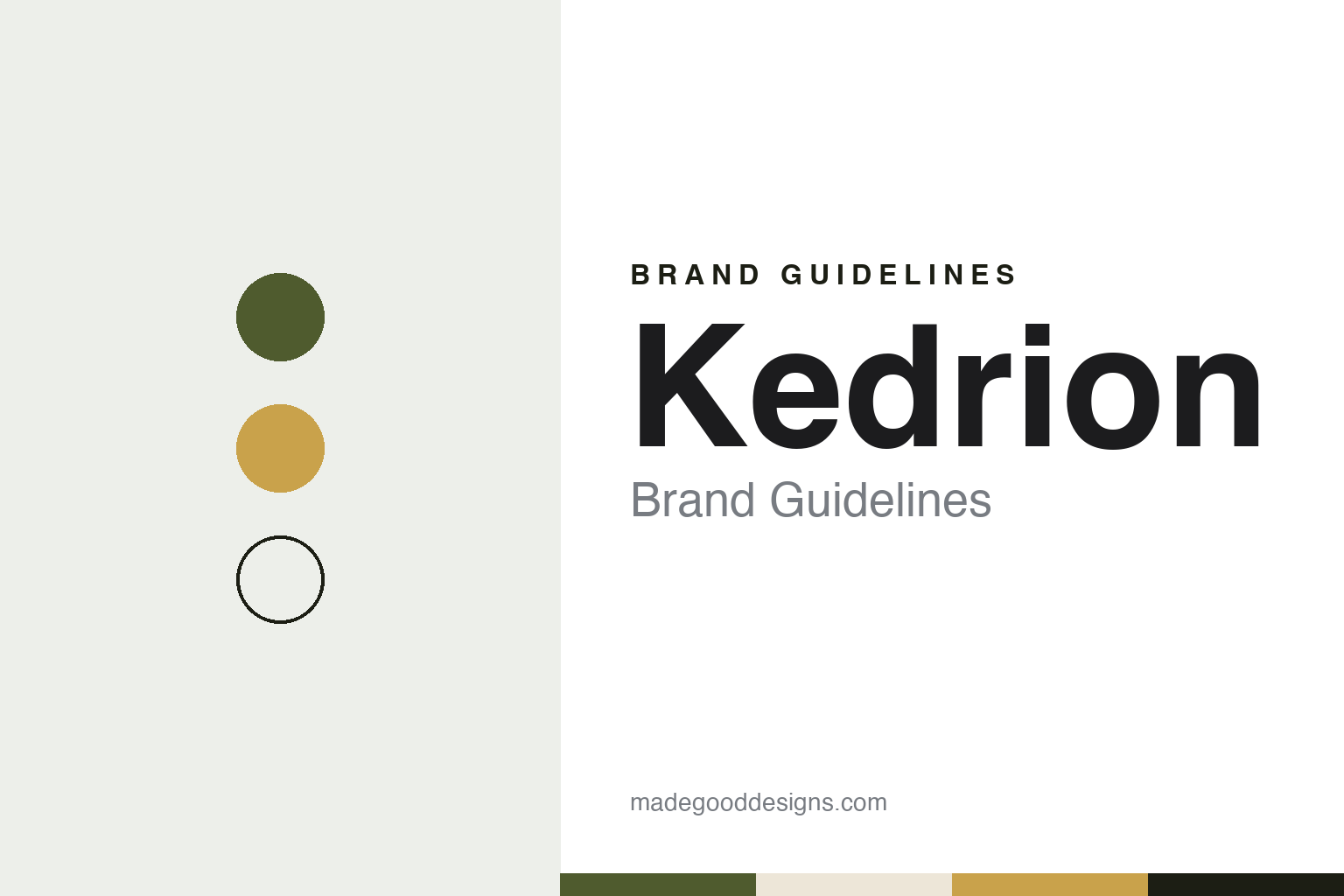
Kedrion Brand Guidelines
The Tuscan plasma company that grew by bringing established names into one group.
Aa
Two constants: an olive, stone and amber palette and an Italian serif register. Abstract homage — not a Kedrion product or mark; no pack, logo or label is reproduced.
Marcucci
A Tuscan family and a restructured company.
Kedrion was founded in 2001. Italian Wikipedia names Guelfo Marcucci as its founder and says the company was formed after the restructuring of a business bought from Enimont in 1990, together with two smaller firms, Aima Plasmoderivati of Rieti and Farma Biogin of Pisa. Fortune Italia, reporting in September 2022, described Kedrion as an Italian company based in Tuscany, founded in 2001 by the Marcucci family, with roots in the Italian pharmaceutical industry going back to the 1950s; reports of the same period call Paolo Marcucci a co-founder.
Its core business is plasma. Kedrion collects and fractionates blood plasma to make medicines derived from it, and Italian Wikipedia says it processes plasma from blood and plasma donations collected in Italy on a contract basis for the Italian national health service, alongside its commercial business in other countries, and calls it the Italian leader in plasma-derived products. Fortune Italia reported in 2022 that Kedrion brought 21 products and more than 600 marketing authorisations around the world into the combined group. The same article gives it production sites in Italy, Hungary and the United States.
The company tried more than once to list its shares. In 2008 it applied to list on the Milan stock exchange but withdrew the request after the price range had already been set, and a second listing was considered in 2013 without result, Italian Wikipedia says. Outside investors came in instead: in 2012 Cassa Depositi e Prestiti, through what is now CDP Equity, took a 25 per cent stake, and in 2019 the FSI fund acquired close to 20 per cent through a capital increase, the article records.
Colour
RhoGAM and the American market.
Kedrion’s largest step into the United States came in 2012. On 1 August 2012 NS Medical Devices reported that the company had bought the RhoGAM line of products from Ortho Clinical Diagnostics, together with Ortho’s subsidiary Somerset Laboratories, a US FDA-licensed donation centre that had collected the plasma used to make RhoGAM. Paolo Marcucci, then Kedrion’s chief executive, called RhoGAM the legacy anti-D immune globulin brand and said it complemented the company’s portfolio of plasma-derived products for haemolytic disease of the newborn, haemophilia and immune deficiencies.
The United States remained central later on. When the combination with BPL was completed in 2022, Private Equity Wire reported that the combined business expected most of its sales to come from the US market, with ten marketed products there, while keeping established positions in Italy and the United Kingdom. Fortune Italia added that it was entering the Chinese market through a distribution agreement for its albumin product, Albuminex.
The company describes its present range in broad terms. In an October 2026 release distributed by EQS, Kedrion Biopharma, the name it uses in its announcements, said it collects and fractionates blood plasma to produce plasma-derived therapies for rare, ultra-rare and serious conditions, including immunodeficiencies, coagulation disorders, neurological diseases and Rh sensitisation. It gave its size as about 5,400 employees and 39 products distributed in more than 100 countries, and called itself the world’s fifth-largest player in plasma-derived products; those are the company’s own figures and its own ranking.
Typography
Blood, plasma and the companies that collect it.
Plasma companies sell medicines that most people never see on a shelf, so their public image is built around the people at either end of the chain. Websites, annual reports and recruitment pages for the sector tend to open on donors: someone relaxing in a reclining chair in a bright, clean collection centre, a nurse at their side, with the equipment kept small in the frame. The tone is calm and grateful rather than clinical.
The middle of the chain is shown through hands and buildings. Close-ups of gloved hands holding vials, labelled blood bags and racks of tubes signal laboratory care without showing a face, while aerial photographs of large fractionation plants, steel tanks and clean-room corridors stand for scale. Collection-device makers add their own register of machines, tubing sets and touchscreens, usually photographed on white.
At the far end are patients. Several of the conditions these medicines are used for are rare, and the companies’ storytelling often leans on named families, children and long-term patients, often filmed at home or outdoors, alongside patient-organisation partnerships and awareness days. Scientific credibility is carried by medical congresses such as those of the International Society on Thrombosis and Haemostasis (ISTH) and the American Society of Hematology (ASH), and by industry meetings such as the Plasma Protein Forum.
The visual identities themselves are mostly quiet: corporate sans-serif wordmarks, generous white space and restrained palettes, with brand colour used sparingly against photography. This guide sets out what can be checked about each brand — who founded it, who owns it and where it says its products are made — and marks clearly what rests only on the company’s own word.
Aa
An Italian serif for a Tuscan family company. (Specimen set in Libre Baskerville, a serif STAND-IN; NOT the Kedrion logo.)
Kedrion
Permira, BPL and a combined group.
Ownership changed in 2022. On 20 January 2022 Reuters, in a report carried by Euronews, said Kedrion would combine with the British plasma company Bio Products Laboratory (BPL). Funds advised by the private equity firm Permira and their co-investor, the Abu Dhabi Investment Authority, had agreed with Kedrion’s existing shareholders, the Marcucci family and FSI, to acquire and combine the two companies, with Permira holding a controlling stake. La Repubblica, which called Kedrion a leading company in the plasma sector, reported the same day that its existing shareholders would reinvest in the new group. The Reuters report also recalled BPL’s recent past: it had been partly privatised in 2013, when a majority stake was sold to Bain Capital, and in 2016 was bought by an investor group controlled by China’s Tiancheng International Investment.
The deal was completed on 1 September 2022. Private Equity Wire reported that day that the Permira funds, in partnership with the Marcucci family and supported by a subsidiary of the Abu Dhabi Investment Authority and by Ampersand Capital Partners, had completed the joint acquisition and combination of Kedrion and BPL, alongside existing shareholders including FSI and CDP Equity. It said the combined business would have close to 75 plasma collection centres in the United States and 37 products reaching more than 100 countries. Paolo Marcucci stayed on as chairman and chief executive until Ugo Di Francesco, chief executive of the Chiesi group, joined as chief executive from January 2023, and then became non-executive chairman. Fortune Italia wrote that BPL, based in Elstree, had taken its present form in 2010.
For a design guide, Kedrion shows how a family-founded company can grow by bringing established names under one roof, from RhoGAM to BPL. Compare BPL, combined with Kedrion in 2022, and Grifols, from the same plasma sector. For this guide we use an olive green, a pale stone and a warm amber with a serif, an unofficial interpretation; no product or logo is reproduced.
Explore & save
Keep Kedrion’s identity on hand — save it to a board in the Made Good inspiration library.
Kedrion identity set
Pin the Kedrion olive, stone and amber palette and the Italian serif register to your own board.