LG Display Brand Guidelines
The Seoul panel maker that went from a Philips joint venture to OLED.
Aa
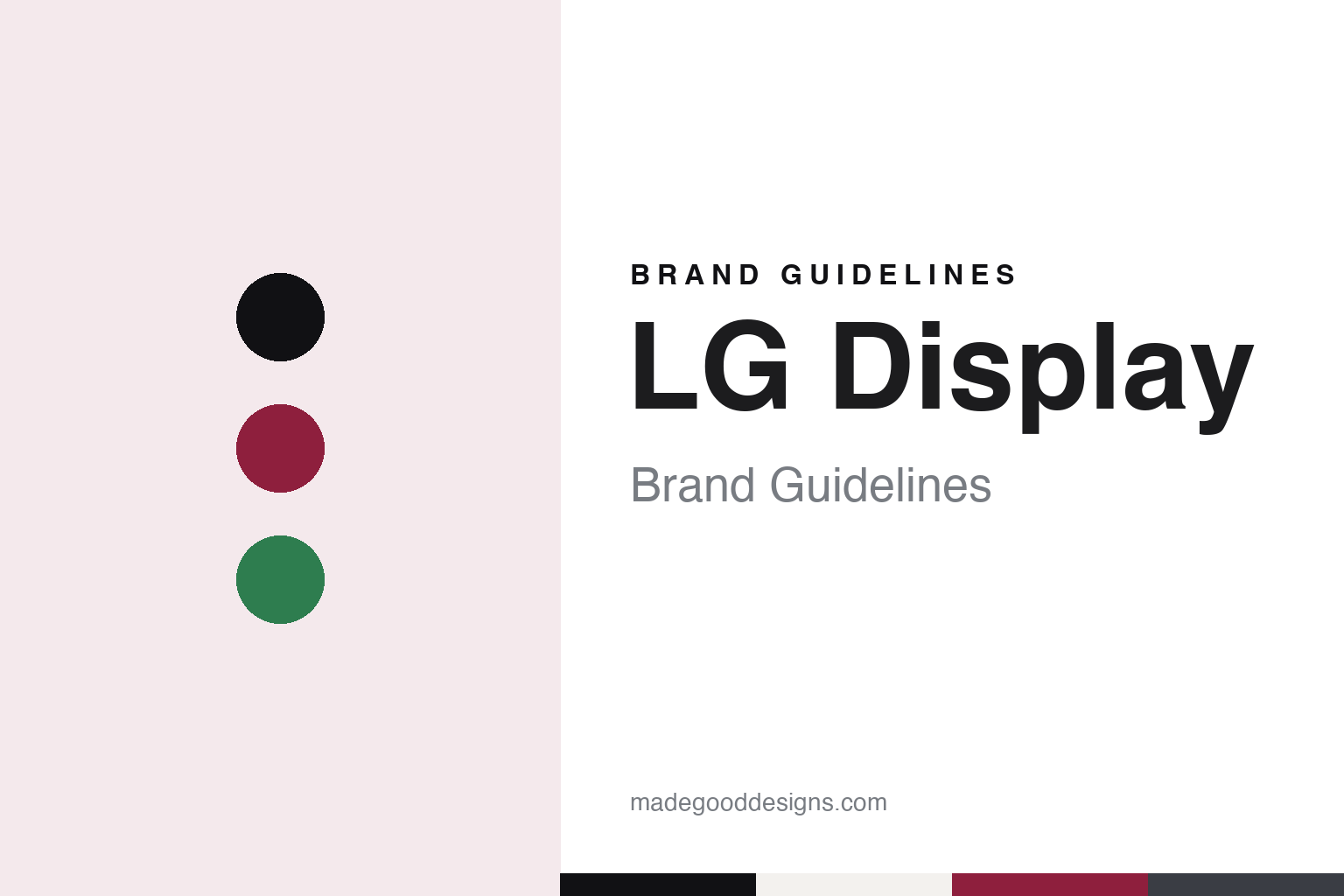
Two constants: a panel black, deep berry and warm white palette and a rounded geometric sans register. Abstract homage — not an LG Display product or mark; no panel, symbol or logotype is reproduced.
LG.Philips LCD
Goldstar research, a Dutch partner and a 2008 name.
LG Display’s history starts inside the LG group. The company’s own timeline says TFT-LCD development began in January 1987 at the Goldstar central research centre, that an LCD business division was set up within Goldstar in 1993, and that the first LCD plant, P1 at Gumi, reached mass production in September 1995. The legal entity is older still: both the company and Korean Wikipedia trace it to Goldstar Software, established in February 1985 and later renamed LG Software and LG Soft, which took over the TFT-LCD businesses of LG Electronics and LG Semiconductor in December 1998.
In August 1999 the business became LG.Philips LCD, a joint venture between LG Electronics and the Dutch electronics group Philips. In July 2004 it listed on the Korea Exchange and the New York Stock Exchange at the same time, which the company calls a first for a Korean company. Large lines followed at Gumi and at a new display cluster in Paju, opened in 2006, with module plants in Nanjing, Guangzhou and, from 2007, Wrocław in Poland.
Philips stepped back in stages. The Korea Times reported in March 2009 that Philips had begun reducing its stake in October 2007, from 32.9% to 19.9%, which led to the name change; the company dates its new name, LG Display, to March 2008. Philips sold its remaining 13.2% stake in March 2009, the same paper reported.
Colour
From IPS LCD to OLED TV panels.
LG Display built its name on LCD panels, including the wide-viewing-angle IPS technology, which Korean Wikipedia credits with consistent picture quality from any angle; its current monitor range includes panels sold as IPS Black 2.0. Its larger bet has been OLED. Korean Wikipedia says that in January 2013 it began mass-producing 55-inch OLED panels for televisions based on its WRGB technology, which it calls a world first, and in October 2013 began mass production of a 6-inch flexible OLED for smartphones. The company says an eighth-generation OLED line at Paju, E4, began mass production in December 2014, and an 8.5-generation OLED plant in Guangzhou followed in July 2020. For smaller screens, the company says, plastic OLED lines began mass production at Gumi, E5, in August 2017 and at Paju, E6, in July 2019; a module plant in Hai Phong, Vietnam, started production in July 2017, and in December 2015 it took over the OLED lighting business of LG Chem.
Show-floor recognition has followed the panels. By the company’s account, its 55-inch Full HD OLED TV panel won Best in Show at the Society for Information Display’s show in 2012, its 65-inch rollable OLED TV won SID’s Display of the Year in 2021, and a 27-inch gaming OLED panel won the same award in April 2026. It also lists a 57-inch pillar-to-pillar automotive LCD that received a CES 2024 Innovation Award, a stretchable display it says expands by 50%, shown in November 2024, and fourth-generation OLED TV panels with “Primary RGB Tandem” technology, unveiled in January 2025.
Today the company sells TV panels under the Tandem WOLED name alongside transparent OLED, laptop, phone, watch and automotive displays. In August 2026 it unveiled FLiPP, which it describes as the world’s first technology for patterning RGB OLED pixels without a fine metal mask.
Typography
How display makers present themselves.
Display-panel makers sell to other companies, so most people meet their work under someone else’s name: the screen in a phone, a television, a laptop or a car dashboard. Their own identities are built for customers, investors and engineers, and they come into view most clearly at trade shows such as the Society for Information Display’s Display Week in the United States and CES in Las Vegas, where makers book large stands to show what their panels can do.
The visual language of those stands is the product itself. Huge curved screens, rollable televisions that rise out of a base and transparent panels set in shop windows or furniture sit beside foldable phones photographed mid-fold and car cockpits wrapped in a single sweep of glass. Close-up photography does the rest: macro shots of red, green and blue sub-pixels, flexible films bent between two fingers and wafer-thin edges seen side-on.
Behind the show floor sits the factory. Company films and reports often show clean fab halls, workers in full-body suits and large sheets of glass substrate carried by robot arms, with plants described by “generation,” a measure of the glass size each line handles. Industry awards add another layer of presentation: Display Week’s Display of the Year awards and CES Innovation Awards appear in the makers’ own timelines.
Their histories run through joint ventures, factory sales and regulatory cases as much as through product launches. This guide sets out what can be checked about each one — who founded it, who owns it and where its panels are made — and marks clearly what rests only on the company’s own word.
Aa
A rounded geometric sans, echoing a circular symbol. (Specimen set in Manrope, a sans STAND-IN; NOT the LG Display logo.)
LG Display
The Face of the Future, and an exit from LCD.
The company’s period as LG.Philips LCD included a cartel case. On 12 November 2008 the US Department of Justice announced that LG Display and its US subsidiary had agreed to plead guilty to taking part in a conspiracy to fix the prices of TFT-LCD panels sold worldwide between September 2001 and June 2006, when the company was still named LG.Philips LCD. On 8 December 2010 the European Commission fined six LCD panel makers, LG Display among them, for a cartel that ran from October 2001 to February 2006; the Commission said the companies had met around 60 times, mainly in hotels in Taiwan, at what they called “the Crystal meetings.”
More recently LG Display has left large LCD panels. It transferred its 8.5-generation LCD line and module factory in Guangzhou to TCL CSOT, which renamed the site T11, TechNode reported on 3 April 2025; the board had approved the sale the previous September, as part of a plan to concentrate on OLED.
The company has its head office in the LG Twin Tower in Seoul, with plants at Paju and Gumi and research at LG Science Park in Seoul’s Magok district, according to its website. Korean Wikipedia gives LG Electronics’ stake in the company as 37.9%. Its symbol mark is called “Face of the Future”: the company says the letters L and G sit inside a circle to show that people are at the centre of the business, standing for world, future, youth, humanity and technology.
For a design guide, LG Display shows how a parts maker carries a group identity onto trade-show stages built around its own screens. Compare LG, the parent group’s guide, and Samsung Display. For this guide we use a panel black, a deep berry and a warm white with a sans, an unofficial interpretation; no product or logo is reproduced.
Explore & save
Keep LG Display’s identity on hand — save it to a board in the Made Good inspiration library.
LG Display identity set
Pin the LG Display panel black, deep berry and warm white palette and the rounded geometric sans register to your own board.