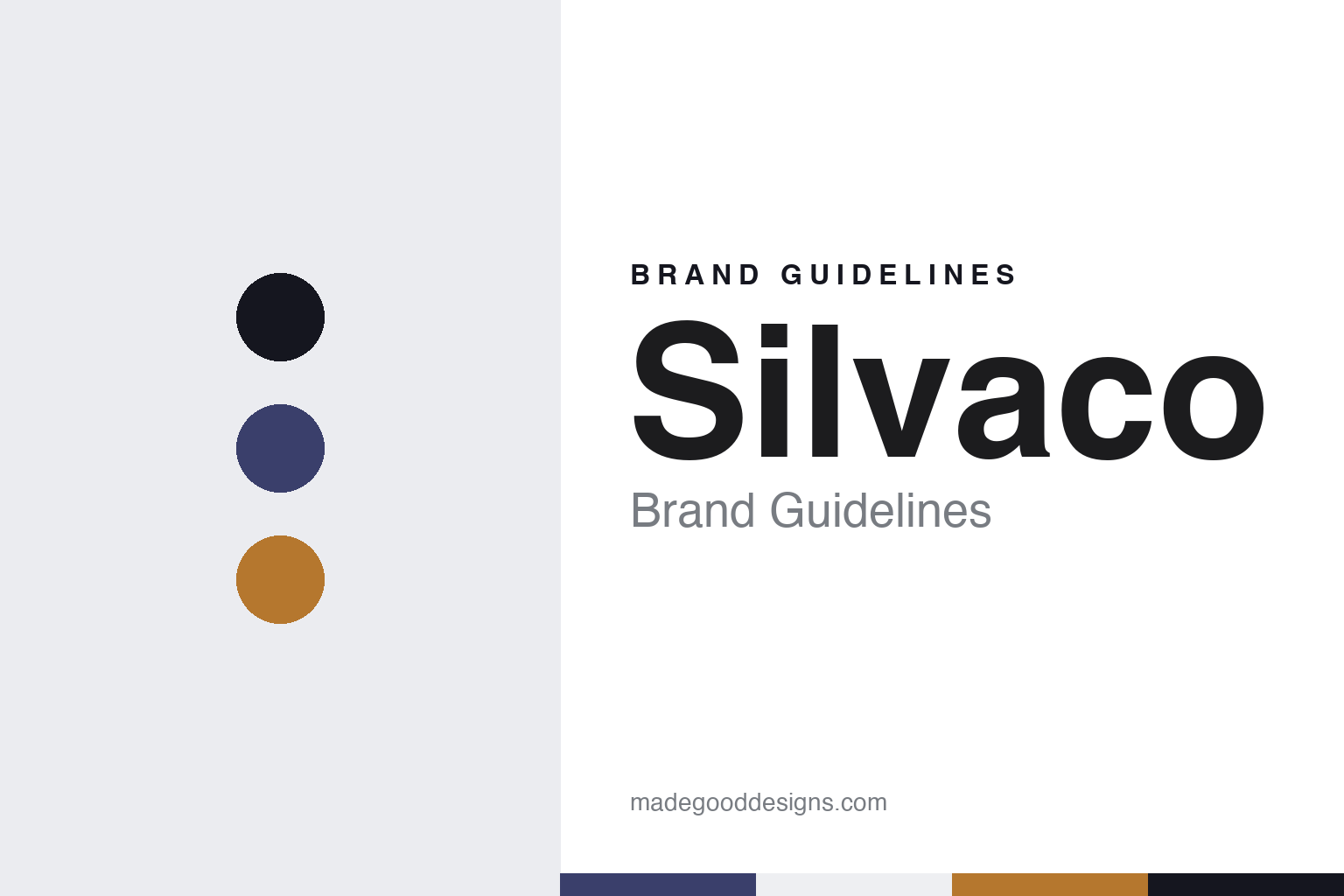
Silvaco Brand Guidelines
Santa Clara’s 1984 TCAD maker, on Nasdaq since 2024.
Aa
Two constants: a Silvaco indigo, amber and mist palette and a technical serif register. Abstract homage — not a Silvaco product or mark; no simulation, logo or interface is reproduced.
Simulation first
A device-physics software house from 1984.
Silvaco was founded in 1984 by Ivan Pesic, and English Wikipedia says it stayed privately held and funded from its own business for four decades, until its listing in 2024. The company, now Silvaco Group, Inc., is based in Santa Clara, California; it has also traded as Silvaco International and Silvaco Data Systems, English Wikipedia says.
Its starting point was technology computer-aided design, or TCAD: software that models how the steps of a semiconductor process shape a device, and how that device will then behave, before a wafer is made. The company still puts that first. Its website describes software and IP that show “what a process, a device or a circuit will do” before a mask set is committed, built on “four decades of device physics.” Its TCAD range is sold under the Victory name — Victory Process and Victory Device, for two- and three-dimensional simulation — alongside an emulation tool called Virtual Wafer Fab.
From TCAD the company moved into electronic design automation for circuits. In 2003, English Wikipedia says, it bought Simucad, a logic-simulation firm founded in 1981; in 2006 it spun its EDA tools out under the Simucad name, and on 17 February 2010 Simucad Design Automation and Silvaco Data Systems were merged back into one company, Silvaco, Inc. Its circuit tools include the SmartSpice analog simulator, the Utmost IV modelling tool, and a custom-chip suite with the Gateway schematic editor and the Expert layout editor. English Wikipedia also lists Guardian for physical verification, Hipex and Clever for parasitic extraction, and Cello and Viola for creating and characterising standard-cell libraries; it groups its EDA work under analog, mixed-signal and RF simulation, custom IC design, interconnect modelling and library development.
Colour
Tools, IP and a run of acquisitions.
Most of Silvaco’s growth in the 2010s came through buying small, specialist software companies, many of them in Europe. English Wikipedia lists Invarian, for power-integrity analysis, and Infiniscale of France, for variability analysis, in 2015; edXact, also French, for parasitic-netlist analysis, in 2016; NanGate, for standard-cell library work, in 2018; the assets of Coupling Wave Solutions, for substrate-noise analysis, and the memory-compiler technology of Dolphin Design in 2020; and the physical-verification firm Polyteda Cloud in 2021.
The same period brought a second business: semiconductor design IP. Silvaco entered it in 2016 by buying IPextreme, English Wikipedia says, and added SoC Solutions in 2017. In May 2019 it announced that the design IP of Samsung Foundry would be marketed, licensed and supported through Silvaco. Its IP range covers interface PHYs and controllers, processor and security cores, analog blocks and foundation IP such as standard-cell libraries and embedded memories. In 2018 it also announced a partnership with Purdue University and the Purdue Research Foundation to commercialise the NEMO tools for nanoelectronics modelling.
The largest recent addition is Mixel. The company says Mixel Group, Inc. became part of Silvaco on 4 August 2025, bringing more than 25 years of MIPI PHY and SerDes interface IP and design teams in Egypt, Vietnam and the United States.
Silvaco now organises its work into two business units, it says: AI-Driven Manufacturing, which holds TCAD, lithography, plasma and photonics simulation and its fab-modelling tools, and AI-Driven Design, which holds circuit simulation, analog and custom IC tools and the IP it licenses. The company says more than 200 universities use its tools for teaching and research, and lists offices across the United States, Asia, Europe and Israel.
Typography
Design and documentation.
Chip-design software and semiconductor IP are hard things to picture. The products are programs, licences and blocks of circuitry that customers place inside their own chips, so the companies that sell them have to borrow images from the work itself. The most common is the chip floor-plan: a die seen from above, its functional blocks lit in bright colour, or the stacked metal routing layers of a layout drawn as glowing lines on a dark ground.
Abstract circuit lines do much of the remaining work. Thin traces, right-angled paths and grids of contact points stand in for a product that no one can hold, and they travel easily from a website banner to a trade-show wall. Alongside them come pictures of people at work: engineers in front of multi-monitor layouts, waveforms and schematics on the screens, the design shown in progress rather than finished.
The trade has its own stages. The Design Automation Conference is where, according to English Wikipedia, Mentor Graphics introduced its first product in 1982, and booths there and at the RISC-V Summit carry the same chip renders, circuit patterns and demonstration screens. Keynote stages follow a familiar pattern too: a chief executive in front of a roadmap slide, with process nodes, product generations and partner names set out across the screen.
This guide looks past those shared images to what can be checked about each company: who founded it, who owns it now, which tools or IP it is known for, and which events in its history — mergers, takeovers, export-control cases — shaped the name it trades under. Where a claim rests only on a company’s own word, we say so.
Aa
A technical serif for a physics-first software house. (Specimen set in Source Serif 4, a serif STAND-IN; NOT the Silvaco logo.)
Silvaco
From private company to SVCO.
After forty years in private hands, Silvaco went public in 2024. Its common stock began trading on the Nasdaq Global Market on 9 May 2024 under the ticker SVCO, the law firm Cooley, which advised the underwriters, reported on 13 May 2024. The company’s website now opens its own description with the year of its founding and that ticker side by side.
Its leadership changed the following year. Silvaco says Walden “Wally” Rhines has been its chief executive since August 2025, and a director since September 2022. The company’s biography says he led Mentor Graphics as president and chief executive from 1993 to 2017, and then led it as Siemens EDA after Siemens bought it. Silvaco’s board is chaired by Kathy Pesic, the company says.
As a brand, Silvaco speaks to process engineers, device physicists and circuit designers. The company lists customers in foundries, memory, power devices, displays, automotive and universities, and its product names lean on that technical register: Victory, SmartSpice, Guardian, Clever, Cello and Viola. Its website frames the current offer around AI models that put decades of physics to work earlier in a project. Silvaco publishes no colour code or typeface for its brand that we rely on here.
For a design guide, Silvaco shows how a specialist software company can present simulation, design tools and licensed IP as one physics-led story, and how a founding year can carry weight in a young listing. Compare Synopsys, another Silicon Valley maker of chip-design software, and Siemens EDA, the former Mentor Graphics. For this guide we use indigo, amber and mist with a serif, an unofficial interpretation; no product or logo is reproduced.
Explore & save
Keep Silvaco’s identity on hand — save it to a board in the Made Good inspiration library.
Silvaco identity set
Pin the Silvaco indigo, amber and mist palette and the technical serif register to your own board.