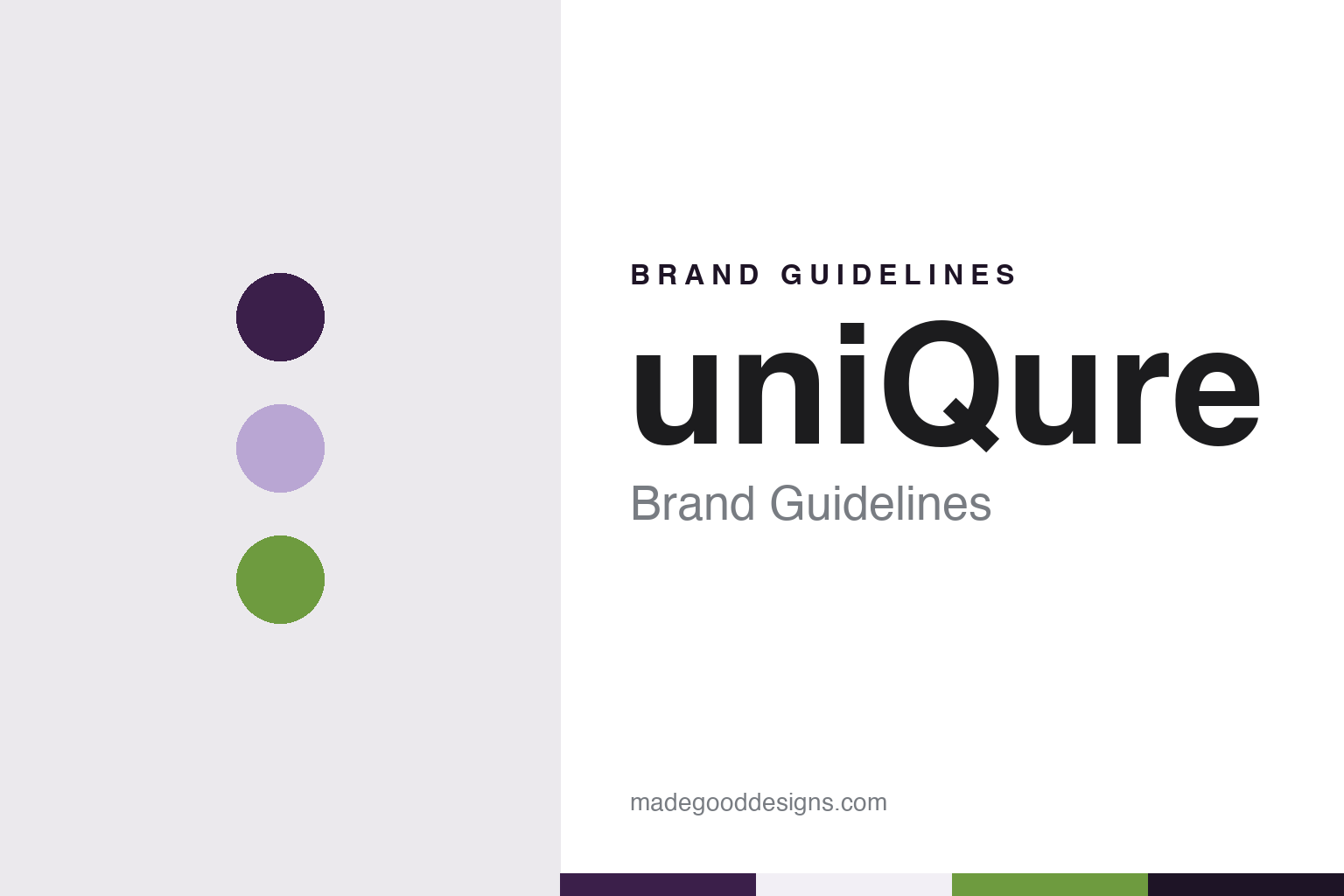
uniQure Brand Guidelines
An Amsterdam gene therapy company with a capital Q in the middle of its name.
Aa
Two constants: a uniQure plum, lilac and leaf palette and a geometric sans register. Abstract homage — not a uniQure product or mark; no pack, logo or label is reproduced.
Amsterdam Molecular Therapeutics
A Dutch company and an early EU gene therapy authorisation.
uniQure traces its history to 1998, when, the company says, it was founded in Amsterdam as Amsterdam Molecular Therapeutics (AMT) Holding N.V. The parent today is uniQure N.V., based in Amsterdam, and the name is written with a lower-case u and a capital Q. Its programme codes, such as AMT-130, still begin with those initials. The company’s own timeline says that in 2008 it licensed a factor IX gene cassette that was used by St. Jude in a first-in-human haemophilia B trial, and that in 2014 it completed an initial public offering in the United States and built a gene therapy manufacturing facility in Lexington, Massachusetts.
Its first product was Glybera. The European Medicines Agency records that Glybera was designated an orphan medicine on 8 March 2004, that the agency published questions and answers on the refusal of an earlier application after re-examination in October 2011, and that a marketing authorisation was finally issued on 25 October 2012, to uniQure biopharma B.V. of Amsterdam. uniQure describes Glybera as the first approved gene therapy in the Western world.
The authorisation did not last. It was valid for a five-year period and expired on 28 October 2017, the EMA says, and the European Commission withdrew Glybera from the Community register of orphan medicinal products in October 2017, at the time the marketing authorisation was withdrawn. Glybera is therefore a closed chapter: the product is no longer authorised in the EU.
Colour
Hemgenix, CSL Behring and the AAV5 vector.
The second approval came through a partner. uniQure says it announced a licence agreement with CSL Behring in 2020 for its haemophilia B gene therapy, and that the transaction, which gave CSL Behring exclusive rights to commercialise the product worldwide, was completed in May 2021. The trade title Pharma Manufacturing reported on 23 November 2022 that the US Food and Drug Administration had approved Hemgenix the previous day as the first gene therapy for adults with haemophilia B, granted to CSL Behring, which it described as an Australian drugmaker.
The generic name is etranacogene dezaparvovec. uniQure says it led the research and clinical development, across three clinical trials at 34 sites, and that the European Commission granted Hemgenix a conditional marketing authorisation in February 2023. It also says that in October 2023 uniQure and CSL received the Prix Galien USA award in the category of best product for rare and orphan diseases.
The technology behind both products is a viral vector. uniQure says its gene therapies use an engineered, non-replicating vector based on adeno-associated virus, or AAV, and that it uses the AAV5 serotype in its haemophilia B and Huntington’s disease programmes, with exclusive worldwide rights to its use in therapeutic products delivered to the brain or the liver. It describes the platform as modular: the same capsids, promoters and manufacturing methods are reused, and often only the disease-specific gene cassette changes.
The pipeline has moved towards the brain. The company’s timeline lists the start of a clinical trial of AMT-130 in Huntington’s disease in 2019, and in 2024 the start of trials of AMT-191 in Fabry disease, AMT-162 in SOD1-ALS and AMT-260 in temporal lobe epilepsy. AMT-130, now named ifezuntirgene inilparvovec, carries an artificial microRNA designed to silence the huntingtin gene, using what the company calls its miQURE silencing technology. BioPharm International describes it as given once, through MRI-guided stereotactic neurosurgery directly into the striatum, a region of the brain.
Typography
Cells, vials and regulators.
Cell and gene therapy companies sell something that is hard to picture. A treatment may be a patient’s own cells, collected, changed in a laboratory and returned as a single dose, or a gene carried into the body by a modified virus. With no tablet or pack to show, these companies build their imagery from a small, shared set of motifs.
The most common is the abstract double helix, often drawn in light against a dark ground, followed closely by glowing cells, strands and particles rendered in soft blues, violets and teals. Where the science is shown more literally, the pictures move to the laboratory: gloved hands holding cryobags and vials, technicians in gowns, and clean manufacturing suites with stainless steel and bright, even light. Manufacturing matters to the story, because many of these treatments are made one patient at a time.
The other half of the visual language is human. Because most of these therapies are aimed at rare and inherited diseases, the companies lean on portraits of patients and their families, photographed at home or outdoors rather than in clinics, and on first-person stories told in their own words. Treatment centres, patient-support programmes and the steps of the “patient journey” often get as much space on a website as the science itself.
The field also has its own calendar. Companies present data and court investors and clinicians at meetings such as the annual meeting of the American Society of Gene & Cell Therapy (ASGCT), the American Society of Hematology (ASH) meeting in December, where blood-disorder therapies are discussed, and the Cell & Gene Meeting on the Mesa, an industry gathering. Names in the sector can change through spin-offs, sales and rebrands, so the identity a company shows at one meeting may not be the one it uses a few years later.
A geometric sans for a name built around a capital Q. (Specimen set in Manrope, a sans STAND-IN; NOT the uniQure logo.)
uniQure
A filing under review.
The Huntington’s programme has had an uneven regulatory path. Pharmaceutical Technology reported in June 2026 that the FDA had earlier asked uniQure for a further study, and that the company said in a release of 17 June that the agency now regarded the three-year analysis from its phase I/II studies as an acceptable basis for a biologics licence application under the accelerated approval pathway, with a confirmatory study still to be run. On 2 November 2026 BioPharm International reported that the FDA had accepted the application with priority review, set a target action date of 1 May 2027 and was tentatively planning an advisory committee meeting. No decision had been made at the time of writing. The chief executive is Matt Kapusta.
The name does most of the brand work. The capital Q sits in the middle of uniQure, recurs in the miQURE platform name and gives the Nasdaq ticker, QURE. The company states its values in four capitalised words — passionate, tenacious, honorable and exceptional — and frames its history as a timeline of firsts, each given as its own claim. Its products, by contrast, carry long generic names alongside short trade names, and Hemgenix reaches patients under its licensee’s name rather than uniQure’s.
For a design guide, uniQure shows how a small company can build an identity around a single letter while its approved haemophilia product travels under a partner’s name. Compare Sarepta and bluebird bio, two more gene therapy companies in this series. For this guide we use a deep plum, a soft lilac and a leaf green with a sans, an unofficial interpretation; no product or logo is reproduced.
Explore & save
Keep uniQure’s identity on hand — save it to a board in the Made Good inspiration library.
uniQure identity set
Pin the uniQure plum, lilac and leaf palette and the geometric sans register to your own board.