bluebird bio Brand Guidelines
A lower-case name for gene therapy, used from 2010 to 2025.
Aa
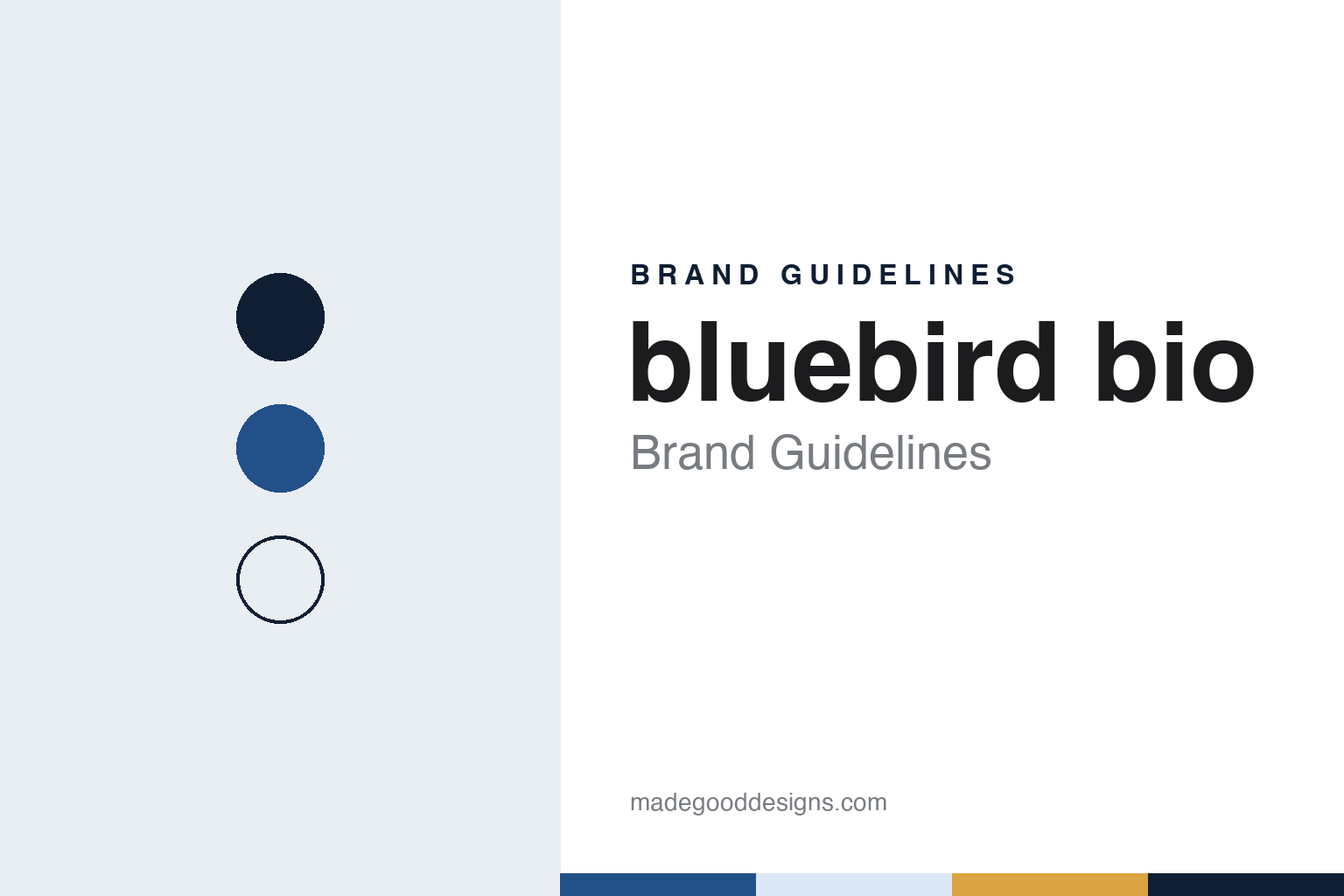
Two constants: a blue, sky and ochre palette and a lower-case sans register. Abstract homage — not a bluebird bio or Genetix product or mark; no logo, bag or vial is reproduced.
Genetix Pharmaceuticals
A 1992 company that took a new name in 2010.
The name bluebird bio, always written in lower case, belonged to a company that is older than the name. According to the company’s own history, it was founded in 1992 as Genetix Pharmaceuticals, emerging from academic research with the aim of developing one-time gene therapies. In those years it built its core gene addition technology, which corrects a faulty gene by adding a working copy to a patient’s own cells, and reached early proof of concept in the clinic.
In 2010, after the release of its first clinical data, the company secured new investment, changed its leadership and was renamed bluebird bio, its own account says. The lower-case spelling appears in the company’s own releases and in trade titles such as Pharmaceutical Technology and PMLive.
For most of the next decade the company was based in Cambridge, Massachusetts; PMLive still described it that way in November 2021. By December 2023 it was based in Somerville, Massachusetts, as MedCity News reported in December 2023, and Somerville remained its headquarters when it changed its name again in 2025.
In November 2021 it spun off its cancer business as a separate company, 2seventy bio, PMLive reported on 8 November 2021. The new company took bluebird’s immune-oncology cell therapies for solid tumours and blood cancers, including its development and commercialisation agreement with Bristol Myers Squibb for the CAR T-cell therapy Abecma, while bluebird bio kept its work on severe genetic diseases under chief executive Andrew Obenshain.
Colour
Three gene therapies in sixteen months.
bluebird bio’s reputation rests on three approvals by the US Food and Drug Administration. The first, in August 2022, was Zynteglo (betibeglogene autotemcel, or beti-cel), a one-time gene therapy for people with beta-thalassaemia who need regular blood transfusions. The second followed weeks later: on 19 September 2022 the FDA gave accelerated approval to Skysona (elivaldogene autotemcel, or eli-cel) for boys aged four to seventeen with early cerebral adrenoleukodystrophy, a rare neurodegenerative disease of childhood. GlobalData analysts, writing in Pharmaceutical Technology on 29 September 2022, described the pair as “back-to-back landmark FDA approvals” and noted that before them only two gene therapies for inherited conditions had been approved in the United States. The same analysts noted that both therapies had carried the FDA’s breakthrough therapy, orphan drug, fast track and priority review designations, and that Skysona had also been designated for a rare paediatric disease.
The third approval came in December 2023, when the FDA approved Lyfgenia for sickle cell disease on the same day as Vertex Pharmaceuticals’ Casgevy, MedCity News reported; for bluebird the decision came nearly two weeks ahead of its target date. MedCity News explained the difference between the two: both are made from a patient’s own harvested stem cells, but where Casgevy uses CRISPR to edit a gene, Lyfgenia adds a working gene using a viral vector.
Each of the three treatments starts with the patient’s own cells, which are collected, modified in a laboratory and given back as a single dose. The Genetix website today is organised around treatment centres, the patient experience and patient stories. The company now says it holds “one of the most robust datasets in the field” and calls itself “the market leader in genetic medicine for rare diseases”; those are its own claims.
Typography
How the category presents itself.
Cell and gene therapy companies sell something that is hard to picture. A treatment may be a patient’s own cells, collected, changed in a laboratory and returned as a single dose, or a gene carried into the body by a modified virus. With no tablet or pack to show, these companies build their imagery from a small, shared set of motifs.
The most common is the abstract double helix, often drawn in light against a dark ground, followed closely by glowing cells, strands and particles rendered in soft blues, violets and teals. Where the science is shown more literally, the pictures move to the laboratory: gloved hands holding cryobags and vials, technicians in gowns, and clean manufacturing suites with stainless steel and bright, even light. Manufacturing matters to the story, because many of these treatments are made one patient at a time.
The other half of the visual language is human. Because most of these therapies are aimed at rare and inherited diseases, the companies lean on portraits of patients and their families, photographed at home or outdoors rather than in clinics, and on first-person stories told in their own words. Treatment centres, patient-support programmes and the steps of the “patient journey” often get as much space on a website as the science itself.
The field also has its own calendar. Companies present data and court investors and clinicians at meetings such as the annual meeting of the American Society of Gene & Cell Therapy (ASGCT), the American Society of Hematology (ASH) meeting in December, where blood-disorder therapies are discussed, and the Cell & Gene Meeting on the Mesa, an industry gathering. Names in the sector can change through spin-offs, sales and rebrands, so the identity a company shows at one meeting may not be the one it uses a few years later.
Aa
A lower-case sans, after a name always written small. (Specimen set in Inter Tight, a sans STAND-IN; NOT the bluebird bio or Genetix logo.)
bluebird bio
Sold in 2025, then renamed Genetix.
bluebird bio no longer trades under that name. In June 2025 the investment firms Carlyle and SK Capital Partners completed their purchase of the company, the law firm Orrick, which advised the buyers, announced on 12 June 2025, and bluebird became a privately held company under a new leadership team led by chief executive David Meek.
On 18 September 2025 the company announced that bluebird bio, Inc. had rebranded as Genetix Biotherapeutics Inc., “returning to its foundational roots” — the Genetix name it had used from 1992 to 2010. The release said the company would concentrate on commercial execution, on more treatment-centre partnerships and on expanding manufacturing capacity, including the ability to cryopreserve patients’ stem cells, and that a Phase 3 study of lovo-cel in sickle cell disease would continue. The old bluebirdbio.com address now redirects to the Genetix website.
The renamed company has kept the products. In June 2026 Genetix announced an agreement with the Saudi company SPIMACO to commercialise and manufacture Lyfgenia and Zynteglo in Saudi Arabia and the wider Middle East, and in December 2025 it presented patient-experience data at the American Society of Hematology’s annual meeting, according to its news page. Its website describes the bluebird bio years, 2010 to 2025, as the period in which three programmes reached FDA approval, and the rebrand release calls bluebird “the first and only company to secure FDA approval for three gene therapies” — a claim made by the company itself.
For a design guide, bluebird bio shows how a soft, lower-case name helped a gene therapy company stand apart, and how a new owner can retire such a name in favour of an older one. Compare Sarepta, another Massachusetts gene therapy company, and CRISPR Therapeutics, a company in the same treatment field. For this guide we use a mid blue, a pale sky and an ochre with a sans, an unofficial interpretation; no product or logo is reproduced.
Explore & save
Keep bluebird bio’s identity on hand — save it to a board in the Made Good inspiration library.
bluebird bio identity set
Pin the bluebird bio blue, sky and ochre palette and the lower-case sans register to your own board.