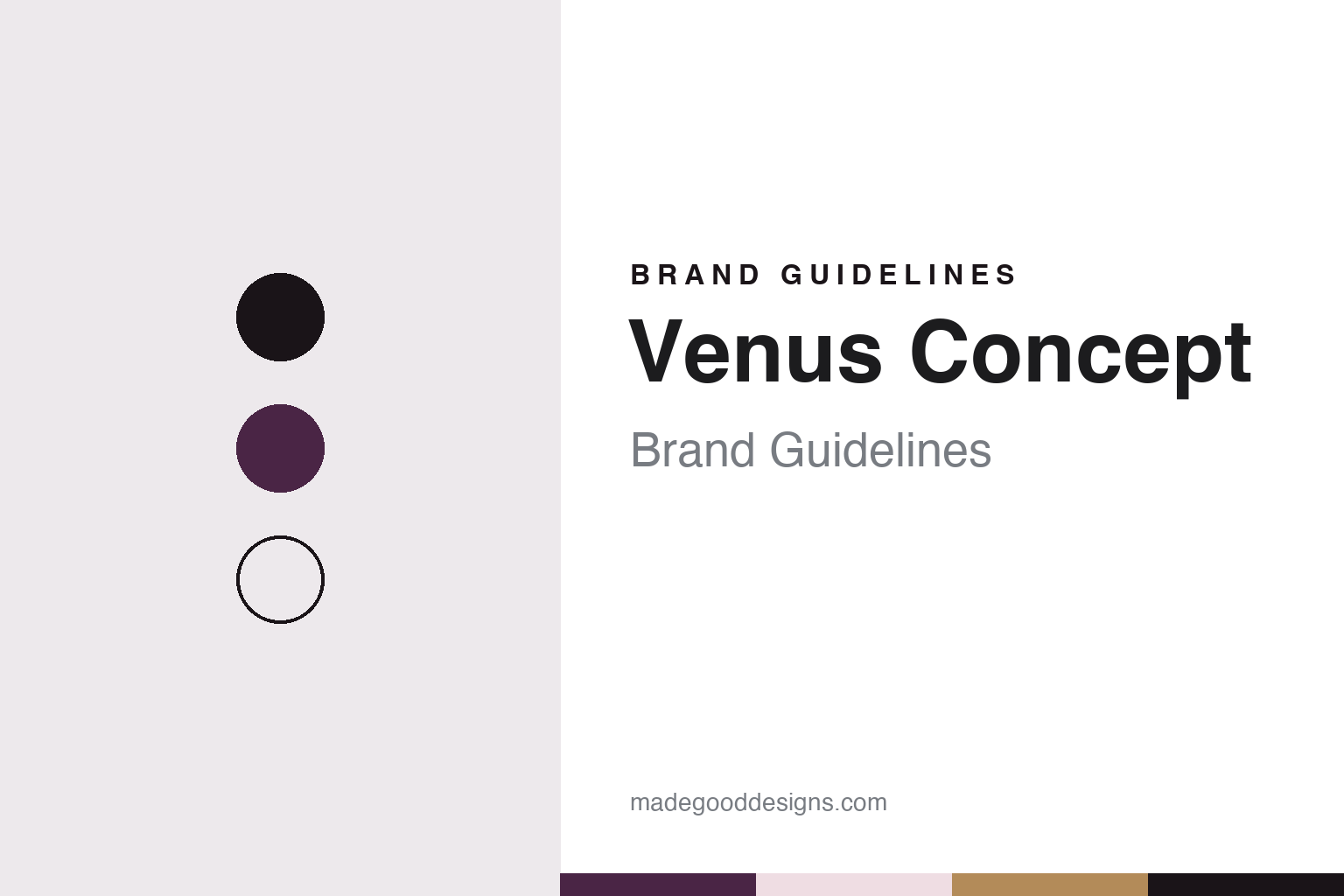
Venus Concept Brand Guidelines
The Tel Aviv-founded aesthetics maker now based in Toronto.
Aa
Two constants: a Venus Concept plum and rose palette and a Soft serif register. Abstract homage — not a Venus Concept product or mark; no device, logo or nameplate is reproduced.
A family company
From a Tel Aviv home to Karmiel.
Venus Concept began as an Israeli family business. Globes, the Israeli business daily, reported in August 2019 that the company was founded in 2008 by a married couple, Oded and Orit Ron Edoute, at their home in Tel Aviv, together with Oded’s brother, Aharon Edoute. Orit Ron Edoute was chief executive and Oded the active chairman, he told the paper, and the two wrote nine patents together. “We founded the company in the garage,” he said.
The company grew outward quickly. According to the same report, it later set up a large production facility in Karmiel, in northern Israel, and opened 23 offices and subsidiaries around the world; Oded Ron Edoute said the company had manufactured its devices itself, without subcontractors. In January 2015, he said, the founders sold a large part of their holdings to a US fund and remained the largest private shareholders, with about a tenth of the company.
By 2019 Globes was describing Venus Concept as an Israeli-Canadian company with nearly 600 employees, 70 to 80 of them in Israel, products installed in about 11,000 clinics and sales in more than 60 countries, 29 of them through its own staff. Its devices, in the paper’s summary, covered the routine work of medical aesthetics — skin rejuvenation and firming, hair removal and acne treatment — and were based on the company’s own technology. The paper added that Venus had recently received US marketing approval for a new body device, due to launch in the following quarter.
Colour
A robot joins the range.
The company’s shape changed in 2019. In March that year, The Robot Report reported, Venus Concept, then privately held, agreed an all-stock merger with Restoration Robotics, the Nasdaq-listed maker of the ARTAS and ARTAS iX robotic hair-restoration systems; Venus shareholders were to own about 85 per cent of the combined company. Restoration Robotics itself dated from 2002, when it was co-founded by Frederic Moll, the surgical-robotics entrepreneur who also co-founded Intuitive Surgical, the same report noted. Domenic Serafino, Venus Concept’s chairman and chief executive, said hair restoration would become an increasingly important part of a portfolio that already covered hair removal, skin rejuvenation, wrinkle reduction, cellulite and body contouring, and that the company planned to use its large direct sales force to sell ARTAS. Globes listed Madryn Asset Management among the investors committed to a new equity investment alongside the merger, and noted that several of them had taken part in Venus Concept’s previous funding round, in 2017.
The merger was completed on 7 November 2019, Modern Aesthetics and Practical Dermatology reported. Restoration Robotics took the name Venus Concept Inc., moved its corporate headquarters to Toronto, and began trading on the Nasdaq Global Market on 8 November under the ticker VERO, run by Venus Concept’s management with Serafino as chief executive. A one-for-fifteen reverse share split followed immediately, the reports said.
Its time as a listed company ended in 2026. Madryn Asset Management, a healthcare investor that had backed Venus since 2016, according to its managing partner, completed a short-form merger on 30 March 2026 that left funds it manages owning all of the company’s common stock, Venus Concept announced from Toronto on 1 April 2026. The company is now privately held by Madryn. Rajiv De Silva, its chief executive, said that with Madryn as sole owner the company could take a long-term view of the business.
Typography
Design and documentation.
Makers of aesthetic lasers and energy-based devices sell to clinicians first and to their patients second, and their brand material is built for both. The usual product image is a tall white console on castors, with a touchscreen and one or more handpieces on coiled cables, photographed in a softly lit treatment room. The machines are designed to look at home in a clinic and in a medical spa alike.
Around the hardware sits a familiar visual language: close-ups of glowing skin, clinicians in white coats, pale backgrounds, generous white space and clean, light sans-serif type. Product names tend to be short coined words, often styled with trademark symbols, and families are extended with suffixes such as Pro, Plus or a version number. Colour is usually held back to one accent against white, grey and skin tones.
Much of the industry’s calendar runs through medical congresses rather than consumer shows. AMWC, the Aesthetic & Anti-Aging Medicine World Congress; IMCAS in Paris; and the annual meeting of the American Society for Laser Medicine and Surgery (ASLMS) are among the places where new systems are shown to doctors. Candela, for example, says it unveiled its Vbeam Pro at the 2025 ASLMS meeting and launched its Glacē system in Europe at IMCAS in January 2026.
The companies behind these brands have changed hands often, through mergers, private-equity buyouts and restructurings, and several now trade under names different from the ones they started with. This guide sets out who founded each maker, who owns it now and what it says about its own products, and gives the company’s claims as its own.
Aa
A soft serif — one name across a family of devices. (Specimen set in Fraunces, a serif STAND-IN; NOT the Venus Concept logo.)
Venus Concept
One name across a family of devices.
Today Venus Concept describes itself as a global medical aesthetic technology company. Its April 2026 announcement said it reaches more than 60 countries, with nine direct markets, and listed a family of aesthetic platforms — among them Venus NOVA, Venus Legacy, Venus Bliss MAX and Venus Viva MD — alongside two hair-restoration systems, NeoGraft and ARTAS iX. The robot that arrived with the 2019 merger is still part of the range.
The brand spans two countries. Its founding and manufacturing story, as Oded Ron Edoute told it to Globes in 2019, is Israeli — a home in Tel Aviv, then a factory in Karmiel — while its headquarters since the 2019 merger has been in Toronto, and its announcements are issued from there. Its investors have also changed over time: the 2026 announcement listed EW Healthcare Partners, HealthQuest Capital and Longitude Capital Management among those that had backed the company, with Madryn now the sole owner.
The naming system is the most consistent part of its identity. Almost every device carries the Venus name followed by a single word — Legacy, Versa, Bliss, Viva, Velocity — and newer models add a suffix such as PRO, MD or MAX. The hair-restoration systems are the exception: ARTAS kept the name it had under Restoration Robotics, and NeoGraft keeps its own.
For a design guide, Venus Concept shows how one word can hold a product family together through changes of ownership, listing and headquarters. Compare InMode and Alma Lasers, two other aesthetic device makers founded in Israel. For this guide we use a deep plum, a soft rose and a brushed gold with a serif, an unofficial interpretation; no product or logo is reproduced.
Explore & save
Keep Venus Concept’s identity on hand — save it to a board in the Made Good inspiration library.
Venus Concept identity set
Pin the Venus Concept plum and rose palette and the Soft serif register to your own board.