Yancoal Brand Guidelines
Yanzhou’s 2004 Austar buy, Gloucester Coal and Coal & Allied.
Aa
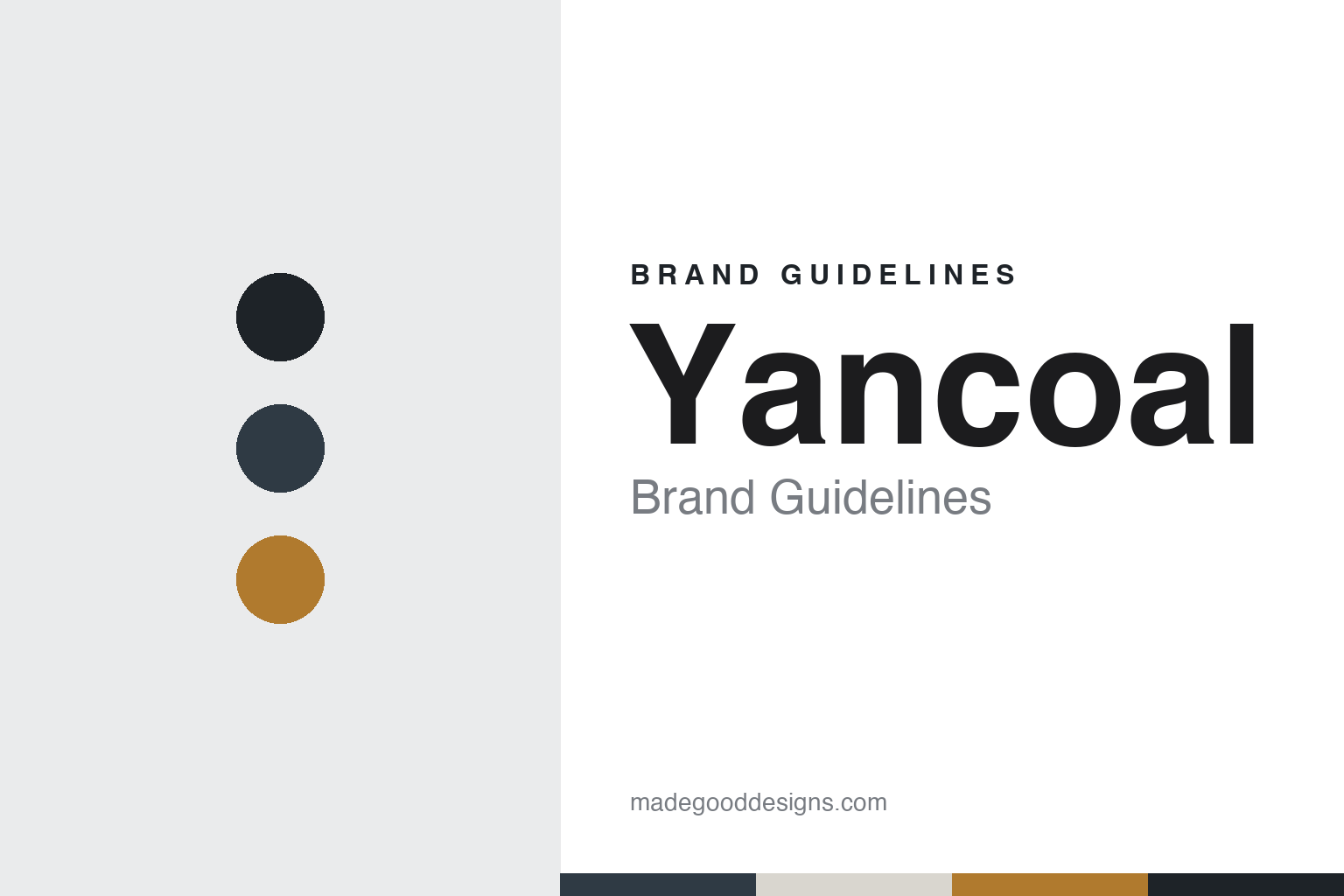
Two constants: a deep slate, coal grey and muted ochre palette and an industrial sans register. Abstract homage — not a Yancoal asset or mark; no logo, site or product is reproduced.
Austar
One underground mine in the Hunter Valley.
Yancoal began as the Australian arm of a Chinese coal producer. According to the company’s November 2018 listing document for the Hong Kong Stock Exchange, Yancoal Australia Pty Limited was established on 18 November 2004 by Yanzhou Coal Mining when Yanzhou acquired the Austar underground mine in the Hunter Valley of New South Wales; the same document says the mine had previously been called Southland. English Wikipedia also dates the company to 2004 and the Austar purchase.
Growth came through takeovers. On 23 December 2009 the group completed its takeover of Felix Resources, then listed on the ASX, which held interests in the Moolarben, Yarrabee and Ashton mines, and on 23 March 2010 it became a public company, Yancoal Australia Ltd, the listing document says. Moolarben, north of Mudgee in the Western Coalfields, combines open-cut and underground mining and is run on behalf of a joint venture that includes a consortium of Korean power companies, the company’s website says.
The step that took Yancoal to the stock market was a merger with Gloucester Coal. Gloucester announced the proposal to the ASX in late December 2011, and in early March 2012 the federal government approved it with conditions, The Australian Mining Review reported on 26 March 2012: the merged company had to stay headquartered in Australia and list on the ASX by the end of the year, and Yanzhou had to bring its holding below 70 per cent by the end of 2013. The Hong Kong listing document says the merger was completed on 6 July 2012, when Yancoal also became listed on the ASX; English Wikipedia gives June 2012 for the listing. Gloucester brought a near-half interest in the Middlemount joint venture and the Stratford Duralie and Donaldson mines. At the time, the same magazine noted, Yancoal was one of six companies in the Newcastle Coal Infrastructure Group, which was building a coal export terminal at the Port of Newcastle.
Colour
Coal & Allied and a second listing.
The largest purchase was Coal & Allied. English Wikipedia says Coal & Allied was formed in 1960 by the merger of Caledonian Collieries with J & A Brown & Abermain-Seaham Collieries, and that Rio Tinto took full ownership and delisted it in December 2011. Yancoal completed its acquisition of the company from Rio Tinto on 1 September 2017, the Hong Kong listing document says, adding interests in Hunter Valley Operations and Mount Thorley Warkworth. In March 2018 it increased its share of the Warkworth joint venture, and on 4 May 2018 it completed a transaction that set up a joint venture with Glencore over Hunter Valley Operations and reduced its own interest; English Wikipedia gives Yancoal’s share as 49 per cent.
In December 2018 Yancoal added a second listing on the Hong Kong Stock Exchange, English Wikipedia says, becoming a dual-listed company. Two years earlier, on 31 March 2016, it had transferred its interests in the Ashton, Austar and Donaldson mines to Watagan, a company it wholly owned but did not control for accounting purposes, as part of financing arrangements, the listing document says.
Today the company says it is headquartered in Sydney and owns or operates eight producing coal mines across New South Wales, Queensland and Western Australia, producing thermal and metallurgical coal, with more than 6,000 employees and contractors drawn mainly from the regions where it works. Its site list runs from Moolarben and the Hunter Valley mines to Middlemount in Queensland’s Bowen Basin and Premier Coal at Collie in Western Australia; Austar is listed as closed and Donaldson as on care and maintenance.
Typography
Coal companies and how they present themselves.
Coal companies rarely sell to the public, so their identity work is aimed at investors, governments, customers in power and steel, and the communities around their mines. The visual language that follows is one of scale: draglines working an open pit, haul trucks on benched slopes, trains on loading loops and ships at export terminals. Peabody’s own description of itself as a supplier of “essential products for the production of affordable, reliable energy and steel” names both of the markets those pictures serve.
Alongside the pit photography sits a second register: the land after mining. Producers publish reclamation and rehabilitation pages, biodiversity and water sections, and reports on safety and community relations. Peabody, for example, groups climate, land, water, safety, human rights and cultural heritage under one sustainability menu on its website, and says it plans progressive restoration of land disturbed by mining.
A third theme is the future of the product itself. Thermal coal for power and metallurgical coal for steelmaking are often reported as separate businesses; Peabody, for instance, lists its mines under “Seaborne Metallurgical,” “Seaborne Thermal,” “Powder River Basin” and “Other U.S.” headings. Some producers point to other energy projects; Coal India, for one, describes a solar project in Gujarat on its own website. How much weight a company gives each story varies, and the guides in this round report what each one says rather than judging it.
The most consistent document in the category is the annual report, with its maps of mines, its tables of operations and its photographs of crews and equipment. For a designer, that report is often the clearest record of how a coal company wants to be seen: the identity is less a logo than a set of repeated scenes, from the open cut to the rail line to the restored hillside.
Aa
An industrial sans for a merged coal producer. (Specimen set in IBM Plex Sans, a sans STAND-IN; NOT the Yancoal logo.)
Yancoal
An Australian producer with a Chinese parent.
Yancoal’s Chinese parent has changed its own name. At an extraordinary general meeting on 1 December 2021, shareholders of Yanzhou Coal Mining Company Limited approved changing its English name to Yankuang Energy Group Company Limited, according to a press release issued through Media OutReach on 3 December 2021. English Wikipedia describes Yancoal as majority owned by the Yankuang group.
Some of the older mines are reaching their end. Stratford, in the Gloucester Basin about 95 kilometres north of Newcastle, began production in June 1995 and completed coal extraction in 2024, the company says, and is now in its closure phase, with the rehabilitated landform to be signed off by the New South Wales government before the mining leases are given up. Yancoal is studying a Stratford Renewable Energy Hub on and beside the site, pairing pumped hydro storage that would use the mine’s existing dams with a solar farm; the company says the state has declared it Critical State Significant Infrastructure. It remains a proposal rather than a built project.
The company presents itself through a short set of values — people, safety, innovation, excellence and integrity — and a homepage line marking 20 years in Australia, and it publishes its market announcements for both exchanges in English and Chinese.
For a design guide, Yancoal shows how a company assembled from bought mines and a merged listing presents one Australian identity. Compare Glencore, its joint-venture partner at Hunter Valley Operations, and Whitehaven Coal, another New South Wales producer. For this guide we use a deep slate, a coal grey and a muted ochre with a sans, an unofficial interpretation; no product or logo is reproduced.
Explore & save
Keep Yancoal’s identity on hand — save it to a board in the Made Good inspiration library.
Yancoal identity set
Pin the Yancoal deep slate, coal grey and muted ochre palette and the industrial sans register to your own board.