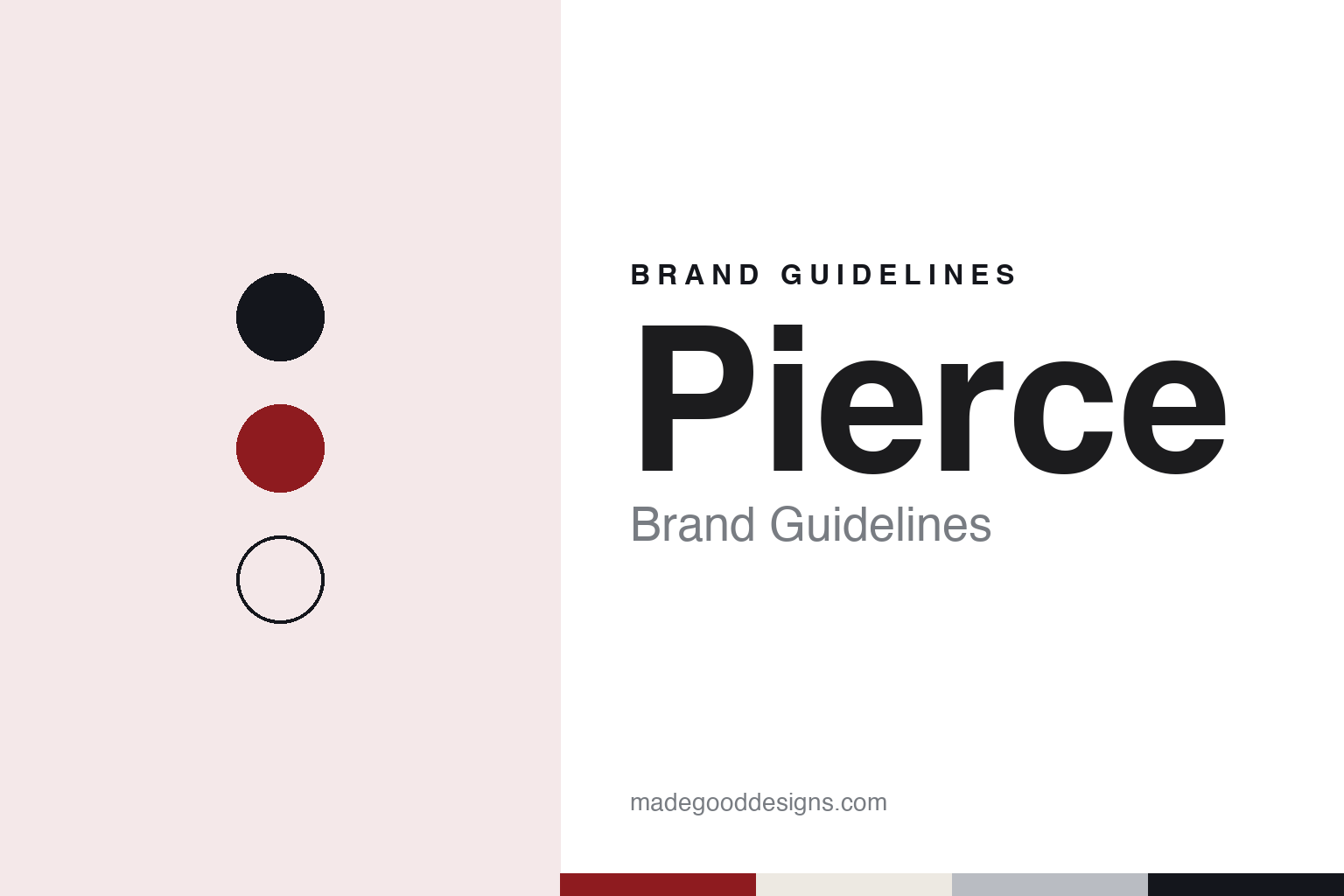
Pierce Brand Guidelines
From a converted church in Appleton to an Oshkosh fire truck maker.
Aa
Two constants: a red, chrome and white palette and a condensed sans register. Abstract homage — not a Pierce product or mark; no vehicle, logo or emblem is reproduced.
Auto Body Works
A father, a son and an old church in Appleton.
Pierce began in Appleton, Wisconsin, in 1913. The company’s own timeline says it was founded as Auto Body Works by Humphrey Pierce and his son Dudley Pierce, in a workshop converted from an old church; English Wikipedia gives the first name as Pierce Auto Body Works, but the company says the family name was only added to the firm’s title in 1960. The business was incorporated in 1917 as Auto Body Works, Inc., and its early trade was building truck bodies on the Ford Model T chassis. That year it outgrew the church and built a new works, still known in the company’s history as the “City Plant.”
For its first decades Auto Body Works was a general body builder. By the company’s account it entered the market for specialised utility bodies in 1927, alongside the truck bodies it was building for Ford and Chevrolet, and built its first fire truck in 1939: a pumper on a Ford chassis with a Barton-American pump. After the Second World War, in 1946, it began producing its own line of fire apparatus on commercial chassis with Darley pumps, while the shop floor still shared space with utility and beverage bodies.
Around 1950, the company says, Auto Body Works began branding its products Pierce. In 1958 it agreed to build bodies for the Snorkel, an articulating boom and platform developed by Pitman Manufacturing; the first was delivered to Elwood, Indiana, in 1959. The company was renamed Pierce Auto Body Works in 1960, dropped its van and beverage bodies to concentrate on utility and fire work, and in 1969 became Pierce Manufacturing, Inc. A new plant beside Highway 41 in Appleton took over fire apparatus assembly in 1971, and in 1975 the company received its first export order, from Saudi Arabia, for rescue trucks, trailers and Snorkels.
Colour
Custom chassis, cab to bumper.
The turning point in Pierce’s products came with its own chassis. In 1979 it introduced the Arrow, its first custom cab, built of aluminium in a cab-forward layout, and in 1982 it began building the Arrow from the ground up — chassis, cab and body — becoming, in its words, a single-source custom fire apparatus manufacturer. The Arrow name has no connection with the Pierce-Arrow car company of Buffalo, New York, English Wikipedia notes. The Dash tilt cab followed in 1984, the Lance in 1985, the Saber in 1992 and the Quantum in 1995; the Arrow and the Quantum both left production in 2023, the company says, as it streamlined its custom chassis.
In 1988, the company’s 75th year, Pierce decided to concentrate solely on fire apparatus and stop building utility vehicles. Its current custom chassis include the Enforcer, introduced in 2000 and relaunched in 2014, and the Velocity, launched in 2006, while it also builds bodies on commercial chassis from makers including Freightliner and Kenworth. Its aerial devices grew into the Ascendant range, which began with a 107-foot steel ladder in 2015 and by 2017 covered five configurations of ladders and platforms. In 2021 it introduced the Volterra platform of electric fire trucks, which the company describes as using a parallel-electric drivetrain.
Ownership changed in 1996, when Pierce became a subsidiary of Oshkosh Truck Corporation, now Oshkosh Corporation, according to both the company and English Wikipedia. Under Oshkosh it acquired a plant in Bradenton, Florida, in 2000, and in September 2021 it completed the purchase of an ownership interest in Boise Mobile Equipment, a wildland fire apparatus builder in Idaho, Firehouse reported. Oshkosh added the Quebec builder Maxi-Métal to the same fire and emergency segment in 2022, according to the Pierce timeline.
Typography
Fire apparatus makers.
Fire apparatus makers sell to a small and particular set of customers: city fire departments, volunteer brigades, airports and industrial plants. Their pictures of themselves tend to look alike. Finished vehicles stand in rows outside the works in red, in lime-yellow or in white, depending on what each fire service orders, with roller doors open to show how the equipment is stowed.
The turntable ladder is the set piece. At demonstrations and open days, a ladder or an aerial platform is raised high beside a building or over an empty yard, often with a crew in the basket. Cabs carry chrome, reflective striping and the customer’s own crest and lettering, so a maker’s name can be small on the vehicle itself and much larger on its brochures, websites and service vans.
Handovers are a genre of their own. A new engine is driven out and photographed with its crew and local officials. At the FLORIAN 2026 fair in Dresden, Magirus handed three new engines to the city’s volunteer fire brigades and ran live demonstrations of turntable-ladder work, according to its own news page.
Trade fairs set the calendar. One of them is Interschutz in Hanover, and Magirus invited visitors to its stand there from 1 to 6 June 2026. Some of the makers go back to the age of horse-drawn ladders and hand pumps; others began in the late twentieth century as equipment dealers and repair shops before building vehicles of their own. This guide looks at each maker in turn: who founded it, who owns it now, where it says its vehicles are built, and which claims rest only on the company’s own word.
Aa
A condensed sans for a maker whose oval logo dates from the late 1960s. (Specimen set in Barlow Condensed, a sans STAND-IN; NOT the Pierce logo.)
Pierce
An oval logo, and a chrome one on the grille.
Pierce publishes the history of its own logo. According to its website, a simple mark appeared in 1917, when the company incorporated as Auto Body Works, Inc., and stayed on documents and signage through the 1920s and 1930s. By 1946 the word “Pierce” had been added above it on the City Plant building. In 1963 the company first used an oval, with a new lettering style and a rectangle below it naming its utility and fire products. The logo in use today was introduced in 1969, the website says — its timeline puts the launch the following year — and although its colouring has varied, the company says it has always returned to that original version, a tri-colour logo. In 2000 Pierce added a chrome logo, a photograph of the emblem worn on the front grille of its trucks, used alongside the tri-colour version in its promotions.
Production remains centred on Appleton. The company says it builds its apparatus “bumper to bumper” in plants in Appleton and Bradenton, both certified to ISO 9001, and that more than 35,000 Pierce apparatus are on the road. In December 2025 Firehouse reported that Pierce was modernising its Appleton fabrication and assembly lines with robotic and laser equipment and extending its paint facility by 26,000 square feet, as part of investment across plants in Wisconsin, Florida and Tennessee begun in 2022. Its tagline is “Perform. Like No Other.”
For a design guide, Pierce shows how a fire apparatus maker can keep one mark for more than half a century and let a chrome badge carry it on the vehicle itself. Compare Seagrave, another Wisconsin fire apparatus maker, and E-ONE, which built its trucks around extruded aluminium in Florida. For this guide we use a deep red, chrome grey and warm white with a sans, an unofficial interpretation; no product or logo is reproduced.
Explore & save
Keep Pierce’s identity on hand — save it to a board in the Made Good inspiration library.
Pierce identity set
Pin the Pierce red, chrome and white palette and the condensed sans register to your own board.