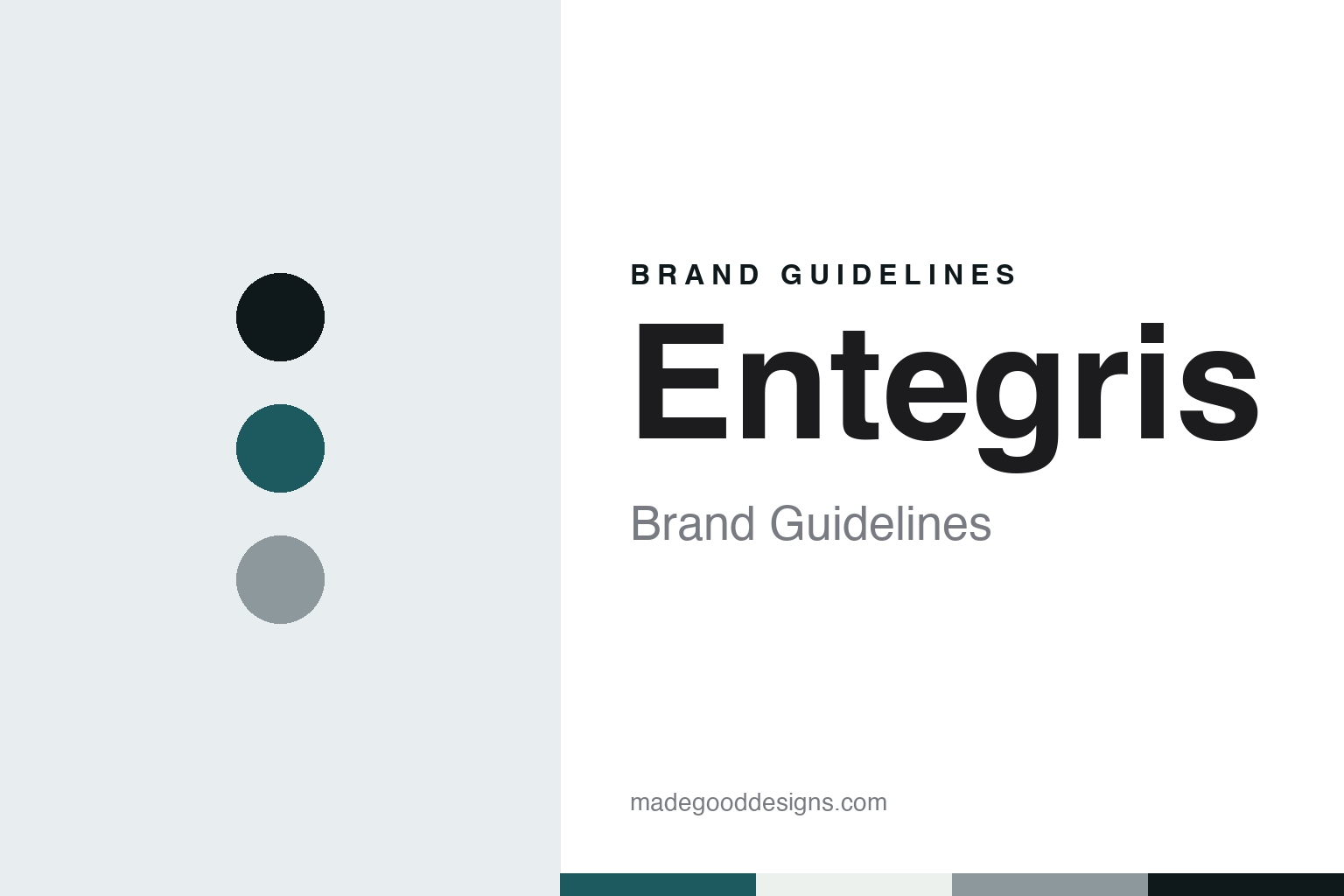
Entegris Brand Guidelines
Fluoroware’s Teflon carriers, Empak and a name from integrity.
Aa
Two constants: a teal, grey and white palette and a clean geometric sans register. Abstract homage — not an Entegris product or mark; no carrier, filter, logo or nameplate is reproduced.
Fluoroware
Molded Teflon for a new industry.
Entegris’s oldest root is Fluoroware, which the company says was founded in September 1966. In an oral history recorded for the industry association SEMI in February 2004 and published by the Computer History Museum, Dan Quernemoen, later Fluoroware’s president and chairman, said Fluoroware was spun off in 1966 from the Booker & Wallestad division of Thermotech Industries, a plastics molder, and that Vic Wallestad was its founder. Its home was Chaska, Minnesota.
Fluoroware’s specialty was injection-molded Teflon. Quernemoen recalled that the opening came when an engineer from Delco Radio, a General Motors division, brought expensive machined Teflon wafer carriers to the molders after DuPont suggested their name. The first carriers held wafers three-quarters of an inch to one inch across; as wafers grew, each new size meant a new series of products, followed by Teflon tanks, beakers and other handling devices, and from the late 1970s molded Teflon fittings and valve components.
The name came from the same place. Quernemoen said the company used “fluoro” for the fluorocarbon material and “ware” for the labware-type products it first made. He also described two spin-offs: an equipment line that left around 1972 as FSI, which began as Fluoroware Systems Inc., and the high-volume wafer packaging products, which left around 1980 as Empak, later a competitor. Entegris dates Empak’s founding to 1980. Quernemoen explained the logic of that split: wafer makers shipped their wafers in cassettes that had to fit automated equipment, and orders could run to half a million or a million pieces, a different kind of high-speed molding from Teflon work.
Fluoroware grew beyond Minnesota early. Quernemoen spoke of a joint venture in Japan and a facility in Germany, and the company says it began manufacturing in Japan in 1984 and in Malaysia in 1997.
Colour
Fluoroware plus Empak, then Mykrolis.
The two halves came back together in 1999. On 9 July 1999 Pharmaceutical Online reported that Fluoroware of Chaska, also the maker of Cynergy sanitary components, and Empak of Colorado Springs had completed their merger as Entegris Inc., serving the semiconductor, data storage, pharmaceutical and chemical processing industries from 17 manufacturing facilities and 70 sales and service offices on six continents. Its board included Fluoroware’s chairman, Quernemoen, and its chief executive, Stan Geyer. The new company was first organized into five operating businesses, the report said, with the Cynergy products staying in a Critical Fluid Management division and other divisions covering semiconductor, data storage and custom manufacturing work.
The name was chosen with meaning in mind. Quernemoen said in 2004 that the founders wanted it to reflect integrity; their first choice was already used by a large French company, so they changed it to Entegris. The company says it began trading on Nasdaq under the symbol ENTG on 10 July 2000, and English Wikipedia also dates the listing to July 2000.
The largest early step was Mykrolis. English Wikipedia describes Mykrolis as a listed supplier of filtration products to the semiconductor industry, spun off from Millipore in 2001, and dates its merger with Entegris to 2005; the company gives August 2005. Further purchases followed, according to Wikipedia and the company: Poco Graphite of Decatur, Texas, a maker of specialized graphite and silicon carbide, in 2008; ATMI of Danbury, Connecticut, in 2014; and CMC Materials, another American semiconductor chemicals company, in 2022.
The company also lists smaller additions over the years, among them a Hsinchu, Taiwan, manufacturing facility opened in 2011 and a research and manufacturing centre for filtration membranes and coatings in Bedford, Massachusetts, opened in 2014.
Typography
Equipment and materials.
Semiconductor equipment makers sell to a small circle of customers: the chip manufacturers that run wafer fabs. Their machines deposit, etch, measure, test and package, and they are rarely seen outside a cleanroom. That shapes how these companies present themselves. The product is a large enclosed tool, and what happens inside it takes place at a scale no camera can show directly.
So the pictures tend to repeat. Corporate sites and annual reports show tools standing in rows behind glass, with panelled housings in white, pale grey or blue, and cleanroom staff in full gowns, hoods and gloves. A polished wafer held up to the light in a gloved hand is a familiar image, because it stands in for the chips the machines help to make. Fab interiors, lit evenly and seen down long corridors, give a sense of size and order.
Words do much of the work that pictures cannot. Makers describe their processes by name — atomic layer deposition, epitaxy, metal-organic chemical vapour deposition, wire bonding, wafer inspection — and give their tool ranges short product names and model numbers. Company histories, milestone lists and timelines are common, since many of these firms began as university spin-offs, sales agents or divisions of larger groups, and changed hands or split along the way.
Trade fairs remain a meeting point for this industry. SEMICON West and SEMICON Taiwan are among the shows where equipment makers set up stands, present new tools and meet customers. For a design guide, the pattern is a disciplined, technical register: cool colours, precise product names and photographs of clean, closed machines.
Aa
A clean geometric sans — a name built from the word integrity. (Specimen set in Manrope, a sans STAND-IN; NOT the Entegris logo.)
Entegris
Materials and handling for the cleanroom.
Entegris today is a materials supplier rather than a toolmaker. English Wikipedia lists its products as filtration that purifies process gases and fluids, liquid systems and components that dispense and transport process fluids, specialty materials and gas management, and wafer carriers and shippers, the direct descendants of Fluoroware’s first molded parts; it says roughly four-fifths of the products are used in the semiconductor industry, across steps that Wikipedia lists as photolithography, wet etch and clean, chemical-mechanical planarization, thin-film deposition and wafer and reticle handling. The company has also narrowed its scope: according to Wikipedia, it sold its electronic chemicals business to Fujifilm in 2023 and its Pipeline and Industrial Materials business to SCF Partners in 2024.
Its headquarters is in Billerica, Massachusetts, and it has about 7,700 employees, both Wikipedia and the company say. Wikipedia lists manufacturing, customer service or research sites in the United States, Canada, China, Germany, Israel, Japan, Malaysia, Singapore, South Korea and Taiwan, and records a 2020 announcement of a new facility in the Kaohsiung science park in Taiwan. The company says Bertrand Loy succeeded Gideon Argov as chief executive in 2012; its website now names David Reeder as president and chief executive.
For a design guide, Entegris shows how a company can carry a material and a value in its names: “fluoro” in Fluoroware, and integrity in Entegris. Compare Applied Materials, the American chip-equipment maker, and ASML, the Dutch lithography maker. For this guide we use a deep teal, a cool grey and a soft white with a sans, an unofficial interpretation; no product or logo is reproduced.
Explore & save
Keep Entegris’s identity on hand — save it to a board in the Made Good inspiration library.
Entegris identity set
Pin the Entegris teal, grey and white palette and the clean geometric sans register to your own board.