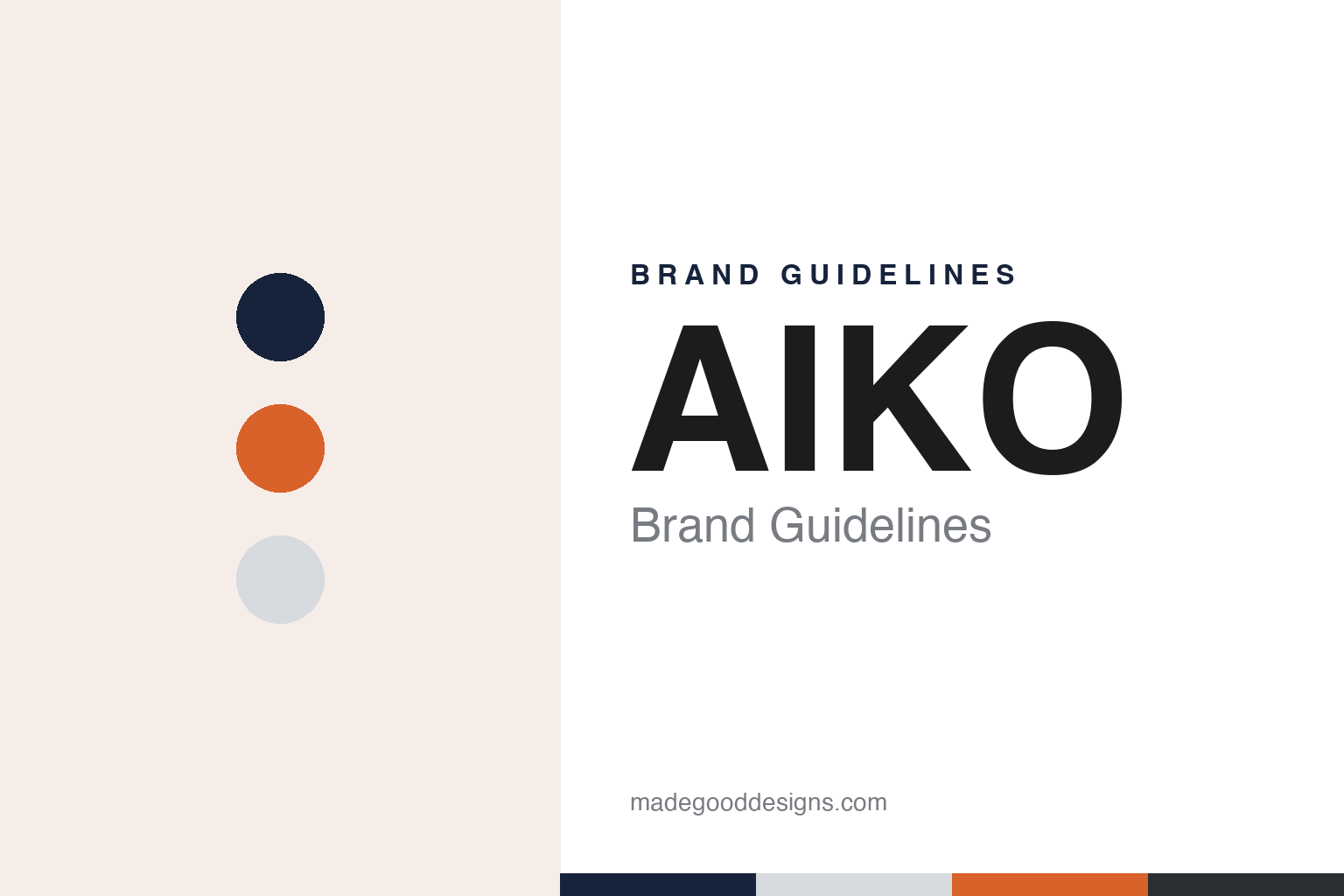
AIKO Brand Guidelines
The Chinese cell maker that moved its contacts to the back.
Aa
Two constants: an AIKO navy, graphite and orange palette and a geometric sans register. Abstract homage — not an AIKO product or mark; no panel, logo or nameplate is reproduced.
AIKO
A cell maker founded in 2009.
AIKO is a Chinese maker of solar cells and modules. The company says it was founded in 2009 and describes itself as a new-energy technology company focused on the research and manufacture of core photovoltaic products. Its main offerings, it says, are high-efficiency solar cells, ABC modules — the letters stand for All Back Contact — and what it calls integrated “solar-storage-application” solutions. Its mission statement is “Leading Humanity into the Net-Zero Era,” and the line that runs with its name online is “Find Your Power.”
The business press places the company in Shanghai. Yicai, the Chinese financial publication, calls Aiko Solar Energy “Shanghai-based” and lists its shares on the Shanghai market under the code 600732. Its factories grew in several Chinese cities. In April 2021 Yicai reported that the company had three large-scale cell production bases — Yiwu in the east, Foshan in the south and Tianjin in the north — and that it had signed a deal with the city of Zhuhai, in south China, to build a new cell production line there, along with a further line at its Yiwu base. At the time, Yicai noted, the company’s website said that all of the world’s top ten module suppliers were its clients.
AIKO now says it has six major production bases and three research centres: a Solarlab in Freiburg, Germany, run by AIKO Europe; an AIKO research centre in Zhuhai; and a joint innovation centre in Yiwu. The company is chaired by Chen Gang, whom AIKO introduced as its chairman when he gave the keynote speech at its AIKO Night event in Shanghai in June 2025.
Colour
From PERC to back contact.
AIKO tells its history as a list of cell technologies. The company says it developed tubular PERC technology in 2016 and a bifacial version in 2017, and that it began mass production of 210mm cells in 2019 and of 166mm cells in 2020. Then it changed course. AIKO says it officially released its ABC cell in 2021 and its first ABC module in 2022, followed by the ABC Infinite module in 2024.
The technology is in the name. Yicai described ABC cells in November 2023 as having their contact grids moved from the front of the cell to the rear, and named LONGi, AIKO and Maxeon among the few big companies that had managed to mass-produce back-contact cells. AIKO said at the time that it had applied for 325 patents on ABC technologies.
The look of the modules is part of the pitch. AIKO lists “superior aesthetics” among the advantages of its ABC modules, alongside efficiency and reliability, and among its honours it lists a Red Dot award in 2023 and The Intersolar AWARD in 2023. Its ranges include the Infinite and Neostar modules, sold for homes, commercial and industrial roofs and utility-scale plants. The company says its ABC modules are exported to Europe, the Asia-Pacific region, Japan, Korea, the Middle East and Africa.
Typography
Design and documentation.
Solar panel makers sell a product that looks much the same from a distance: a dark rectangle of glass divided into a grid of cells. Their visual identities work around that sameness. Company websites and brochures return again and again to a few scenes — black or blue module grids on house roofs, long rows of panels across desert or farmland at utility-scale plants, and close-ups of individual cells, where the fine lines of the metal contacts, or their absence, become the detail that sets one technology apart from another.
The factory is the second stage set. Makers show clean production lines, robotic handling and testing laboratories, and they name their cell technologies — TOPCon, heterojunction, back contact — the way other industries name materials. Product families are given short, branded names, and colour is used sparingly: a corporate blue, green or orange against white, with the dark face of the module doing most of the visual work.
Because most panels reach homes and businesses through others, makers also speak to installers. Partner programmes, installer training, distributor networks and warranty pages appear prominently on their websites, addressed to the people who specify and fit the panels.
Trade fairs are where the industry shows itself in public. Intersolar Europe at the Messe München and SNEC in Shanghai draw module makers from China, Europe, North America and elsewhere, who use large booths to launch new module families, storage systems and inverters side by side. This guide sets out what can be checked about each maker — where it began, who owns it, and what it makes — and marks clearly what rests only on the company’s own word.
Aa
A geometric sans for a brand built on one technology. (Specimen set in Sora, a sans STAND-IN; NOT the AIKO logo.)
AIKO
Europe, a patent case and a licence.
Europe became central to AIKO’s brand. Yicai reported in November 2023 that the company had signed supply agreements that year with the Dutch distributors Libra Energy and VDH Solar and with the Belgian distributor Gutami Group. In July 2025 Yicai reported that AIKO credited its improving results to growing recognition of its all-back-contact technology and to a focus on overseas markets such as Europe, Australia and Japan. In September 2026 TaiyangNews reported that, according to the company, overseas sales made up more than half of its ABC module sales in the first half of 2026, with project orders in France, Finland, the Czech Republic, Egypt and Romania.
That push brought a patent dispute. In November 2023 a unit of the Singapore-based Maxeon Solar Technologies sued AIKO for patent infringement at a court in Germany, Yicai reported; AIKO said its ABC products were fundamentally different from Maxeon’s and that it would defend its rights. The dispute went on to involve courts in the Netherlands and the Unified Patent Court. On 6 February 2026 the two companies announced a settlement: AIKO took a licence to Maxeon’s back-contact patents, covering products outside the United States, and both sides agreed to withdraw or end the related legal proceedings, Yicai reported. Maxeon is majority-owned by the Chinese wafer maker TCL Zhonghuan, which became a shareholder in 2020; TCL Zhonghuan said the agreement would let it work with partners to build an ecosystem around back-contact technology, while AIKO said it would help its back-contact products sell more smoothly in global markets and spare both sides long litigation.
For a design guide, AIKO shows a young maker building its name around one technology: the letters ABC run through its product names, its timeline and its patent story, and it presents the look of its modules as part of the offer. Compare Maxeon, whose back-contact patents it licensed, and LONGi, another Chinese back-contact maker. For this guide we use night navy, graphite and ember orange with a sans, an unofficial interpretation; no product or logo is reproduced.
Explore & save
Keep AIKO’s identity on hand — save it to a board in the Made Good inspiration library.
AIKO identity set
Pin the AIKO navy, graphite & orange palette and the geometric sans register to your own board.


