BOC Brand Guidelines
Brin’s oxygen of 1886, part of Linde since 2006.
Aa
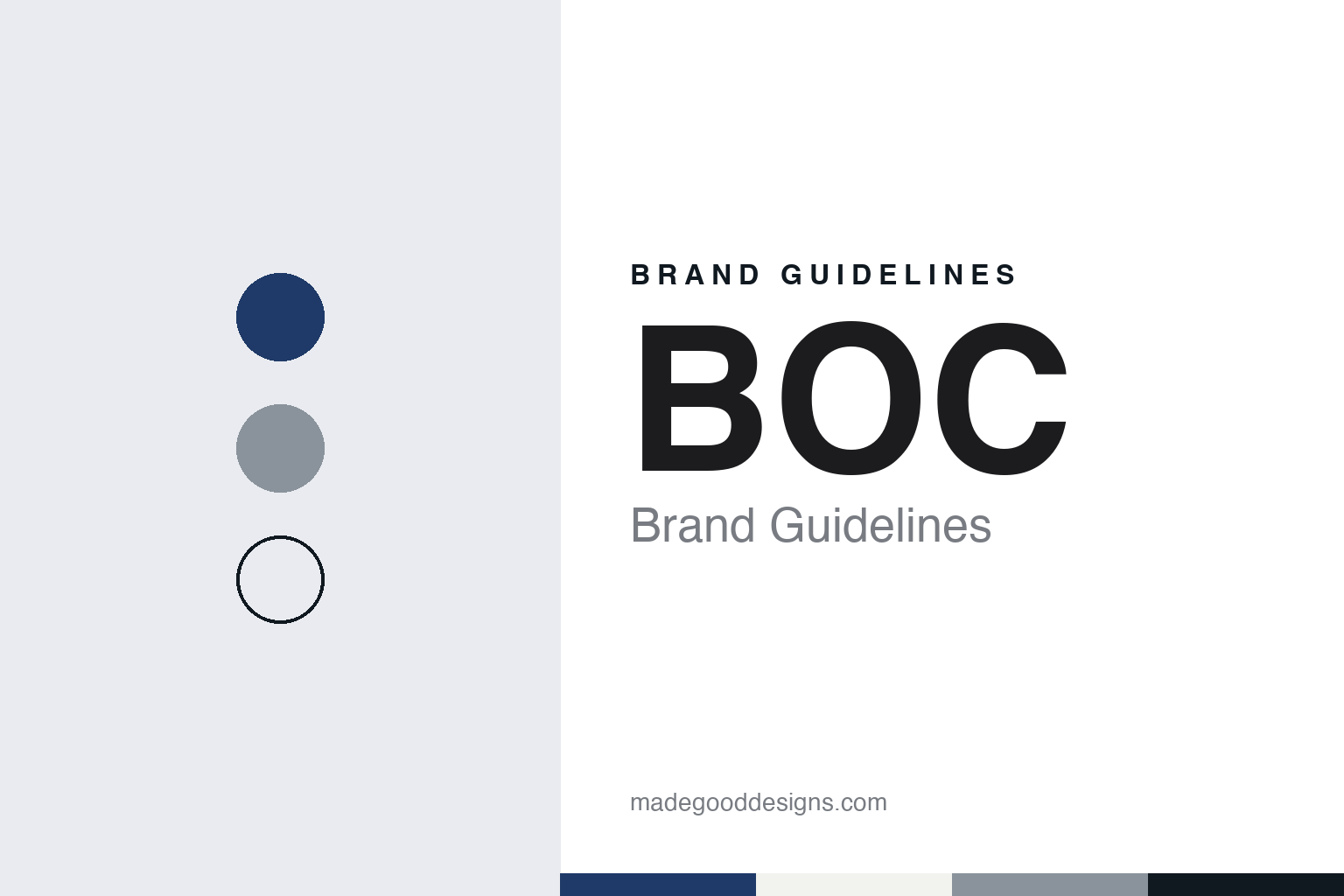
Two constants: a blue, steel and chalk palette and a Victorian company serif register. Abstract homage — not a BOC product or mark; no cylinder, logo or livery is reproduced.
Brin’s Oxygen Company
Two French chemists and a stage light.
BOC began as Brin’s Oxygen Company, formed in January 1886. The International Directory of Company Histories says the French brothers and chemists Arthur and Léon Brin came to London for the Inventions Exhibition in South Kensington in 1885 to show their newly patented way of making oxygen by heating barium oxide, and found a backer in Henry Sharp, an English stoneware maker. BOC’s New Zealand business dates the brothers’ first patents to 1880.
The early market was small. Oxygen was then used mainly for limelight, the bright stage and lantern lighting of theatres and lecture halls, and the Directory says the board went looking for other uses, from bleaching sugar to making steel. It also says the company began licensing the Brin process to other British firms in 1887 and introduced a steel cylinder for storing the gas in 1890, shipping oxygen to Australia for medical use.
The process that made the company large came from Germany. English Wikipedia says that around 1903 oxyacetylene welding opened a new market, and that the Brins agreed to use Carl von Linde’s patents for separating oxygen from liquefied air; in return Linde took a stake and a seat on the board, which he held until 1914. The barium oxide process was dropped, and in 1906 the company was renamed the British Oxygen Company.
Colour
Cutting, welding and two wars.
Cutting and welding steel drove the business for half a century. The Directory says trade rose sharply during the First World War, when ships, tanks and lorries all needed cutting or welding; Wikipedia, citing a history of the industry, adds that during that war BOC and the French company Air Liquide reached an informal agreement to stay out of each other’s home markets, which held until the 1960s. Between the wars BOC bought Sparklets, a London maker of small carbon dioxide bulbs, in 1920, the acetylene company Allen-Liversidge in 1930 and the Quasi-Arc welding company in 1936, the Directory says.
In the Second World War BOC was a main supplier of gases for munitions and for medical use, Wikipedia says, citing a Cambridge University Press history of the industry; the Directory adds that it supplied oxygen and high-pressure equipment to the Royal Air Force and allied air forces. The medical side had grown in the 1930s, when, the Directory says, BOC built a gas-and-air apparatus for midwives in 1935 and set up a division to pipe oxygen through hospitals.
Its size drew official scrutiny. In the mid-1950s the Monopolies and Restrictive Practices Commission examined the supply of oxygen and acetylene and found that BOC held about 98 per cent of the British market; Wikipedia dates the finding to 1956 and the Directory dates the report to 1957, saying the commission called the company’s prices “unjustifiably high” and against the public interest. Restrictions aimed at opening the market followed.
The company then spread abroad and into new trades. Wikipedia says it had subsidiaries in more than twenty countries after the war, became BOC International in 1975 and, in 1978, completed the purchase of the American gas company Airco after years of antitrust litigation; it then took the name The BOC Group. A planned split of the group between Air Liquide and Air Products lapsed in May 2000, Wikipedia says, after the two failed to reach agreement with the United States Federal Trade Commission.
Typography
Design and documentation.
Industrial gas companies sell something nobody sees. Oxygen, nitrogen, argon, carbon dioxide and hydrogen are colourless, so the identity of a gas supplier has to live on the things that hold and move the product: the cylinder, the storage tank, the delivery truck and the plant where air is separated into its parts.
The cylinder is the most familiar object in the category. Rows of steel and aluminium bottles, their shoulders painted in colours that identify the contents, appear in almost every supplier’s photography, often chained in racks at a welding shop or a filling plant. Beside them stand the larger forms of the trade: white or pale-grey bulk tanks outside factories and hospitals, and long tanker trucks that carry liquefied gases from plant to customer, usually wearing the supplier’s name and colours along the side.
The plants themselves have become an image of their own. An air-separation unit is a tall column, often wrapped in cladding and pipework, that cools air until its components can be drawn off one by one. Photographed at night, lit against a dark sky, these columns give the sector its most dramatic pictures, and many companies use them in annual reports and on their home pages.
The human scenes are fewer and more settled. A welder behind a mask in a shower of sparks stands for the industrial side; a hospital corridor or a patient at home with an oxygen concentrator stands for the medical side. Between the hardware and those two scenes, most of the visual language of the category is set. The brands in this guide work within that shared vocabulary, and what separates them is largely the name on the truck and the colour of the paint.
Aa
A Victorian company serif for a firm founded in 1886. (Specimen set in Source Serif 4, a serif STAND-IN; NOT the BOC logo.)
BOC
Back with Linde after a century.
The independent BOC ended in 2006. Wikipedia says the German group Linde made an offer in January that the BOC board rejected, made a higher one in March that was accepted, and completed the takeover on 5 September 2006. The European Commission cleared the deal on 6 June 2006, its press release says, on condition that Linde sell its own industrial gases business in the United Kingdom and BOC’s business in Poland, give up several helium supply contracts and cut its links with Air Liquide in a number of Asian joint ventures. Wikipedia says Linde sold the vacuum business, BOC Edwards, to CCMP Capital in March 2007.
The name did not disappear. Wikipedia describes BOC Limited, based in Woking, as a subsidiary of Linde plc, the company formed when Linde merged with the American gas company Praxair. BOC still trades under its own name in Britain, and BOC’s Australian and New Zealand websites trace the same history back to the Brins and list the 2006 combination with Linde. The old global head office at Windlesham, Surrey, built in the 1980s, was later sold, Wikipedia says. The company was granted a coat of arms by the College of Arms in 1961, with the Latin motto Auris vitalibus vesci.
For a design guide, BOC shows how a Victorian company name, shortened to three letters, can outlast its independence and live on as a regional brand inside a larger group. Compare Linde, the group that now owns it, and Afrox, the South African gas company; in 2003, Wikipedia says, BOC agreed to sell Afrox’s hospital business. For this guide we use a deep blue, a steel grey and chalk white with a serif, an unofficial interpretation; no product or logo is reproduced.
Explore & save
Keep BOC’s identity on hand — save it to a board in the Made Good inspiration library.
BOC identity set
Pin the BOC blue, steel and chalk palette and the Victorian company serif register to your own board.