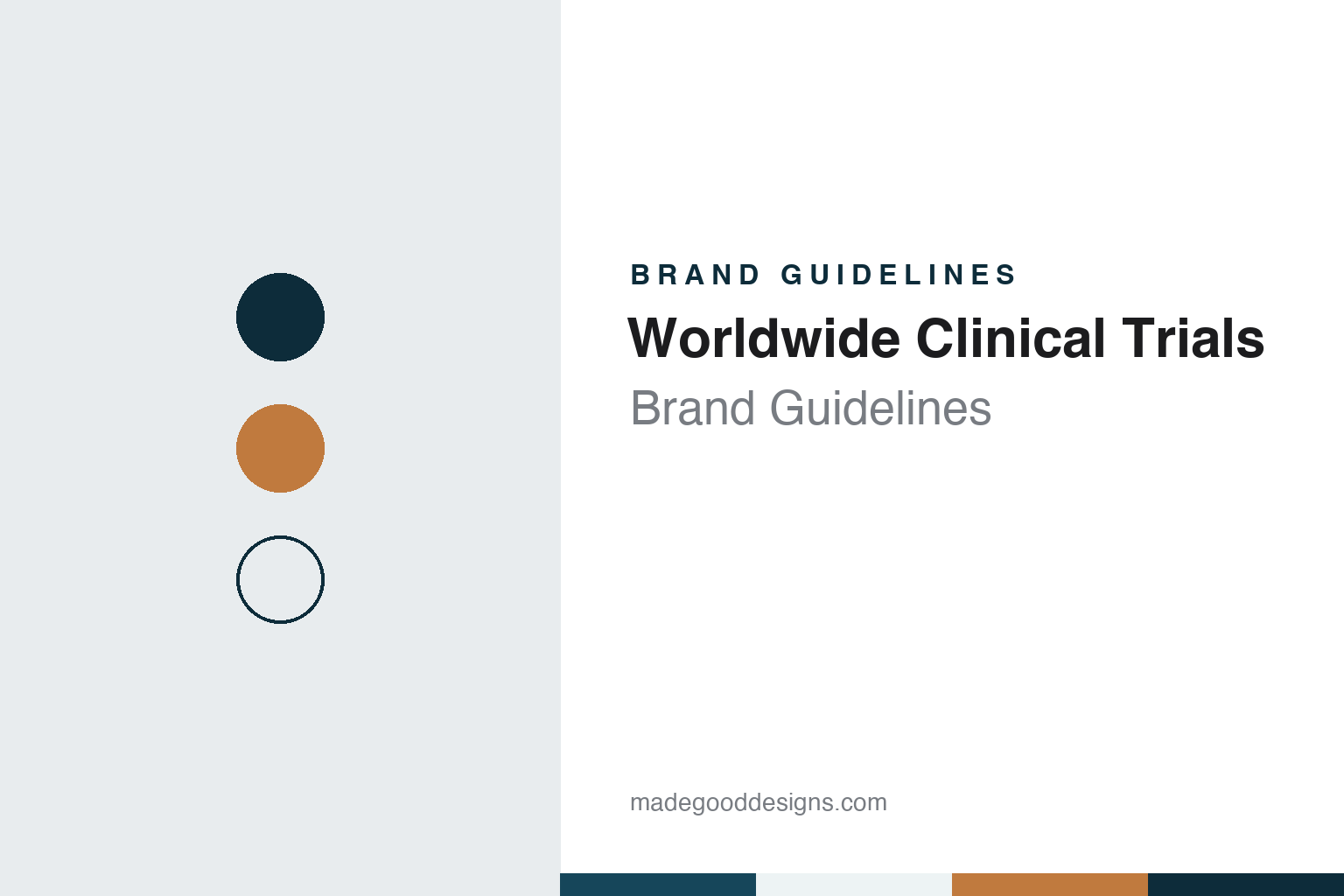
Worldwide Clinical Trials Brand Guidelines
A physicians’ research company that keeps narrowing its focus.
Aa
Two constants: a deep harbour blue and copper palette and a calm editorial serif register. Abstract homage — not a Worldwide Clinical Trials asset; no logo, product or screen is reproduced.
Founded by physicians
A Research Triangle CRO with a medical origin story.
Worldwide Clinical Trials is a contract research organisation headquartered in Research Triangle Park, North Carolina, and it usually calls itself simply “Worldwide.” The company says it was founded in 1986 by physicians committed to advancing medical science, and that origin is the thread running through how it describes itself: its About page introduces “a team of clinicians, scientists, and researchers” and says it was founded on a commitment to personal attention.
That idea is built into its working method as the company presents it. Worldwide says it pairs each sponsor with Therapeutic Leads, medical and scientific advisers who understand the disease being studied and the patients taking part, and it describes a set of house standards for project management under the name the “Worldwide Way.” Among the standards it lists are following a clear, repeatable and consistent process, aligning expectations and goals at the start of each project, and managing and communicating risk throughout. Its three stated qualities are short and plain: personal, accessible and united with its clients.
In August 2023 the company described itself as a full-service CRO whose work ran from bioanalytical laboratory services through Phase I to IV clinical trials to post-approval and real-world evidence studies, with more than 3,200 employees across nearly 60 countries and a therapeutic focus on cardiovascular, metabolic, neuroscience, oncology and rare diseases.
Colour
TJC, Kohlberg and Catalyst.
Worldwide has been owned by private equity for most of its recent history. The trade title bioXconomy reported in December 2023 that the American private equity firm TJC had backed Worldwide since 2007.
On 7 August 2023 Worldwide announced that an affiliate of Kohlberg & Company had agreed to acquire the company in partnership with its management team, with TJC keeping a minority stake; Peter Benton, then president and chief executive, thanked TJC for its years of support. bioXconomy reported on 19 December 2023 that Kohlberg had completed the deal, described as a recapitalisation, and that Kohlberg’s Matt Jennings had joined the board as chairman. The same report noted that Worldwide had teamed up in early 2022 with Science 37, a decentralised-trial technology company, to use its clinical-trial operating system, and in May 2023 had expanded in Europe through agreements with Next Oncology in Spain and the site organisation Pratia.
The next step was an acquisition of its own. On 20 January 2026 Worldwide announced an agreement to buy Catalyst Clinical Research, a specialised oncology CRO known for early-phase oncology trials, biometrics and a functional service provider model. The company said on 16 February 2026 that it had completed the purchase, bringing Catalyst’s oncology and Flex businesses into the group and taking its staff to about 4,400 people across more than 70 countries. That announcement was datelined both Research Triangle Park and Nottingham, England, named Alistair Macdonald as chief executive and described Kohlberg as the majority owner. Catalyst’s former chief executive, Nik Morton, joined Worldwide as chief strategy and transformation officer, and Catalyst’s chairman joined Worldwide’s board.
Worldwide markets its delivery models under the name Worldwide Flex, which covers both full-service trial management and functional service partnerships.
Typography
How research organisations present themselves.
Contract research organisations sell a service rather than a product. Drug, biotechnology and medical-device companies hire them to plan and run clinical trials, to test compounds before they reach people, to manage laboratories and to collect and analyse the data that regulators review. Because what they sell is largely invisible, their public image is built from people, places and numbers.
The pictures tend to repeat. Corporate sites and annual reports in the category often show clinicians and patients of different ages and backgrounds talking in calm, well-lit consulting rooms; scientists in lab coats working with pipettes and sample plates; and world maps dotted with the countries and sites where studies run. Data dashboards, charts and screens are common too, reflecting how much of the work is now about managing information as well as patients.
Colour follows the same caution. Blues and greens, from deep navy to soft teal, are frequent choices in health care and research branding, usually set against plenty of white, with a clean sans for names and headings. The aim is to look steady and trustworthy rather than playful, and names are often short, sometimes initials or a single coined word, partly because many of these companies are the product of mergers.
The industry also meets in person. Large gatherings such as the DIA Global Annual Meeting and the SCOPE Summit for clinical-operations staff bring sponsors, research organisations and technology suppliers together, and exhibition stands, panels and presentation slides there are another place where these identities are on show. This guide sets out what can be checked about each company’s history and ownership, and treats every colour and typeface here as our own interpretation.
Aa
A calm editorial serif — a three-word name that shortens to one. (Specimen set in Source Serif 4, a serif STAND-IN; NOT the Worldwide Clinical Trials logo.)
Worldwide
Selling the early-phase unit to Fortrea.
In September 2026 Worldwide and Fortrea signed an agreement under which Fortrea would buy Worldwide’s Early Phase Services division, Applied Clinical Trials reported on 2 September 2026. The division consisted of a 200-bed clinical pharmacology unit in San Antonio, Texas, a bioanalytical laboratory in Austin and a biospecimen storage facility in Pflugerville, all in Texas. Worldwide said the sale would let it focus its investment on its late-stage business in oncology, neuroscience, internal medicine and rare disease, while it continued to offer healthy-volunteer studies through its external site network.
The sale was completed in October 2026: Worldwide dated its announcement of the completed divestiture 19 October 2026, and Fortrea’s own announcement, published through the Malaysian news agency Bernama, was datelined Durham, North Carolina, on 20 October 2026. Fortrea said the purchase took its early-phase capacity to more than 570 beds worldwide and that the acquired operations would join its Clinical Pharmacology Services business, and both companies said they had made agreements to support continuity for clients, employees and ongoing programmes.
The result is a narrower Worldwide than the one Kohlberg bought in 2023. Its clinical pharmacology unit and bioanalytical laboratory now belong to Fortrea, and the company describes itself as a global CRO with dedicated expertise in four therapeutic areas and support across every development phase, from early-stage and first-in-human studies to Phase III registration trials. Its newsroom lists it as a finalist for the 2026 SCRS Eagle Award.
For a design guide, Worldwide shows how a contract research organisation can carry a physician-founded story and a personal, plain-spoken voice through several owners, an oncology acquisition and the sale of a whole division, while its long name stays the same and shortens naturally to one word. Compare it with Premier Research, another privately owned CRO from the Research Triangle, and with Fortrea, the buyer of its early-phase unit. For this guide we use a deep harbour blue and copper with a serif, an unofficial interpretation; no product or logo is reproduced.
Explore & save
Keep Worldwide Clinical Trials’s identity on hand — save it to a board in the Made Good inspiration library.
Worldwide Clinical Trials identity set
Pin the Worldwide Clinical Trials deep harbour blue and copper palette and the calm editorial serif register to your own board.