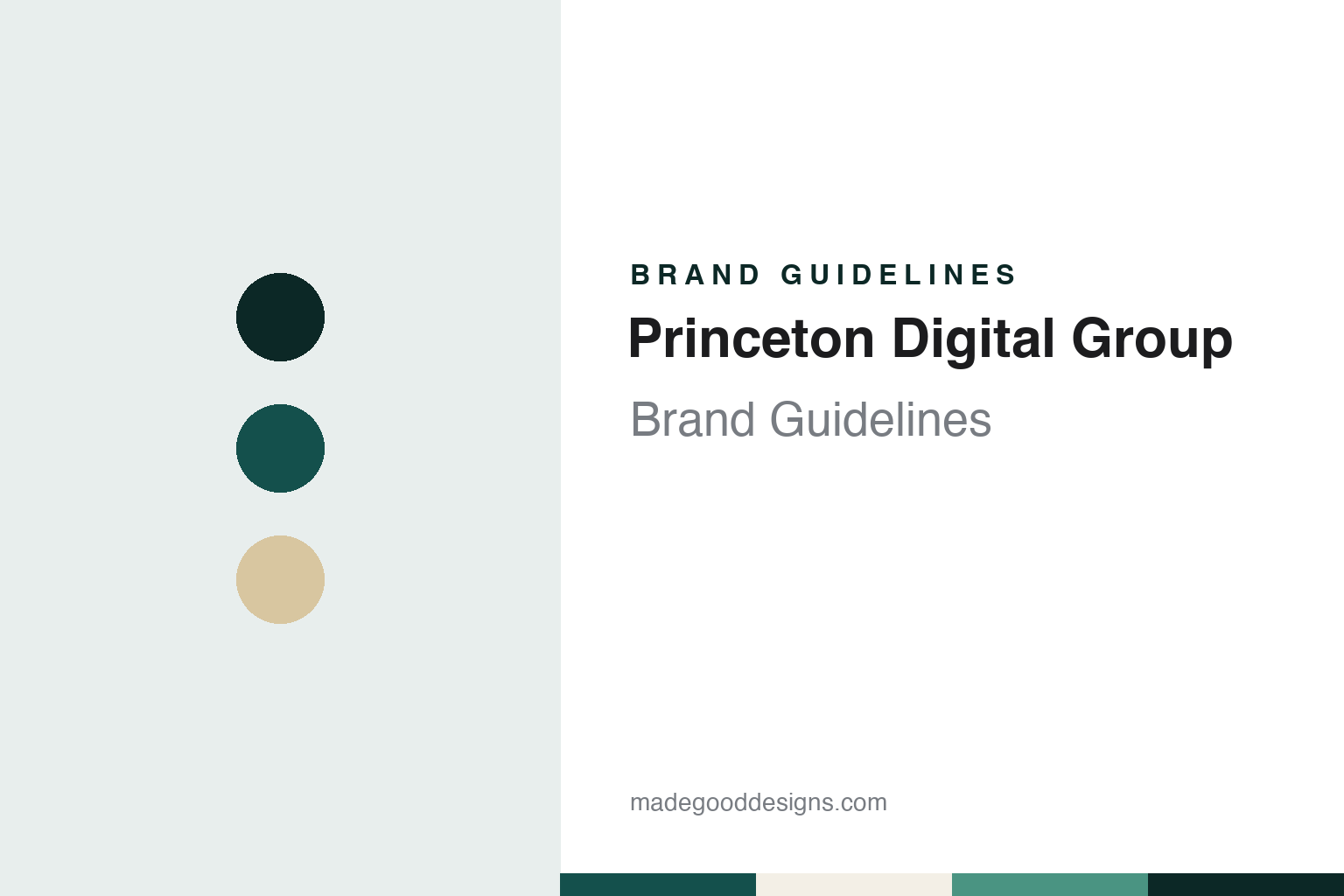
Princeton Digital Group Brand Guidelines
A New York start, a Singapore base and campuses with three-letter codes.
Aa
Two constants: a teal, jade and sand palette and a rounded geometric sans register. Abstract homage — not a Princeton Digital Group asset or mark; no building, logo or signage is reproduced.
Warburg Pincus
A New York start and a Singapore base.
Princeton Digital Group, usually shortened to PDG, is a developer and operator of data centres across Asia Pacific, headquartered in Singapore. Sources differ by a year on its start. The company’s website says it was founded in 2018. Data Center Knowledge, carrying Bloomberg reports in June 2021 and February 2022, said the private-equity firm Warburg Pincus helped set it up in 2017 together with Rangu Salgame, its chairman and chief executive, and Varoon Raghavan, its chief operating officer; the property news site Mingtiandi also gave 2017 in August 2024.
It did not start in Asia. Speaking in 2024, Salgame told Mingtiandi that six years earlier the company had decided “to move from New York to Asia” and had chosen Singapore as its headquarters. PDG’s releases describe Salgame as co-founder, chairman and chief executive, and in October 2026 he summed up the approach as entering a market, establishing a strong operating presence and then expanding for scale.
Warburg Pincus has stayed at the centre of the shareholder list. Ontario Teachers’ Pension Plan led a funding round in 2020, according to Data Center Knowledge, and Abu Dhabi’s sovereign fund Mubadala led another in February 2022, with Warburg Pincus and Ontario Teachers’ taking part. In July 2025 PDG signed a definitive agreement for a preferred-equity investment from the infrastructure investor Stonepeak; W.Media reported on 18 July 2025 that Warburg Pincus would remain the largest shareholder, and quoted Warburg Pincus describing itself as a founding investor.
Colour
Buy an operator, then build campuses.
PDG has grown by buying existing data centres and then building larger campuses in the same markets. It entered Indonesia in 2019 by acquiring an established portfolio of enterprise data centres, the company said in October 2026, and has since assembled what it calls a 400-megawatt hyperscale portfolio there across its JC2, JC3 and JC4 campuses in Greater Jakarta. It entered India in 2022; in March 2026 it announced a 210-megawatt, multi-site acquisition in Mumbai and Hyderabad that it said took its operating and planned capacity in the country to about a gigawatt.
In June 2021 Data Center Knowledge counted 18 PDG data centres in 12 cities, in countries including China, Singapore, India and Indonesia; by February 2022 the count was 20 in 14 cities, with Japan on the list. In Singapore PDG ran SG1 in the Tai Seng area and, in August 2024, bought a Yahoo data centre near Jurong Port, now called SG3, where Yahoo stayed on as a customer, Mingtiandi reported. The same report described a “Singapore-plus” plan taking in campuses in Johor, Malaysia, where PDG had reached a completion milestone at its 150-megawatt JH1 campus in July 2024, and on the Indonesian island of Batam. The Johor milestone came less than 14 months after PDG acquired the development site, Mingtiandi said, and the Yahoo building, a carrier-neutral facility, has fibre links to the nearby Tuas and Sakra cable landing stations. Mingtiandi also reported that in July 2024 the company had opened a new global headquarters at CapitaLand’s CapitaGreen in downtown Singapore.
The money raised has been tied to that pattern of expansion. The 2022 round led by Mubadala was meant to help PDG enter new markets and deepen its presence in existing ones, Data Center Knowledge reported, and W.Media wrote in 2025 that Stonepeak’s capital would support greenfield development as well as acquisitions, in both established and emerging Asia Pacific markets.
Each site carries a short code. The company’s website lists TY1 in Saitama, north of central Tokyo; MU1 and MU2 in Navi Mumbai; HY1 in Hyderabad; CH1 near Chennai; and LF1, LF2 and NJ1 in China, at Langfang near Beijing and in Nanjing. In July 2025 W.Media put the portfolio at more than 1.1 gigawatts across six countries; by 2026 PDG’s own releases spoke of more than 1.8 gigawatts and listed South Korea and Australia among its markets.
Typography
How data-centre operators present themselves.
Data-centre operators sell something most of their customers will rarely see in person. The product is space, power, cooling and connections inside buildings that are secure by design, so the industry has built a recognisable visual language to stand in for the real thing. Long white halls lined with rows of server racks, often lit in a cool blue, are the most common image on websites, in reports and on trade-show stands.
The second stock image is the campus from the air. Aerial photographs show low, windowless buildings set out in a grid, with car parks, substations and fenced yards around them. Close-ups fill in the detail: banks of cooling towers or chillers on a roof, rows of backup generators, cable trays crowded with fibre and power cords, and engineers in hi-vis vests checking a tablet between the racks. The pictures are meant to suggest scale, order and control rather than any single product.
Names and marks tend to follow the same logic. Many operators use short coined names, initials or plain descriptive words, set in clean sans-serif type, and organise their sites with city or airport codes and numbers. Colour schemes lean on blues, greys and one sharper accent, and campaigns talk about capacity, connectivity and growth in measured, technical language. Because the buildings look alike, the difference is often carried by naming, maps of locations and the way a company describes its customers.
Much of this identity is presented in person at industry gatherings such as Datacloud Global Congress and PTC, where operators, investors and network companies meet. Stands, keynote slides and printed site maps there tend to repeat the same visual cues as the websites: hall photography, campus renders and lists of markets. The guides in this group look at how individual operators use those shared conventions.
Aa
A rounded geometric sans for a three-letter name. (Specimen set in Manrope, a sans STAND-IN; NOT the Princeton Digital Group logo.)
PDG
A pending sale and a three-letter name.
PDG is still reshaping its portfolio. On 12 October 2026 it announced a definitive agreement to sell its Indonesian enterprise data-centre business — five facilities in Greater Jakarta, Bandung, Surabaya and Pekanbaru — to SM+, a digital-infrastructure investment platform backed by the Sinar Mas group. The sale was agreed in October 2026 and had not completed at the time of writing; the company said it remained subject to customary closing conditions, and that it planned to keep investing in its hyperscale campuses in the country.
In its own materials the three letters do most of the work. The page titles of its website end in “PDG,” most of the news headlines on its home page begin with it, and the full name, Princeton Digital Group, appears in the formal company description at the foot of each release. The website describes the business as a “pan-APAC developer and operator of hyperscale data centers.”
For a design guide, Princeton Digital Group shows how a three-letter abbreviation and a system of short campus codes can hold together a business spread across eight markets. Compare ST Telemedia Global Data Centres, another Singapore-based operator, and STACK Infrastructure, which is also building in Johor. For this guide we use a deep teal, a jade and a warm sand with a sans, an unofficial interpretation; no product or logo is reproduced.
Explore & save
Keep Princeton Digital Group’s identity on hand — save it to a board in the Made Good inspiration library.
Princeton Digital Group identity set
Pin the Princeton Digital Group teal, jade and sand palette and the rounded geometric sans register to your own board.