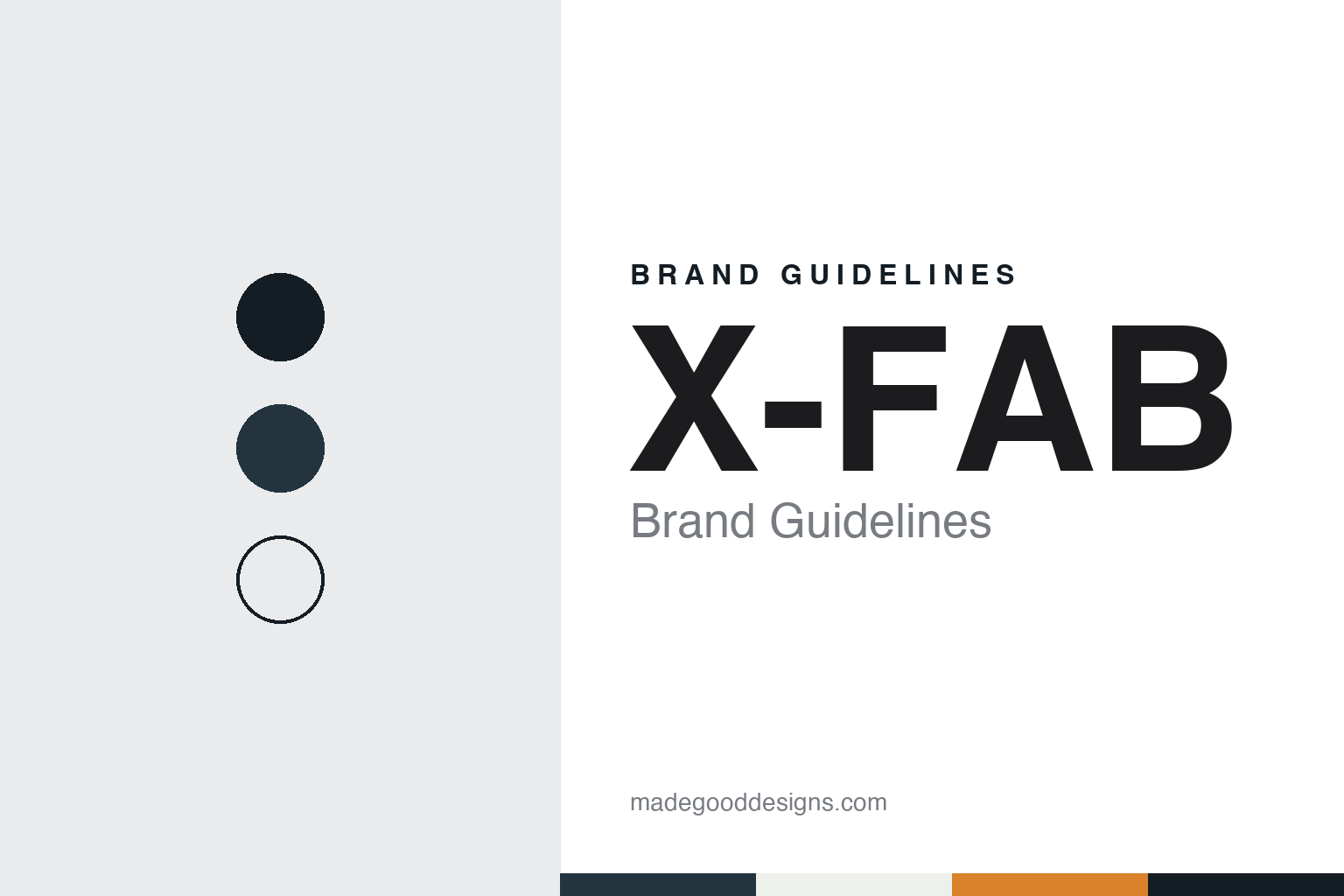
X-FAB Brand Guidelines
An East German chip works turned analog foundry group.
Aa
Two constants: a slate, grey and amber palette and a grotesque sans register. Abstract homage — not an X-FAB product or mark; no wafer, logo or nameplate is reproduced.
Erfurt
From an East German combine to a Belgian-owned foundry.
X-FAB came out of the East German chip industry. German Wikipedia traces it to the Kombinat Mikroelektronik Erfurt, the state semiconductor combine formed in 1978 that joined chipmakers at several sites and had its headquarters in Erfurt from 1989; until 1986 it also included the Zentrum Mikroelektronik Dresden, whose foundry business X-FAB would buy two decades later. After German reunification the combine was broken up and its plants partly privatised.
In 1992, German Wikipedia says, the Erfurt facilities were split between X-FAB Gesellschaft zur Fertigung von Wafern mbH, which made wafers, and Thesys, which designed chips; the Free State of Thuringia had been a part-owner. In 1999 both were sold to the Belgian company Elex NV, today Melexis, of Ieper. English Wikipedia adds that X-FAB took the non-foundry business out of Thesys that year, and that it also bought a Texas Instruments fab in Lubbock, Texas, in 1999.
Buying fabs that larger companies no longer wanted became the pattern. eeNews Europe wrote in March 2017 that X-FAB had grown partly by acquiring older wafer fabs from chip companies that wanted to give up manufacturing. English Wikipedia lists the Zarlink wafer plant in Plymouth in 2002 and the foundry business of ZMD in Dresden in 2007; X-FAB sold the Plymouth plant to Plus Semi in December 2009, according to both language editions.
In 2006 X-FAB merged with 1st Silicon, a wafer fab in Kuching, Sarawak. eeNews Europe reported that the Malaysian state of Sarawak had been a shareholder since that merger, with a stake it put at 35 percent before the 2017 listing. Hans-Jürgen Straub led the company as chief executive for 22 years until 2014, German Wikipedia says, when Rudi De Winter took over.
Colour
Six fabs and the analog world.
X-FAB describes itself as a pure-play foundry for analog and mixed-signal semiconductors, making chips that its customers design, and states its aim as being “the foundry of choice for the analog world.” It says its main markets are automotive, industrial and medical. German Wikipedia notes a focus on high-voltage circuits up to 700 volts and gives its process range, as of 2020, as 1.0 micron down to 130 nanometres on 150 mm and 200 mm wafers.
The group runs six wafer fabs, in Germany, France, Malaysia and the United States. English Wikipedia lists CMOS and MEMS production at Erfurt and CMOS at Dresden, and the company lists 350, 180 and 130 nanometre CMOS processes at Kuching. The Itzehoe fab in northern Germany began as a MEMS foundry spun off from the Fraunhofer Institute for Silicon Technology; English Wikipedia says X-FAB acquired it in 2012 and owned it fully from 2015.
The sixth site came in 2016, when X-FAB took over the insolvent Altis Semiconductor at Corbeil-Essonnes, south of Paris, according to German Wikipedia. In Lubbock, X-FAB worked with PowerAmerica, a US manufacturing institute, from 2015 on 150 mm silicon carbide wafers for power electronics, English Wikipedia says, and German Wikipedia notes the fab can now process them.
X-FAB also licenses technology from research partners. In 2022, English Wikipedia says, X-FAB licensed a 130-nanometre silicon-germanium BiCMOS platform from the Leibniz Institute for High Performance Microelectronics (IHP). The company now groups its expertise under analog and mixed-signal technology, microsystems, photonics and wide-bandgap products.
Typography
How foundries present themselves.
Contract chip makers sell a service rather than a product with their own name on it. The chips they make leave the plant under their customers’ names, so a foundry’s identity has to be built from the things it can show: the wafer, the cleanroom, the fab and the people who run it.
The wafer is the usual starting point. Foundry photographs often show a finished wafer held up to the light, its grid of chips throwing back a rainbow sheen, or a stack of wafers in a carrier ready for the next step. Close-ups of patterned silicon give a company a recognisable image without revealing any customer’s design.
Inside the fab, the pictures follow a familiar pattern: engineers in full-body cleanroom suits, often called bunny suits, standing at tools under the yellow light used in lithography areas; long, bright corridors lined with equipment; and overhead transport systems carrying wafer pods along tracks in the ceiling. From outside, aerial shots of fab campuses, with their long, low buildings and utility plants, stand in for scale and capacity.
Foundries also present themselves at trade shows and conferences, such as the SEMICON exhibitions held in several regions, as well as through their own technology events for customers. Their names usually travel as abbreviations or short forms, and their written materials lean on process names, node figures and fab locations. This guide sets out what can be checked about each company — who founded it, who owns it, where it makes wafers — and marks clearly what rests only on the company’s own word.
Aa
A grotesque sans for an engineering group. (Specimen set in Archivo, a sans STAND-IN; NOT the X-FAB logo.)
X-FAB
A Paris listing and a new cleanroom in Erfurt.
The group’s holding company, X-FAB Silicon Foundries SE, has its registered seat in Tessenderlo, Belgium, while its operational headquarters is in Erfurt. Before the listing, eeNews Europe reported in March 2017, X-FAB was majority-owned by Xtrion NV of Tessenderlo, an investment company linked to its chief executive and partners, with Sarawak as the other large shareholder. English Wikipedia says Xtrion also holds a majority of Melexis, which it lists as X-FAB’s largest customer as of 2016. Euronext announced on 6 April 2017 that X-FAB had been admitted to trading on Euronext Paris, calling it the market’s largest listing since January.
In July 2020, English Wikipedia says, X-FAB temporarily halted its IT systems and production lines after a ransomware attack, to prevent damage.
Erfurt is now being reshaped around microsystems. German Wikipedia, citing Handelsblatt in December 2025, says X-FAB is to receive state aid for a new Erfurt plant for MEMS, due to start commercial operation in 2029. In October 2026 the company broke ground on a new cleanroom at Erfurt for its Fab4Micro project, run by X-FAB MEMS Foundry GmbH for microsystems and photonics and funded by the German federal government and the Free State of Thuringia under the EU Chips Act. The company says representatives of government, industry and academia joined the ceremony, which it presented as continuing Erfurt’s move towards becoming the group’s microsystems hub; it says it has about 4,000 employees.
For a design guide, X-FAB shows a foundry that names its specialism rather than its size: an analog house built from other companies’ fabs, held together by one short, technical name. Compare Tower Semiconductor, another specialty foundry, and GlobalFoundries, another contract chipmaker. For this guide we use a slate, a silicon grey and an amber with a sans, an unofficial interpretation; no product or logo is reproduced.
Explore & save
Keep X-FAB’s identity on hand — save it to a board in the Made Good inspiration library.
X-FAB identity set
Pin the X-FAB slate, grey and amber palette and the grotesque sans register to your own board.