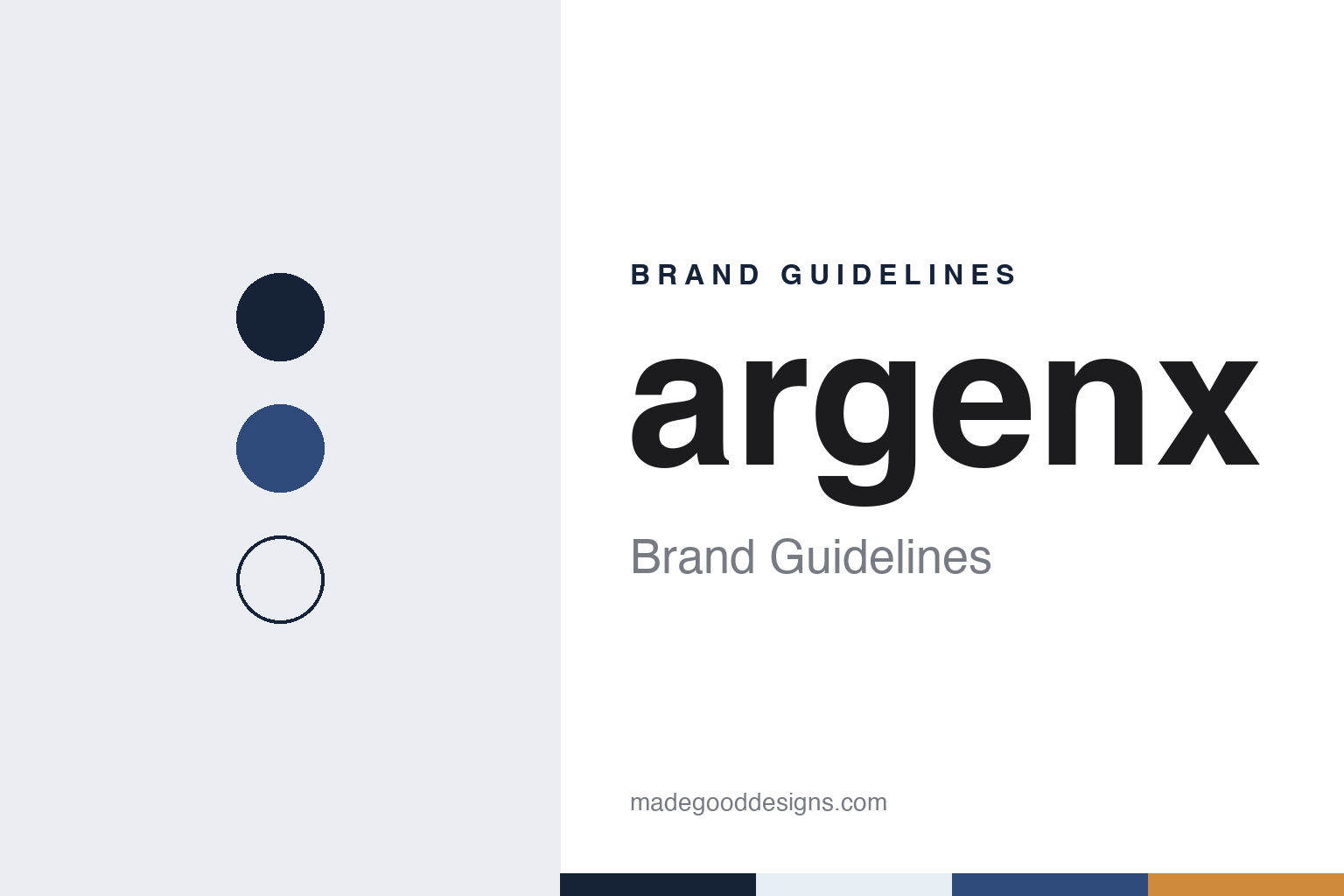
argenx Brand Guidelines
The Ghent antibody company named after a ship’s crew.
Aa
Two constants: a navy, blue and gold palette and a lower-case sans register. Abstract homage — not an argenx product or mark; no logo, pack or medicine is reproduced.
arGEN-X
Three scientists and a crew from Greek myth.
argenx was founded in 2008 in Ghent, Belgium, by three scientists: Tim Van Hauwermeiren, a former executive of the Ghent antibody company Ablynx, and his colleagues Hans de Haard and Torsten Dreier, according to English Wikipedia. Their aim was to bring new medicines for autoimmune diseases to market. Wikipedia says that, working with academic researchers including the scientist Sally Ward, they developed medicines aimed at immunoglobulin G autoantibodies, the antibodies that turn on the body’s own tissues.
The name has a story the company tells itself. argenx says it comes from the Argonauts of Greek legend, the crew who sailed in search of the golden fleece, and that it chose them because the tale celebrates the collective power of a team over a single hero. Dutch Wikipedia gives an earlier spelling, arGEN-X. Today the company writes its name entirely in lower case.
The structure is Belgian-Dutch. Dutch Wikipedia describes argenx SE, a European company, as the Dutch parent of the Belgian operating company argenx BV; the company’s own list of locations places argenx BV at the Zwijnaarde science park on the edge of Ghent and argenx SE at an office in Amsterdam, with subsidiaries in the United States, Japan, Switzerland, Germany, France, Italy and the United Kingdom.
The company says it completed its stock-market debut on Euronext Brussels in 2014, under the ticker ARGX, and added a listing on the Nasdaq Global Select Market in 2017. It joined Belgium’s BEL 20 index in June 2018, according to both English and Dutch Wikipedia, and, English Wikipedia says, the Euro Stoxx 50 in September 2025. In April 2016, Dutch Wikipedia notes, it agreed a collaboration with AbbVie to develop the antibody ARGX-115.
Colour
Efgartigimod and the FcRn route.
argenx’s first medicine is Vyvgart, the brand name for efgartigimod alfa. On 17 December 2021 the U.S. Food and Drug Administration announced that it had approved Vyvgart for adults with generalized myasthenia gravis who test positive for antibodies against the acetylcholine receptor. The FDA described Vyvgart as the first approval of a new class of medication: an antibody fragment that binds the neonatal Fc receptor, or FcRn, which normally recycles immunoglobulin G back into the blood. Dutch Wikipedia adds that the medicine was also approved in Japan and the European Union in 2022.
A second form followed. Vyvgart Hytrulo is an injection given under the skin that pairs efgartigimod with an engineered enzyme from the American company Halozyme, MedCity News reported on 24 June 2024, when the FDA approved it for chronic inflammatory demyelinating polyneuropathy, or CIDP, a rare nerve disease; the report said Hytrulo had been approved for myasthenia gravis a year earlier. The company’s own timeline adds a first approval for immune thrombocytopenia in Japan in 2024, FDA approval in 2025 covering further forms of myasthenia gravis, and a prefilled syringe for self-injection, which English Wikipedia dates to April 2025.
Not every trial went its way. Dutch Wikipedia records that in late November 2023 argenx stopped a study of efgartigimod in immune thrombocytopenia, and on 20 December 2023 announced that it was ending a study in pemphigus, a rare blistering skin disease, after the results showed no difference from placebo. English Wikipedia describes both as setbacks in the attempt to widen the medicine’s uses.
The company calls itself an “immunology innovation company” and names further candidates in development, among them empasiprubart, which it says is engineered to block a step in the complement system, and ARGX-118, which it links to a target in airway inflammation.
Typography
How biotech presents itself.
Biotechnology companies sell things that are almost impossible to photograph. A medicine made from a strand of RNA or an engineered antibody has no shape a camera can see, so the sector leans on a small set of stand-in images: rendered molecules, ribbons and double helices, antibodies drawn as glowing Y-shapes, and close-ups of cells under a microscope. These macro images carry most of the visual weight on corporate websites, investor decks and annual reports.
The second familiar picture is the laboratory itself. Scientists at benches with pipettes, racks of sample tubes and gloved hands over a plate reader appear again and again, because they show work in progress rather than a finished product. Alongside them sit patient-advocacy portraits: people living with a rare disease, their families and the groups that represent them, photographed in everyday settings rather than in the clinic.
Architecture does the rest. Glass-fronted lab campuses in clusters such as Cambridge, Massachusetts, Copenhagen and South San Francisco stand in for scale and ambition, and company websites often show their buildings alongside their people. The calendar adds its own stage: the BIO International Convention and the J.P. Morgan Healthcare Conference, held each January in San Francisco, are where pipelines are presented to partners and investors.
Within that common language, names and colours do much of the work of telling companies apart. This guide sets out what can be checked about each brand — who founded it, where it is based, what it makes and what has happened to it — and marks clearly what rests only on the company’s own word. No product, logo or pack is reproduced, and the palettes are our own unofficial interpretation.
aa
A lower-case sans for a name that never takes a capital. (Specimen set in DM Sans, a sans STAND-IN; NOT the argenx logo.)
argenx
Teamwork as a founding myth.
argenx builds its identity around the crew rather than the captain. Its “About us” page retells the Argonaut story at length: a small boat, an ocean, a task that seemed impossible and was achieved through the contributions of each member of the team. The same idea runs through the cultural pillars the company lists, which include co-creation and humility, summed up in its own phrase “We don’t believe in ‘I.’”
The lower-case name is the most visible part of that system, and the company keeps to it across its own website, from product pages to its list of offices. The earlier spelling recorded by Dutch Wikipedia, arGEN-X, mixed capitals and lower case and added a hyphen.
Its storytelling leans on patients rather than laboratories. The company’s newsroom carries first-person stories of people living with myasthenia gravis, CIDP and myositis, alongside explanations of how FcRn works, and it runs an Immunology Innovation Program with academic partners. The company says it innovates by bringing academic discovery, clinical insight and patient experience together.
The company has grown into a multinational without losing its Ghent base: its Belgian operating company remains at Zwijnaarde, while its American company, argenx US, is listed at an office in Boston.
For a design guide, argenx shows how a single typographic decision, never using a capital, can carry a name across two stock exchanges and many markets. Compare Genmab, another European antibody company, and Novo Nordisk. For this guide we use a deep navy, a harbour blue and a warm gold with a sans, an unofficial interpretation; no product or logo is reproduced.
Explore & save
Keep argenx’s identity on hand — save it to a board in the Made Good inspiration library.
argenx identity set
Pin the argenx navy, blue and gold palette and the lower-case sans register to your own board.