Cardinal Health Brand Guidelines
A food wholesaler from Ohio that became a national drug distributor.
Aa
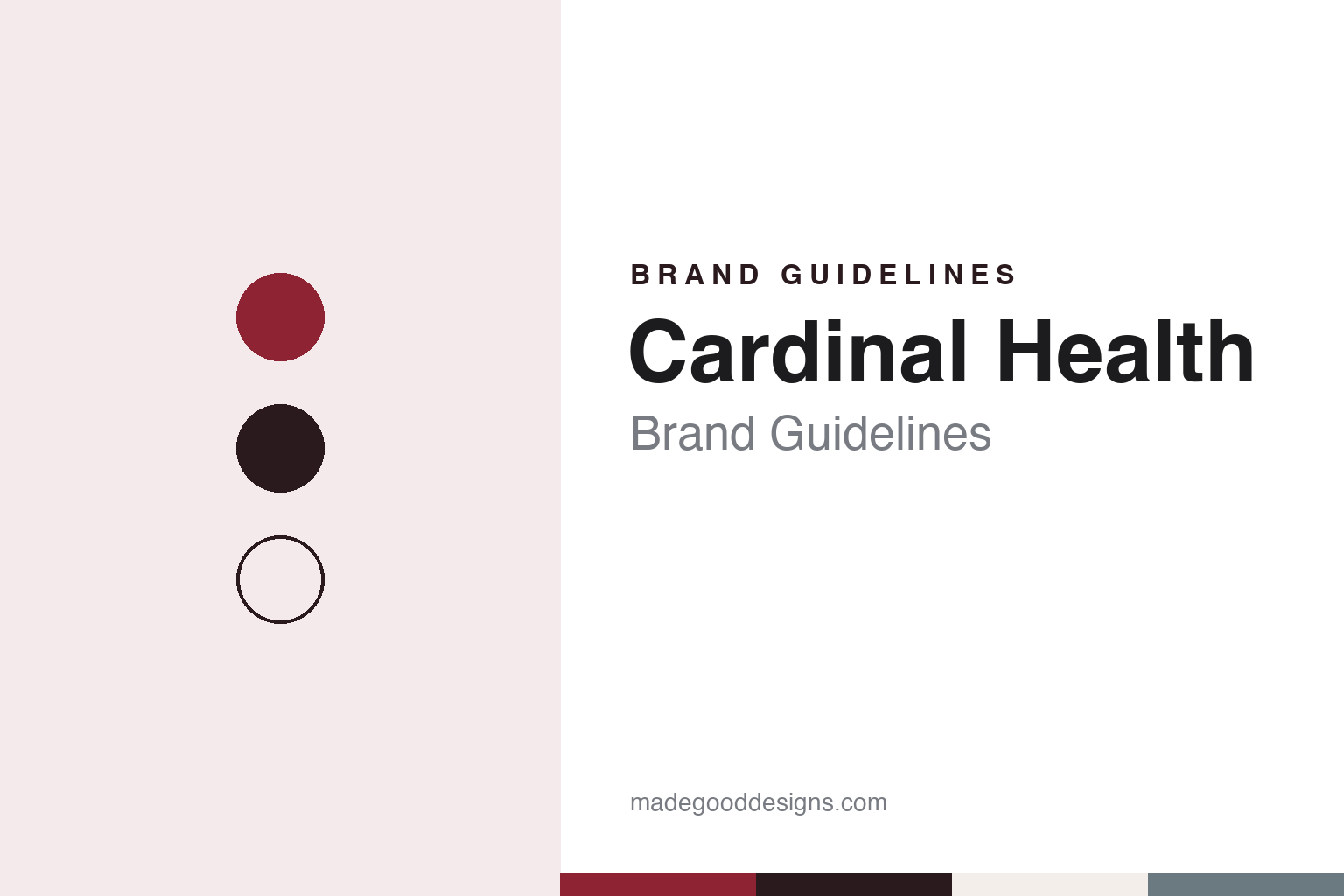
Two constants: a deep red, plum and warm paper palette and a humanist sans register. Abstract homage — not a Cardinal Health product or mark; no logo or wordmark is reproduced.
Cardinal Foods
A food wholesaler that turned to medicines.
Cardinal Health did not start in medicine. English Wikipedia says the company was founded in 1971 as Cardinal Foods by Robert D. Walter, and that it began as a food wholesaler. The turn came in 1979, when it bought the Bailey Drug Company and began wholesaling drugs. The company listed its shares on the NASDAQ in 1983, sold its food operations to Roundy’s in 1988, and in 1994 changed its name to Cardinal Health, by which time it had become the third-largest pharmaceutical wholesaler in the United States, Wikipedia says.
Acquisitions followed through the 1990s. Wikipedia lists the retail-pharmacy franchiser Medicine Shoppe International in 1995, which it describes as the company’s first acquisition outside distribution; Pyxis, a maker of automated medicine-dispensing cabinets for hospitals, in 1996; the pharmacy-management firm Owen Healthcare in 1997; and, in 1999, Allegiance Healthcare of Chicago, a medical-products maker and distributor that had been a division of Baxter. In 1997, Wikipedia adds, Cardinal Health planned to buy the wholesaler Bergen Brunswig, but Bergen instead merged with Amerisource to form AmerisourceBergen, the company now called Cencora. In 2001 it added Bindley Western Industries, a pharmaceutical wholesaler in Indianapolis.
The company has also shed businesses. In 2009, Wikipedia says, it spun off its clinical and medical products businesses as an independent medical-technology company, CareFusion, and Cardinal Health’s shares are traded on the New York Stock Exchange under the symbol CAH. Today the company is based in Dublin, Ohio, and its chief executive, as named in an October 2026 press release, is Jason Hollar.
Colour
Distribution, products and pharmacies.
In its own press releases Cardinal Health describes itself as a distributor of pharmaceuticals and specialty products; a global manufacturer and distributor of medical and laboratory products; a supplier of home-health and direct-to-patient products and services; an operator of nuclear pharmacies and manufacturing facilities; and a provider of performance and data solutions. Much of that range arrived through acquisitions.
The medical-products side grew through deals. Wikipedia records the purchase of the privately held medical-supply distributor AssuraMed of Twinsburg, Ohio, with its subsidiary Edgepark Medical Supplies, in March 2013; of Johnson & Johnson’s Cordis cardiology and endovascular business, completed in October 2015 and sold again in August 2021 to the private-equity firm Hellman & Friedman; and of a patient-care product portfolio from Medtronic, completed in July 2017. On the pharmaceutical side it bought the independent wholesaler Kinray in December 2010, and in July 2014 it began operating Red Oak Sourcing, a generic-drug sourcing venture with CVS, according to Wikipedia.
The CVS link has continued. On 1 October 2026 Cardinal Health announced a binding letter of intent to extend its distribution agreement with CVS Health through 30 June 2032, covering its current scope of distribution services.
More recent deals have pushed into physician services and home care. On 3 November 2025 the company said it had completed its acquisition of Solaris Health, which it called the country’s leading urology management services organisation, with more than 750 providers at more than 250 locations in 14 states; Solaris joined The Specialty Alliance, Cardinal Health’s multi-specialty platform. In July 2026, the health-industry site HLTH reported on 22 July, Cardinal Health agreed to acquire AdaptHealth’s Diabetes Health business and the medical-supply provider Strive Medical for its at-Home Solutions business, subject to regulatory approvals; the deals were agreed in July 2026, and the reports used for this guide do not confirm that both had closed at the time of writing. HLTH described an earlier purchase, Advanced Diabetes Supply, as a cornerstone of that business.
Typography
The category.
Pharmaceutical wholesalers sit between the companies that make medicines and the pharmacies, hospitals and clinics that hand them out, so their public image is mostly an image of movement. The pictures these companies tend to show are long automated warehouse aisles, conveyor lines carrying plastic totes, and high racks of shelving, with staff in high-visibility vests picking orders between them. The aim of that imagery is to show scale and order rather than any single product.
The second recurring scene is the road. Fleets of liveried vans and temperature-controlled trucks carry the company name through towns and onto motorways and are often the most visible sign of a wholesaler on the street. Close-ups of insulated cold-chain boxes, data loggers and handheld barcode scanners carry the same message at a smaller size: goods are tracked from shelf to doorstep.
The third scene is the pharmacy counter. Because many wholesalers also run pharmacy networks, franchise banners or buying groups, their brochures often show a pharmacist behind a counter talking with a customer, which gives a logistics business a human face. These banners usually carry their own names and colours, separate from the parent company, so one wholesaler can stand behind several identities on the high street.
Beyond that, the visual record is corporate: trade-fair stands, investor presentations and annual reports with supply-chain diagrams of arrows linking factories, distribution centres and pharmacies. For a design study, the useful question is how one identity can work on a lorry side, a carton label, a pharmacy sign and a screen at the same time.
Aa
A humanist sans for a name the company asks to be written in full. (Specimen set in Source Sans 3, a sans STAND-IN; NOT the Cardinal Health logo.)
Cardinal Health
Two words, always.
The company is unusually direct about how its name should appear. Its newsroom’s brand guidelines ask writers always to refer to the company as “Cardinal Health” in speech and print, state that the name is not simply “Cardinal,” and say it is always written as two words. The same page says the logo is trademarked worldwide, that the wordmark should not be replicated, and that only official master art should be used — never a recreation. In other words, the company treats the full two-word name as the core of its identity.
Its record also includes regulatory and legal history, stated here neutrally. In February 2012, Wikipedia says, the US Drug Enforcement Administration suspended the licence of the company’s distribution centre in Lakeland, Florida, to distribute controlled substances; a federal district court upheld the suspension later that month, and the company and the agency later reached a settlement. Earlier, in August 2006, the company stopped production of its Alaris SE infusion pump after the US Food and Drug Administration seized units, and in February 2007 it signed a consent decree with the agency, according to Wikipedia. In July 2021 Cardinal Health was one of the companies, alongside McKesson, AmerisourceBergen and Johnson & Johnson, that agreed to settle thousands of opioid-related lawsuits in the United States; Wikipedia notes that the company did not admit wrongdoing.
For a design guide, Cardinal Health shows how a distributor can build a recognisable identity on a name used consistently and in full. Compare McKesson and Cencora, the other large US pharmaceutical wholesalers. For this guide we use a deep red, a dark plum and warm paper with a sans, an unofficial interpretation; no product or logo is reproduced.
Explore & save
Keep Cardinal Health’s identity on hand — save it to a board in the Made Good inspiration library.
Cardinal Health identity set
Pin the Cardinal Health deep red, plum and warm paper palette and the humanist sans register to your own board.