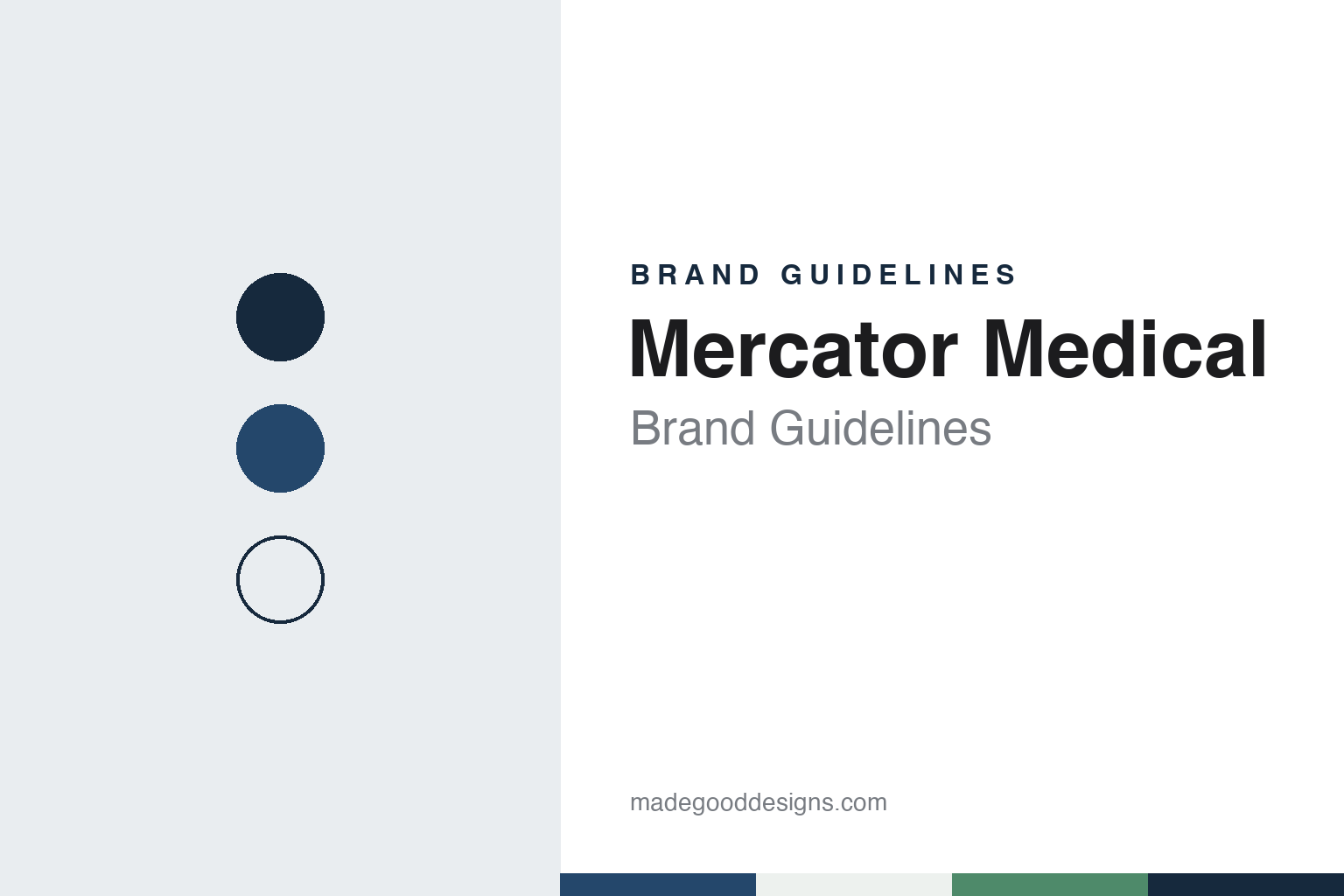
Mercator Medical Brand Guidelines
The Kraków distributor that became a glove maker in Thailand.
Aa
Two constants: a Mercator navy and green palette and a Clean geometric sans register. Abstract homage — not a Mercator Medical product or mark; no glove, pack or logo is reproduced.
Mercator
A family trading firm that split in three.
Mercator Medical comes out of a trading business started in Kraków in 1989. Polish Wikipedia, citing the company’s share prospectus, says the brothers Piotr and Wiesław Żyznowski began as Mercator Żyznowski i Spółka, a general partnership, turned it into a joint-stock company in 1993 and then split it into three independent firms: Mercator Medical in 1996, and Mercator Papier and Mercator Poligrafia in 1998. The company itself says Mercator Medical was set up on the initiative of Wiesław Żyznowski and Monika Sitko, then a long-serving vice-president, who both became major shareholders.
It started as a distributor. The company says its first business was selling disposable medical and protective gloves to Polish hospitals through public tenders, and that dressings, disposable clothing and surgical drapes followed. Polish Wikipedia says its own glove brands began in 1997 with Comfort, Santex and Proster, and that its Vinylex vinyl examination gloves were named product of the year in 2003 by the trade review Ogólnopolski Przegląd Medyczny.
Distribution spread east and south. Polish Wikipedia and the company say Mercator began selling directly in Hungary and Ukraine in 2004 and in Romania in 2006, with a branch in Budapest and subsidiaries in Kyiv and Cluj-Napoca. In 2005 it began distributing surgical gloves for Ansell, the company says. Later subsidiaries followed in the Czech Republic and the United States in 2015, Italy in 2017 and Germany in 2019.
Colour
Buying into a Thai factory.
The decisive step came in 2006. The company says it bought 50.4 percent of B-Care, a Thai maker of medical gloves, which became Mercator Medical (Thailand) Ltd.; Polish Wikipedia gives the aim as securing supplies of natural latex, the raw material for latex gloves, and calls the purchase the first industrial investment by a Polish company in Thailand, a point the company also makes. The company says it added four double production lines between 2014 and March 2015, taking output to 110 million gloves a month.
That expansion needed money. Mercator Medical listed on the main market of the Warsaw Stock Exchange on 21 November 2013; Bankier.pl reported on the day that the company, which it called a maker of disposable medical gloves, would spend the proceeds on expanding the factory in Thailand, that all the shares on offer had been sold, and that the founders remained the majority shareholders. Polish Wikipedia, citing the company, names Anabaza Ltd as the main shareholder in July 2020, with just over 60 percent.
A second Thai plant followed, built for gloves made from synthetic latex, or nitrile. In October 2018 the health-industry site Rynek Zdrowia reported that the last of its eight lines had started, ending the main construction that began in January 2017, and that the group’s capacity had risen by more than 150 percent to over 3 billion gloves a year. The hall stands on a six-hectare plot and holds seven double lines and one single line kept for smaller runs, the site reported, and the company called it the largest investment in its history. In February 2022 BiznesRadar reported that the first line of a third factory had started at the same Thai site, with a target of about 4.2 billion gloves a year across the three plants, alongside a solar farm.
The company says the three factories stand in Songkhla province in southern Thailand, near the ports of Songkhla and Penang, and that they sell mainly under customers’ own OEM brands. It describes nitrile rubber as the main raw material.
Typography
Gloves, rubber and the record.
Disposable gloves are among the most anonymous products in healthcare. They arrive in plain dispenser boxes, are worn for minutes and are thrown away, and most of the companies that make them sell to distributors, hospital buyers and other brands rather than to the public. Their visual identities are therefore built less around the product in use and more around the factory, the material and the scale of output.
The pictures repeat across the category. A gloved hand in blue or purple nitrile is held against a white ground; long dipping lines carry rows of ceramic hand-shaped formers through tanks of latex or nitrile; finished gloves are stripped, stacked and boxed; and dispenser boxes are piled into walls of colour, each size and material given its own shade. Cleanroom and hospital scenes supply the setting, with gowned staff, stainless steel and soft, even light.
Geography is part of the story. Malaysia and Thailand, both rubber-growing countries, are home to many of the makers in this series, and corporate material from the region often opens with aerial views of factory complexes, rows of long white sheds, alongside figures for lines, plants and annual capacity. Makers in China, Europe and elsewhere use the same vocabulary of automation, testing laboratories and certificates.
Trade fairs are where many of these brands meet their buyers. Stands at MEDICA in Düsseldorf and at the Dubai healthcare show long known as Arab Health tend to show stacked boxes, glove samples and product walls, with a company name in a clean sans and a colour that can carry from carton to booth. The guides in this series look at how individual makers handle that shared language.
Aa
A clean geometric sans for a distributor turned maker. (Specimen set in Manrope, a sans STAND-IN; NOT the Mercator Medical logo.)
Mercator Medical
One umbrella name over factory and distribution.
Mercator Medical still works on two tracks. It describes itself as both a maker of disposable gloves and a distributor of single-use medical materials, selling gloves, nonwoven products and dressings to healthcare, industry and trades such as beauty, food processing, cleaning and the motor trade. It names the gogrip range among its glove lines on its website. In 2022 BiznesRadar quoted Monika Żyznowska, then head of the distribution unit, describing Mercator as the group’s umbrella brand in international distribution; in October 2026 the company named her president of the management board of Mercator Medical S.A.
The group keeps its head office in Kraków and, the company says, a logistics centre in Gdańsk, with further warehouses in Romania, Hungary and Ukraine. Alongside the glove business it set up a property arm, Mercator Estates, in June 2023, and a foundation, Hear ME, in 2024. In its results for the first half of 2026 the company said a cogeneration plant at the Thai factory was in its final phase.
The name is shared with unrelated businesses, including the Slovenian retailer Mercator, so the Kraków glove group is easiest to find as Mercator Medical rather than by the single word.
For a design guide, Mercator Medical shows how a Polish distributor turned itself into a manufacturer in South-East Asia while keeping one family name over the whole chain. Compare Ansell, whose surgical gloves it has distributed since 2005, and Sri Trang Gloves, a Thai glove maker. For this guide we use a deep navy and a leaf green with a sans, an unofficial interpretation; no product or logo is reproduced.
Explore & save
Keep Mercator Medical’s identity on hand — save it to a board in the Made Good inspiration library.
Mercator Medical identity set
Pin the Mercator navy and green palette and the Clean geometric sans register to your own board.