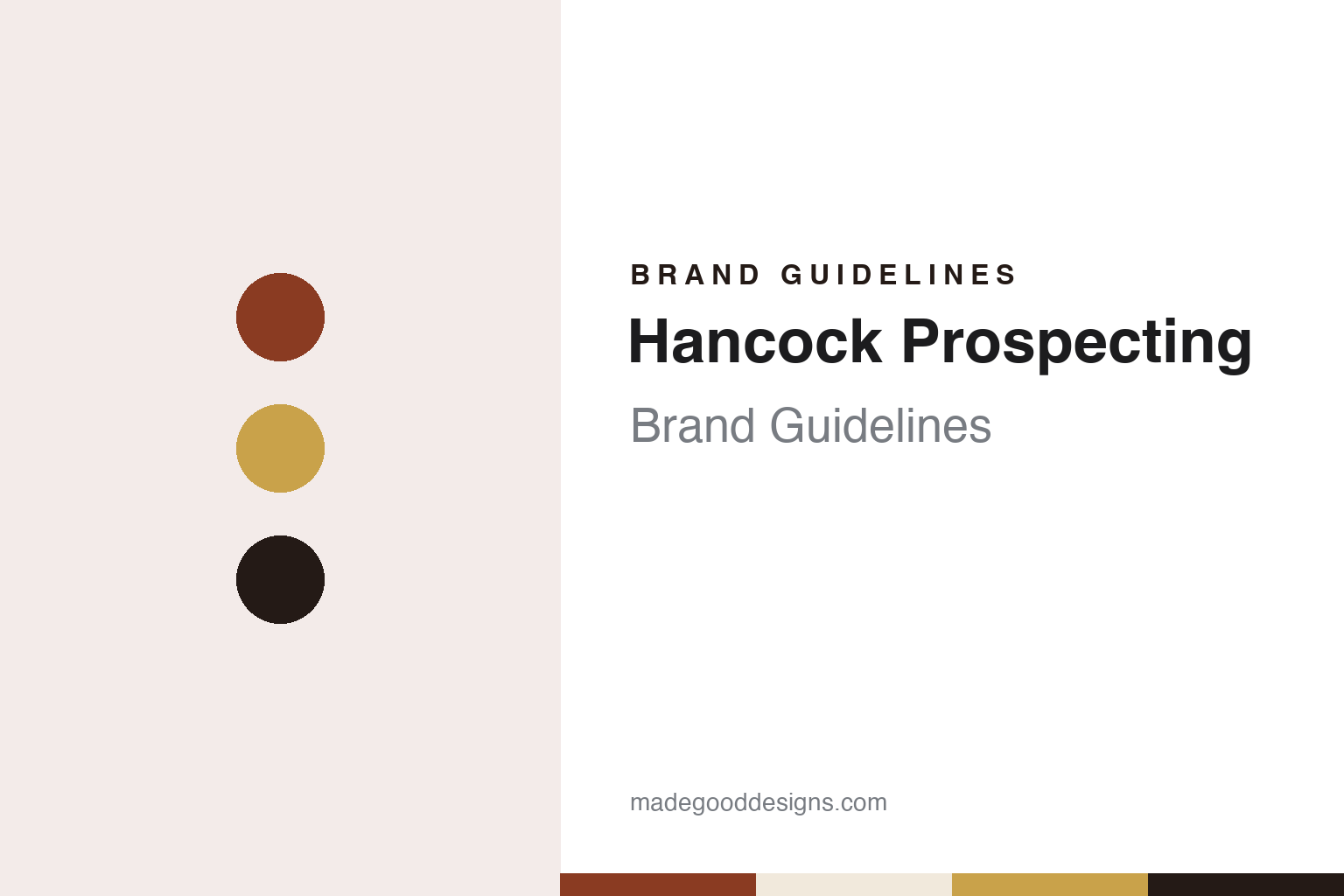
Hancock Prospecting Brand Guidelines
The flying prospector’s company, from Pilbara discovery to Roy Hill.
Aa
Two constants: a red earth, ink and spinifex gold palette and a frontier serif register. Abstract homage — not a Hancock Prospecting product or mark; no logo, mine or product is reproduced.
The flying prospector
A 1955 company built on Pilbara discoveries.
Hancock Prospecting was founded in Western Australia on 25 November 1955 by Lang Hancock and his wife Hope, the company says; English Wikipedia also gives 1955 and names Lang Hancock as the founder. Its history reaches back further, to a partnership formed in the late 1930s between Hancock and a former schoolmate, Peter Wright, called Hanwright; one of the partnership’s early ventures, English Wikipedia says, was an asbestos mine at Wittenoom. Over the decades the business has also traded as Hancock Prospecting Ltd, Hancock Resources Ltd and Hancock & Wright Ltd, according to the same article.
The company’s founding story is about iron ore in the Pilbara. Hancock Prospecting says its founder discovered iron ore there in 1952 during a “flight of discovery,” and then spent years urging governments to lift a state ban on pegging tenements and a federal export embargo. It calls him “the flying prospector,” the first in Western Australia to use light aircraft to explore successfully for minerals. In the 1960s, English Wikipedia says, Hanwright reached an agreement with Rio Tinto that gave it a 2.5% royalty on iron ore sold from its Pilbara discoveries, and the company says ten major iron ore mines, the first in 1966, have been developed from original Hancock discoveries.
Today Hancock Prospecting Pty Ltd is privately owned, by its executive chairman and a family trust, English Wikipedia says. Gina Rinehart has been executive chairman since 1992, the company says, adding that by March of that year few assets were left and most were mortgaged. It now describes itself as a diversified group with interests in iron ore, coal, beef and dairy as well as continuing mineral exploration. English Wikipedia says the wider Hancock group holds iron ore leases covering about 500 square kilometres, mostly in the Central Pilbara, and a manganese project at Nicholas Downs run as a joint venture with the mining services company Mineral Resources.
Colour
Hope Downs, Roy Hill and Atlas.
The company’s first large modern project was Hope Downs. Hancock Prospecting says it secured a State Agreement for the tenements in December 1992, carried out feasibility studies, and in July 2005 formed a 50/50 joint venture with Rio Tinto. Production began at Hope North in late 2007, followed by Hope South a year later and, several years after that, the Hope 4 mine, the company says; English Wikipedia dates first production to November 2007 and Hope Downs 4 to 2013. The complex is named after Hope Hancock, and a 30-kilometre spur joining it to Rio Tinto’s rail network was named the Lang Hancock Railway, English Wikipedia says.
Roy Hill, in the Chichester Range about 115 kilometres north of Newman, is the company’s own integrated operation. Hancock Prospecting says it holds 70% of Roy Hill Holdings, with the rest held through consortia of Marubeni, POSCO and China Steel Corporation. Work began in 2011, and English Wikipedia says the first ore train ran on the new 344-kilometre heavy-haul railway to Port Hedland in December 2015, the month the first shipment left; the railway shared the 2016 Railway Project Award of the Railway Technical Society of Australasia. The company calls Roy Hill “Australia’s single largest iron ore mine,” with its own railway and purpose-built port facilities.
The group grew again in October 2018, when its subsidiary Redstone Resources acquired the listed Pilbara miner Atlas Iron, which left the Australian Securities Exchange that November, English Wikipedia says. In 2025 Roy Hill and Atlas Iron were combined under the name Hancock Iron Ore, headquartered in West Perth, the ABC reported in June 2026. In that report the company said a new life-of-mine plan had extended Roy Hill’s mine life by ten years while reducing mining activity, keeping production from the Roy Hill system above 63 million tonnes a year; it confirmed job cuts but did not say how many.
Typography
Design and documentation.
Iron ore miners sell a raw material that few people ever see, so their public image is built from the places where it comes out of the ground. The standard picture is aerial: a red-earth open pit cut into benches, haul roads spiralling down its walls, trucks reduced to specks. Underground miners show the opposite view — tunnels, drill rigs and lit caverns far below the surface — but the aim is the same, to make scale legible.
The second set of images is about movement. Iron ore is heavy and cheap to dig but costly to carry, so miners photograph the chain that gets it to customers: ore trains kilometres long crossing dry country or snow, pellet plants and stockpiles, and export jetties where bulk carriers load at the end of a long line. Rail and port pages often get as much space as the mines themselves.
Much of what these companies publish is explanation. Websites and reports carry geology and grade explainers, describe ore types such as lump, fines and pellets, and set out reserves and production as the companies report them. Alongside sit pages on rehabilitation of mined land, water use and tailings, and on newer projects to cut emissions in steelmaking.
The last layer is accountability. Miners publish community and Indigenous-partnership reports, accounts of resettlement where mines reach towns, sustainability reports and, for listed or state-owned groups, detailed annual reports. For a designer, the identity of an iron ore company lives as much in these documents, maps and diagrams as in any logo.
Aa
A frontier serif for a prospector’s company. (Specimen set in Source Serif 4, a serif STAND-IN; NOT the Hancock Prospecting logo.)
Hancock Prospecting
Cattle stations alongside the pits.
Beyond iron ore, Hancock Prospecting has built a large pastoral business. In December 2016 it bought a majority stake in the cattle company S. Kidman & Co through a joint venture, the company says; English Wikipedia gives the stake as 67%. Its stations include Mulga Downs, Fossil Downs and Liveringa, and the company says it has extended Kidman into the Rossi Boots, Driza-Bone and Kidman hat and clothing labels. It also lists a majority stake in Bannister Downs Dairy, and English Wikipedia records a holding of nearly 15.7% in Arafura Rare Earths.
The company sets out its relations with Traditional Owners on its website. It says it has agreements with the Kariyarra, Palyku, Nyiyaparli, Ngarla and Nyamal peoples across its current operations, and that in 2022 it launched the Hanrine Futures Indigenous Scholarship Program, with ten students in the first intake. English Wikipedia notes that the Nyiyaparli are the traditional inhabitants of the Roy Hill area.
For a design guide, Hancock Prospecting shows how a private miner’s identity can rest on a founding story: the light aircraft, the discovery flight and the ore that followed. Compare Rio Tinto, its partner at Hope Downs, and Fortescue, another Pilbara iron ore producer. For this guide we use a Pilbara red earth, a spinifex gold and a deep ink with a serif, an unofficial interpretation; no product or logo is reproduced.
Explore & save
Keep Hancock Prospecting’s identity on hand — save it to a board in the Made Good inspiration library.
Hancock Prospecting identity set
Pin the Hancock Prospecting red earth, ink and spinifex gold palette and the frontier serif register to your own board.