Enpara Brand Guidelines
A bank without branches, built inside another bank and then set free.
Aa
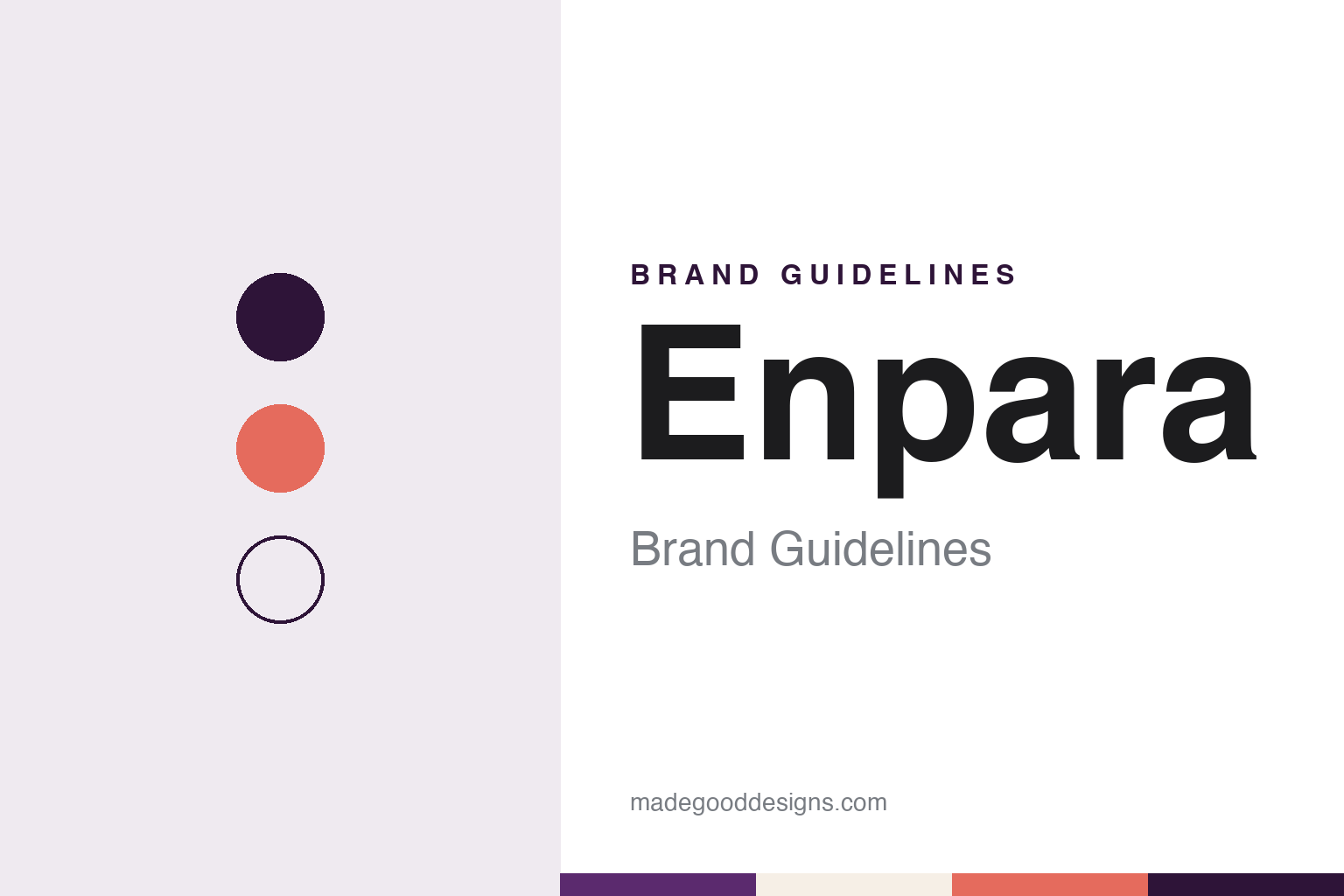
Two constants: a plum, cream and coral palette of our own and a rounded sans register. Abstract homage — not an Enpara product or mark; no logo, card or app screen is reproduced.
A bank inside a bank
Launched by Finansbank in 2012 as a branchless service.
Enpara began in Istanbul in September 2012 as a digital-only service of Finansbank, the bank later renamed QNB Finansbank and then QNB. Turkish Wikipedia, citing several Turkish academic papers on digital banking, describes it as a retail banking service built on the idea that everyday banking could be done entirely through digital channels, without physical branches; its infobox gives the launch date as 14 September 2012 and names Elsa Pekmez Atan and Cumhur Türkmen as founders. Enpara’s own website says it was set up in 2012 to offer digital banking and claims it brought the idea of “digital banking” to Türkiye earlier than many developed countries did.
For its first thirteen years Enpara was not a separate company. Turkish Wikipedia says Enpara.com operated legally as a branch of the bank, serving customers through an internet branch, a mobile branch, a call centre and ATMs. It began with personal customers and, according to the same article, added business customers from October 2016. For most of that time the service was written Enpara.com, the form CNBC-e still used in 2025.
The move to independence was announced in stages. Turkish Wikipedia says that in August 2023 approval was published for the founding of a new bank, Enpara Bank A.Ş., within QNB Group, and that Enpara.com would be transferred to it. Enpara Bank says on its website that it received an operating licence as a deposit bank from Türkiye’s Banking Regulation and Supervision Agency, the BDDK, as of August 2024.
In July 2025 the business channel CNBC-e reported that the transfer of Enpara.com from QNB Bank A.Ş. to Enpara Bank A.Ş. was expected to be completed in the autumn, and that customers’ IBANs would change because the bank code would change, while account numbers stayed the same. Enpara Bank says the transfer took place on 28 August 2025 by partial demerger, a date the fintech news site Fintechtime also reported in November 2026 as August 2025.
Colour
No branches, no fees and a wheel on the home screen.
Enpara’s offer has been built around a short list of promises written into its customer contract. Its website says customers never pay fees for everyday banking transactions, a promise it places in article six of its contract, and that it will never charge an annual credit-card fee, which it places in article one. It also lists commission-free share trading on Borsa İstanbul, personal loans applied for through its internet or mobile branch, savings accounts that it says pay standing rates rather than short introductory rates, and free cash withdrawals and deposits at QNB ATMs.
Newer products extend the range. Encard Genç, which the bank describes as an allowance card, lets a parent create a card for a child aged 10 to 17 from the mobile branch, with a choice of card design. The website also offers motor insurance quotes from several Turkish insurers inside the app. In November 2026 Fintechtime reported that Enpara Bank’s new virtual point-of-sale service for merchants had been connected to Payten’s payment orchestration platform, which an Enpara Bank executive presented as part of its growth in corporate banking.
The brand’s tone is informal. The website talks to customers in the first person plural, uses smiley faces in its copy, and describes a “famous wheel” on the opening screen of its mobile branch, a circular menu into which it placed its “Kalpten transfer” donation feature. That feature began, the bank says, as a “Mama transferi” for buying food for animals in shelters, and was then widened to work with a number of foundations and charities, with all transfers free of charge.
Turkish Wikipedia gives the brand’s slogans as “Bankadan Güzeli,” used from September 2012 to 2025, and “Bankanın Güzeli,” used since 2025.
Recognition has come from the banking press. In August 2026 the Turkish trade site Banka Dünyası reported that Enpara Bank had come top in two categories of Global Finance’s 2026 digital bank awards, the neobank categories for Türkiye and for Western Europe, with entries judged on digital customer growth, product range, mobile app design and user experience. The same report said the bank would go forward to a global round in Singapore in October 2026.
Typography
Turkish banking and its visual language.
Turkish banks tend to present themselves through bold, simple wordmarks and one dominant colour. Across the country’s large lenders the palettes run through greens, reds, blues and purples, and the names keep their Turkish letters — the dotted capital İ, the ş, the ı and the ğ — on logos, apps and branch signs, so a typeface that handles those diacritics cleanly belongs in any design brief for the sector.
Advertising is a large part of how these brands are known at home. Mascots, recurring characters and campaigns led by well-known actors and athletes appear across the sector, alongside photography of branches, city streets and Istanbul itself. On their websites the banks arrange themselves around everyday tasks: accounts, loans, credit cards and loyalty programmes, and mobile apps that sit at the front of most pages.
Sponsorship and culture extend the identity. Turkish banks sponsor football, concerts and festivals, and some run publishers, galleries, museums or art collections under their own names; İşbank’s publishing house and painting collection, and the SALT institution that grew out of Garanti BBVA’s Ottoman Bank archive, are two documented examples covered in this series.
The banks also publish a great deal of formal material. Listed lenders produce annual and integrated reports, sustainability reports and investor presentations in Turkish and English. This series sets out what can be checked about each bank — when and where it was founded, who owns it and how its name has changed — and marks clearly what rests only on a bank’s own word.
Aa
A rounded, friendly sans for a bank that writes in the first person. (Specimen set in Nunito Sans, a sans STAND-IN; NOT the Enpara logo.)
Enpara Bank
A QNB Group bank listed in Istanbul.
Enpara Bank remains part of the Qatari group that started it. Its website describes Enpara Bank A.Ş. as a subsidiary of Qatar National Bank (Q.P.S.C.), QNB Group, and a public disclosure by the bank in October 2025 names Qatar National Bank as its controlling shareholder. Its head office is in Esentepe, in Istanbul’s Şişli district, according to Turkish Wikipedia.
The demerger also made the bank public. Bloomberg HT reported in April 2026 that Enpara Bank had become a publicly held company through QNB Bank’s partial demerger, under a model in which shares were transferred to QNB Bank’s shareholders. It said shares representing 3 per cent of Enpara Bank’s capital had been registered as tradable, and that they would begin trading on 7 April 2026 on Borsa İstanbul’s Pre-Market Trading Platform under the code ENPRA.
The bank reports its scale through its own statements. In March 2026 Anadolu Ajansı reported Enpara Bank’s 2025 results and quoted its general manager, Cumhur Türkmen, as saying that the last quarter of 2025 was the first period in which it had operated as an independent bank after leaving QNB Türkiye, and that it had about nine million customers; the bank said it ranked eighth among private deposit banks in Türkiye at the end of 2025. By August 2026 he was quoted by Banka Dünyası as putting the customer count at more than nine million.
The website states that Enpara Bank intends to stay fully digital and branchless. It also describes sustainability as part of its business model rather than only an environmental commitment.
For a design guide, Enpara shows how a digital service can carry one short name and one informal voice from a web address inside a larger bank to a separately licensed, listed company without changing what customers see on their screens. Compare QNB Türkiye, the bank it grew out of, and QNB, the Qatari group that owns both. For this guide we use plum, cream and a soft coral with a sans, an unofficial interpretation; no product or logo is reproduced.
Explore & save
Keep Enpara’s identity on hand — save it to a board in the Made Good inspiration library.
Enpara identity set
Pin the Enpara plum, cream and coral palette and the rounded sans register to your own board.