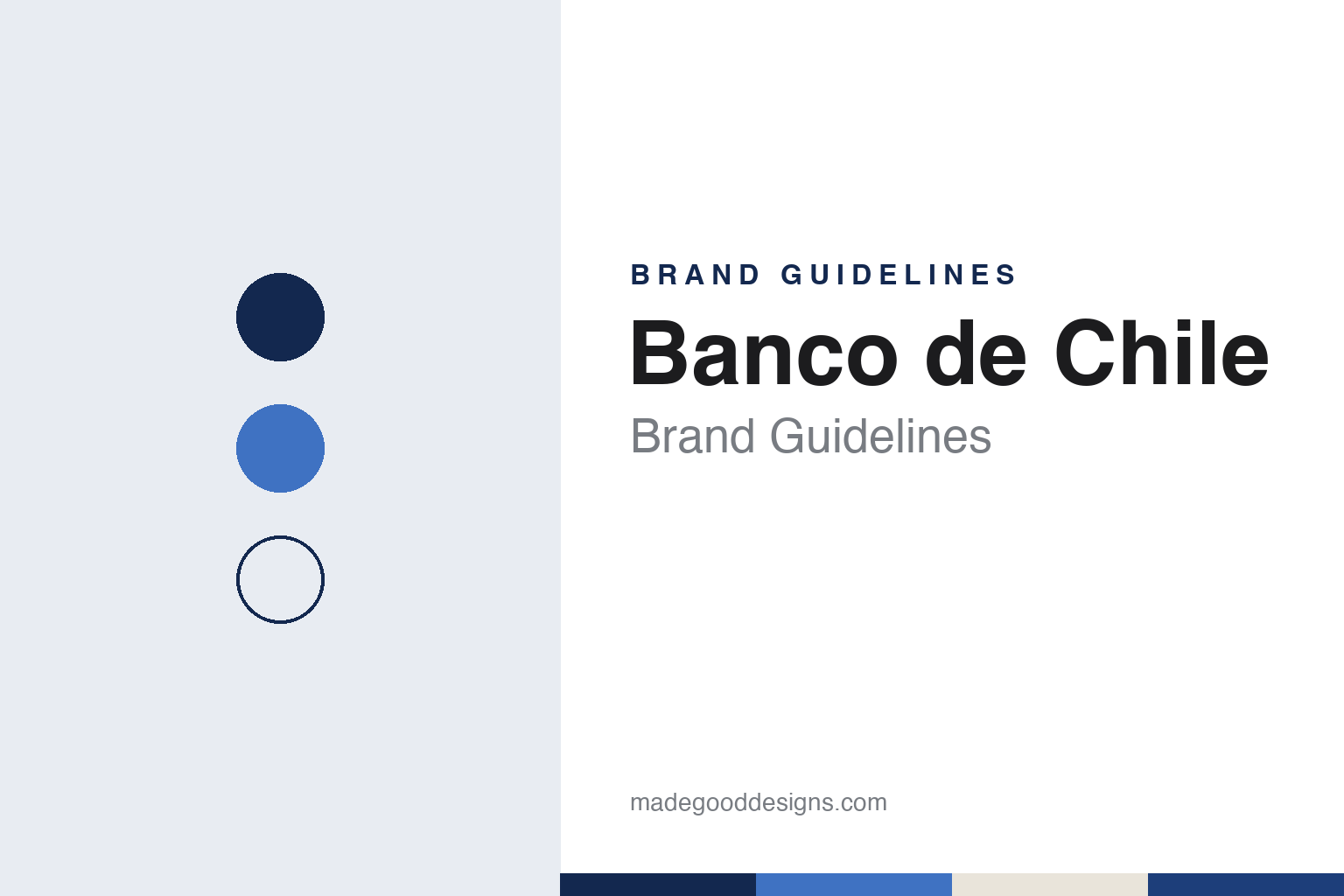
Banco de Chile Brand Guidelines
The Santiago bank formed by an 1893 merger, still under its own name.
Aa
Two constants: a Banco de Chile navy, blue and stone palette and an institutional sans register. Abstract homage — not a Banco de Chile product or mark; no logo, card or sign is reproduced.
Three banks
An 1893 merger and a head office on Paseo Ahumada.
Banco de Chile was formed in Santiago in October 1893 by the merger of three nineteenth-century banks: the Banco de Valparaíso (1855), the Banco Nacional de Chile (1865) and the Banco Agrícola, which English Wikipedia dates to 1869 and Spanish Wikipedia to 1868. Spanish Wikipedia, citing a history of Chilean banking published by the banking supervisor, says the new bank began operating on 2 January 1894, and that the same three banks created the Banco Hipotecario de Chile, a mortgage lender, at the same time.
The bank’s early decades are still visible in its building. Spanish Wikipedia says the head office on Paseo Ahumada in central Santiago was designed in 1921 by the Austrian-born Chilean architect Alberto Siegel, built from 1922 and opened in April 1926: a neoclassical building in the French academic manner, with a circular dome, marble staircases and large public halls. It was declared a national historic monument by a decree of July 2016, and it remains the bank’s headquarters address, according to Quiñenco’s company page.
The twentieth century brought several changes of ownership. Spanish Wikipedia says the state development agency CORFO became the largest shareholder in 1973 and that the bank was returned to private hands in 1975. In December 1978 it was among the first Chilean banks to operate credit cards, through Diners Club, and that year it became the collecting bank for the first Teletón charity appeal, opening its branches to take donations. In 1982 it opened a branch in New York; a United States Treasury filing from 2005 says that branch was licensed by the Office of the Comptroller of the Currency in 1982. In the same year, during the financial crisis of 1982, the authorities intervened in the bank; Spanish Wikipedia says a subordinated debt to the Central Bank of Chile arising from that rescue was paid off by the bank’s parent at the end of April 2019. Ownership passed back to private investors in 1987, when the bank also took over the assets and liabilities of Banco Continental.
Colour
Quiñenco, LQIF and Citigroup.
The modern shape of the bank dates from the early 2000s. Spanish Wikipedia says the Luksic group’s holding company Quiñenco took control in December 2001 after reaching a majority stake, and that a merger with Banco de A. Edwards, also controlled by Quiñenco, was authorised in 2002. Quiñenco says it has invested in the bank since 1999 and holds it through LQ Inversiones Financieras (LQIF), a company set up in 2000 for the group’s financial businesses.
Citigroup came in next. A merger between Banco de Chile and Citibank Chile was agreed in December 2007 and completed on 1 January 2008, Spanish Wikipedia says, citing the banking supervisor, and Quiñenco says Citigroup has been its partner in LQIF since 2008. La Tercera reported in January 2010 that Citigroup had exercised an option over a further 8.52% of LQIF, taking its stake above 41%. Quiñenco says the two have held equal stakes in LQIF since April 2010, and that LQIF held 51.2% of the voting and economic rights of Banco de Chile as of 31 December 2025. Quiñenco also describes a strategic alliance with Citigroup that gives the bank international connections, and Spanish Wikipedia lists Banco Edwards Citi among the bank’s retail brands.
The bank also has a regulatory record in the United States. In October 2005 Banco de Chile consented, without admitting or denying the findings, to a civil money penalty assessed by the Treasury’s Financial Crimes Enforcement Network over Bank Secrecy Act failings at its New York and Miami branches, the FinCEN assessment shows; English Wikipedia adds that the Comptroller of the Currency issued a cease-and-desist order in the same matter.
Other dates show how the bank sells itself to retail customers. Spanish Wikipedia says it created CrediChile in 1993 as a consumer-credit division for middle- and lower-income customers, and announced its closure in the first quarter of 2022, moving its customers to Banco de Chile. In August 2020 it launched Cuenta FAN, a digital account linked to a Visa debit card, and in April 2022 a fully online current account. In November 2025, Spanish Wikipedia adds, it launched Banchile Pagos, a card-acceptance business with its own payment terminal, starting with a pilot among several hundred merchants. Its shares trade on the Santiago exchange and, as American Depositary Shares, on the New York Stock Exchange, Quiñenco says.
Typography
Design and documentation.
Latin American banks tend to present themselves through a few strong signals rather than many small ones. A bold wordmark or a simple symbol, set in one dominant colour, does most of the work: reds, blues, oranges and yellows recur across the region, sometimes chosen to echo a national flag, as English Wikipedia says of Banco do Brasil’s blue and yellow. Some banks go further and commission their own typefaces, as Bradesco did with Bradesco Sans in 2020, according to the Brazilian site B9.
The copy is written in Spanish or Portuguese first, and the photography is local: branches, city streets, customers at work and families at home. Product pages are built around the same practical headings almost everywhere — accounts, cards, credit, insurance and the bank’s own digital apps.
Banks in the region also present a public side that goes beyond banking products. Financial-inclusion programmes, foundations and cultural institutes appear alongside the commercial pages; Fundação Bradesco has worked in education since 1956, and the Centro Cultural Banco do Brasil runs cultural centres in several Brazilian cities. Sport sponsorship, from national teams to motor racing, carries the colours further still.
Many of these banks are listed companies, so annual and integrated reports are part of the identity too, setting out history, ownership and governance in a consistent house style. This guide sets out what can be checked about each bank — when and where it was founded, who owns it and how it presents itself — and treats its palette as our own interpretation rather than an official specification.
Aa
An institutional sans — set in blue since 1991. (Specimen set in Work Sans, a sans STAND-IN; NOT the Banco de Chile logo.)
Banco de Chile
A stylised logotype and one institutional blue.
On identity, the documented facts are few but specific. Spanish Wikipedia says that from 1991 Banco de Chile renewed its corporate image, stylising its logotype and defining blue as its institutional colour. No typeface or exact colour values are given here. Quiñenco names the strength of the brand as one reason for the bank’s position in the Chilean market, alongside its scale, its funding structure, its risk management and its Citigroup alliance.
Its other visual assets are architectural and civic: the 1926 head office on Paseo Ahumada, a national historic monument since 2016, and decades of branches opened for the Teletón appeal. Its subsidiaries trade under the Banchile name, Spanish Wikipedia shows, from Banchile Corredores de Bolsa, the stockbroker, to Banchile Administradora General de Fondos, the fund manager, and Banchile Corredores de Seguros, the insurance broker. Abroad, Spanish Wikipedia records an agency in Miami from 1995, offices in Mexico City, Caracas, Buenos Aires and São Paulo in 1996–1997, and a representative office in Beijing opened in 2006, which Quiñenco still lists.
For a design guide, Banco de Chile shows how a bank formed by merger in 1893 has kept its own name through state ownership, private control and a partnership with a global bank, holding its identity to one institutional blue. Compare Santander and Itaú. For this guide we use a deep navy, a clear mid-blue and a warm stone with a sans, an unofficial interpretation; no product or logo is reproduced.
Explore & save
Keep Banco de Chile’s identity on hand — save it to a board in the Made Good inspiration library.
Banco de Chile identity set
Pin the Banco de Chile navy, blue and stone palette and the institutional sans register to your own board.