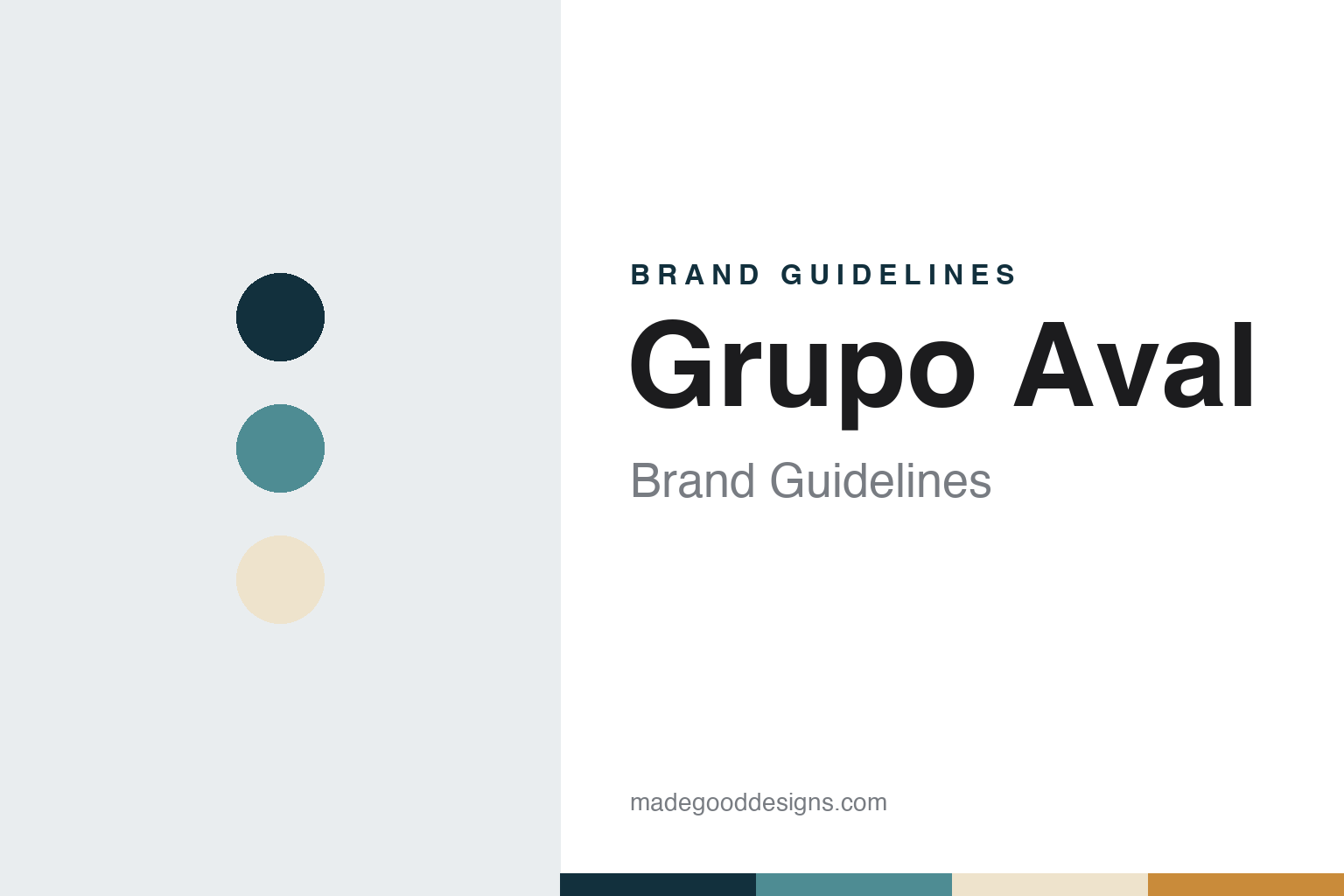
Grupo Aval Brand Guidelines
The Bogotá holding name above four banks that keep their own.
Aa
Two constants: a Grupo Aval blue, teal and sand palette and a holding sans register. Abstract homage — not a Grupo Aval product or mark; no logo, card or sign is reproduced.
A holding name
Administraciones Bancarias, Sociedad A.B., then Aval.
Grupo Aval is the Bogotá holding company through which Luis Carlos Sarmiento Angulo, whom the group names as its founder, controls four Colombian banks. Its legal name is Grupo Aval Acciones y Valores S.A. English Wikipedia gives its founding year as 1994 and says the company was called Administraciones Bancarias S.A. until April 1997, when it became Sociedad A.B. S.A., and that it took its present name in January 1998; Spanish Wikipedia gives the same months with slightly different days. Its current slogan, Spanish Wikipedia says, is “Tú vas adelante, nosotros somos tu aval,” roughly “you go ahead, we are your backing.”
The group’s own timeline starts well before the holding company. Grupo Aval says the organisation entered banking in 1971–1972 by buying Banco de Occidente, and that the savings and housing corporation Las Villas was founded in the same period. In 1991–1992, it says, it acquired and consolidated Banco de Bogotá, founded the severance-fund manager Porvenir, which later added pensions, and bought Banco del Comercio, which was merged into Banco de Bogotá; Spanish Wikipedia dates Banco de Bogotá’s entry into the Sarmiento Angulo organisation to 1987. Between 1997 and 1999 the group bought Banco Popular and the savings corporation Ahorramás, and merged several finance corporations to form Corficolombiana. Ahorramás and Las Villas were merged between 2000 and 2007, the group says.
The oldest of the banks is far older than the group. Banco de Bogotá was founded on 15 November 1870, Spanish Wikipedia says, and Grupo Aval calls it the country’s longest-established financial institution and the largest company in the group by assets; it marked 150 years in 2021. Grupo Aval says it began operating as a holding company in 1998–1999 and made its first share offer on the Colombian stock exchange in that period; English Wikipedia dates the offer to November and December 1999.
Colour
BAC, Multibank and a spin-off.
Growth after 2000 came through acquisitions inside and outside Colombia. Grupo Aval lists the purchases of Megabanco, Banco Aliadas and Banco Unión Colombiano between 2000 and 2007. In 2010–2011 it registered with the United States Securities and Exchange Commission and bought BAC Credomatic, the Central American banking group, from GE Consumer Finance; Spanish Wikipedia, citing Semana, says the purchase was made through Banco de Bogotá’s Panamanian leasing subsidiary. In 2012–2013 the group closed the purchases of BBVA Horizonte, later merged into Porvenir, and of BBVA Panamá and Grupo Reformador in Guatemala, which were folded into BAC. In 2014 it listed preferred shares as American Depositary Receipts on the New York Stock Exchange, a step La República reported in September 2014, according to Spanish Wikipedia. In 2020 it closed the purchase of Multi Financial Group, the Panamanian owner of Multibank, after Panama’s banking superintendency authorised the transfer in March 2020.
The Central American arm was later separated. Grupo Aval says that in 2021–2022 Banco de Bogotá spun off 75% of BAC Holding International to its own shareholders, that Grupo Aval in turn passed the BHI shares it received to its shareholders, and that Banco de Bogotá sold a further 20.89% in a tender offer for BHI shares. In December 2024 the group completed the purchase of most of Aval Fiduciaria, formerly Fiduciaria Corficolombiana, and of a stake in Aval Casa de Bolsa, formerly Casa de Bolsa; Aval Banca de Inversión, an investment bank, was constituted in January 2025, it says.
The group’s record includes a United States case. In August 2023 Grupo Aval and its subsidiary Corficolombiana agreed to settle charges brought by the US Department of Justice and the Securities and Exchange Commission under the Foreign Corrupt Practices Act, connected with the Ruta del Sol II highway contract that Corficolombiana held with its joint-venture partner Odebrecht, the Organized Crime and Corruption Reporting Project reported. Corficolombiana agreed to cooperate with investigators and to strengthen its compliance programme. In October 2026 a US court dismissed the case after Corficolombiana met the terms of its 2023 deferred prosecution agreement, Grupo Aval said, as reported by Ad Hoc News.
Typography
Design and documentation.
Latin American banks tend to present themselves through a few strong signals rather than many small ones. A bold wordmark or a simple symbol, set in one dominant colour, does most of the work: reds, blues, oranges and yellows recur across the region, sometimes chosen to echo a national flag, as English Wikipedia says of Banco do Brasil’s blue and yellow. Some banks go further and commission their own typefaces, as Bradesco did with Bradesco Sans in 2020, according to the Brazilian site B9.
The copy is written in Spanish or Portuguese first, and the photography is local: branches, city streets, customers at work and families at home. Product pages are built around the same practical headings almost everywhere — accounts, cards, credit, insurance and the bank’s own digital apps.
Banks in the region also present a public side that goes beyond banking products. Financial-inclusion programmes, foundations and cultural institutes appear alongside the commercial pages; Fundação Bradesco has worked in education since 1956, and the Centro Cultural Banco do Brasil runs cultural centres in several Brazilian cities. Sport sponsorship, from national teams to motor racing, carries the colours further still.
Many of these banks are listed companies, so annual and integrated reports are part of the identity too, setting out history, ownership and governance in a consistent house style. This guide sets out what can be checked about each bank — when and where it was founded, who owns it and how it presents itself — and treats its palette as our own interpretation rather than an official specification.
Aa
A holding sans — one short name above many banks. (Specimen set in Manrope, a sans STAND-IN; NOT the Grupo Aval logo.)
Grupo Aval
An umbrella name, and the banks beneath it.
Today Grupo Aval describes its businesses in groups: banking through Banco de Bogotá, Banco de Occidente, Banco Popular and Banco AV Villas; pensions and severance funds through Porvenir; investment and the real economy through Corficolombiana, in infrastructure, energy, agribusiness and tourism; and non-bank financial services, including trust and investment services and a digital wallet called dale!. Its shares trade on the Bolsa de Valores de Colombia and the New York Stock Exchange, it says.
In naming terms, each bank keeps its own name and history, from the 1870 Banco de Bogotá onward. The Aval name sits on the holding company, on the shared cash-machine network Red Aval, formerly ATH, which Spanish Wikipedia lists for the group’s banks in Colombia, and, since 2024–2025, on Aval Fiduciaria, Aval Casa de Bolsa and Aval Banca de Inversión. No typeface or exact colour values are given here.
For a design guide, Grupo Aval shows how a holding company can carry a short name above banks that keep their own identities, then extend that name to newer businesses. Compare Bancolombia, another Colombian bank, and Banco de Chile. For this guide we use a deep blue, a muted teal, a warm sand and an amber accent with a sans, an unofficial interpretation; no product or logo is reproduced.
Explore & save
Keep Grupo Aval’s identity on hand — save it to a board in the Made Good inspiration library.
Grupo Aval identity set
Pin the Grupo Aval blue, teal and sand palette and the holding sans register to your own board.