Commercial Bank of Ethiopia Brand Guidelines
A 1942 state bank, split in 1963, that became Ethiopia’s commercial lender.
Aa
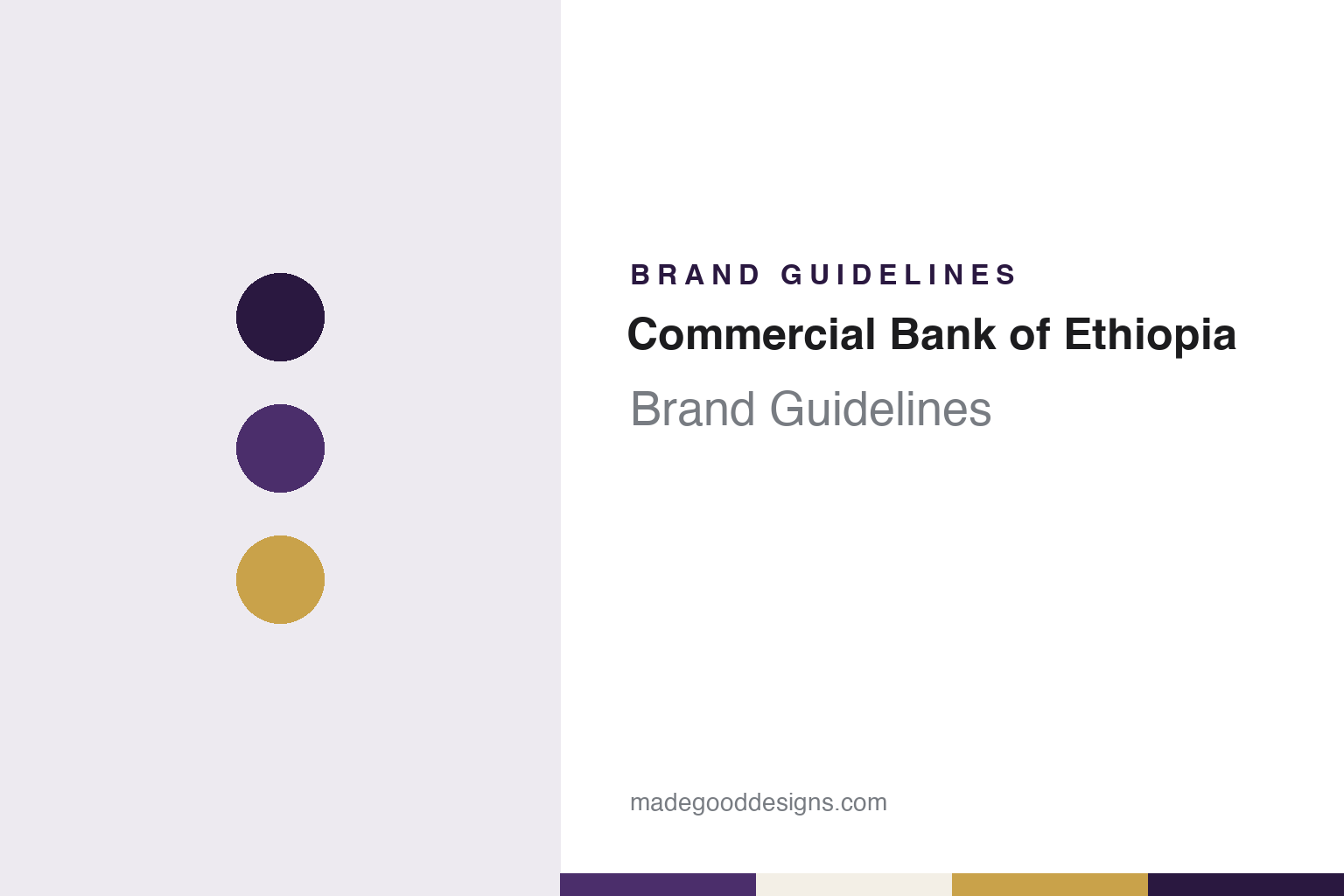
Two constants: a violet, plum and gold palette of our own and a civic sans register. Abstract homage — not a Commercial Bank of Ethiopia asset; no logo, card or banknote is reproduced.
The State Bank
A proclamation in 1942 and a split in 1963.
The Commercial Bank of Ethiopia traces its line to the State Bank of Ethiopia. English Wikipedia says a government proclamation dated 26 August 1942 created that bank, which began full operations on 15 April 1943 with two branches and 43 staff. For two decades it did two jobs at once: it was the country’s central bank, issuing notes and coins as agent of the Ministry of Finance, and it was also the main commercial bank. Wikipedia says the government gave it the sole right to issue currency in 1945, and that its first governor was an American, George Blowers, who introduced the new national currency.
The State Bank also reached beyond Ethiopia. Wikipedia records a branch in Khartoum, Sudan, opened in 1958, and a branch in Djibouti in the 1950s, built up from a transit office. In 1963 the government split the State Bank in two: the National Bank of Ethiopia became the central bank, and the Commercial Bank of Ethiopia took over commercial banking. The BBC, reporting in March 2024, described CBE as established 82 years earlier, which matches the 1942 start of the State Bank rather than the 1963 split.
The Sudanese branch did not stay with the bank for long: Wikipedia says the government of Sudan nationalised the Khartoum branch in 1970, seven years after the split.
Colour
One commercial bank, then many branches.
The 1970s and 1980s reshaped Ethiopian banking around CBE. English Wikipedia says the government formed Addis Bank from the nationalised Addis Ababa Bank, an affiliate founded in 1963 in which National and Grindlays Bank had held 40 per cent, together with the Ethiopian operations of Banco di Roma and Banco di Napoli. In 1980 Addis Bank was merged into CBE, leaving it as the sole commercial bank in the country, with 128 branches and 3,633 employees at that point, Wikipedia says.
Later changes were organisational. Wikipedia records that CBE’s branches in Eritrea were nationalised in 1991 and in 1994 formed the basis of the Commercial Bank of Eritrea, and that the Ethiopian government reorganised and re-established CBE in the same year. The bank closed its Djibouti branch in 2004 and, after approval in January 2009, opened in Juba, in what is now South Sudan; Wikipedia says two branches there remain.
Today the bank is state-owned, as the BBC and the Ethiopian outlet Addis Standard both describe it. The BBC called it Ethiopia’s biggest commercial bank in 2024 and said more than 38 million people held accounts with it; Gulf News in September 2025 called it Ethiopia’s largest bank and put its network at nearly 2,000 branches.
Its digital side has grown fast. In January 2026 Addis Standard, republished by allAfrica, reported the bank as saying that digital channels carried about 88 per cent of its transfers and payments in the first half of the 2025/26 fiscal year. The same report described CBE Noor, the bank’s interest-free banking service, which has its own financing, trade and deposit products on the bank’s website. In September 2025 Gulf News reported a partnership with the Dubai-based app Botim, letting users in the United Arab Emirates send money to CBE accounts, mobile wallets or branches for cash collection.
Typography
How banks in the region present themselves.
Banks in East and West Africa tend to present themselves through short, bold names. Many trade under abbreviations or compact wordmarks, often set in strong single colours such as orange, green, red or blue, and the same mark has to work on a branch fascia, a cash machine, a mobile banking app and a sponsored event banner. Some groups operate in many countries at once, so one identity has to read clearly in English, in French and in local languages.
Language is part of the voice. Many bank websites in the region are written mainly in English, with French in francophone markets, while taglines, product names and campaign lines can borrow from Swahili, Yoruba, Hausa, Amharic or other local languages; Guaranty Trust, for example, named its online entertainment channel NdaniTV after the Swahili word for “inside,” the company says. Photography on bank websites usually leans on branches, city skylines and customers at work rather than abstract imagery.
Bank websites in the region tend to follow a common structure. Pages on current and savings accounts sit beside pages on loans for small and medium-sized businesses, mobile money, short USSD codes for banking from a basic phone, and agent banking through shops and kiosks. Investor sections carry annual reports and sustainability reports, often designed with as much care as the consumer pages.
Sponsorship and community programmes carry much of the brand work. Banks fund fashion and food festivals, arts programmes, school essay competitions, sports tournaments and foundations, and announce them through the national press. For a designer, the useful lesson is how a short name, one strong colour and a consistent tone hold together across branches, apps, reports and events in many markets.
Aa
A civic sans for a state lender. (Specimen set in Libre Franklin, a sans STAND-IN; NOT the Commercial Bank of Ethiopia logo or lettering.)
CBE
One acronym across a national network.
The short form CBE does most of the work in the bank’s identity. It recurs across its product names on the bank’s website, from the interest-free CBE Noor to the CBE Birr service, and in the address of the site itself. The site groups its pages for customers in Ethiopia and for the diaspora, with dedicated diaspora accounts and CBE Noor diaspora accounts, alongside exchange-rate pages and annual reports.
The bank has also faced public scrutiny of its systems. On 16 March 2024, the BBC reported, customers found that they could withdraw or transfer more money than they held, through ATMs and the bank’s app, before CBE froze transactions. The National Bank of Ethiopia said a glitch had occurred during maintenance and inspection work; the bank’s president said CBE had not suffered a cyber-attack and that personal accounts were intact, and several universities asked students to return money that was not theirs.
Its history explains the scale of the name. CBE is the successor to a bank that once issued Ethiopia’s currency; from 1980 it was, for a time, the country’s only commercial bank, according to Wikipedia; and in 2025 and 2026 it was described in the press as a state-owned lender with close to 2,000 branches and a growing share of payments made on phones and online. The same three letters now appear on a branch in Addis Ababa and, through the Botim partnership, inside a money-transfer app used in the United Arab Emirates.
For a design guide, Commercial Bank of Ethiopia shows how a state lender carries one short acronym across branches, interest-free products and digital channels. Compare Ecobank, a pan-African group, and Equity Bank, an East African lender. For this guide we use a deep violet, a dark plum and a warm gold with a sans, an unofficial interpretation; no product or logo is reproduced.
Explore & save
Keep Commercial Bank of Ethiopia’s identity on hand — save it to a board in the Made Good inspiration library.
Commercial Bank of Ethiopia identity set
Keep the violet, plum and gold palette and the civic sans register for your own reference.