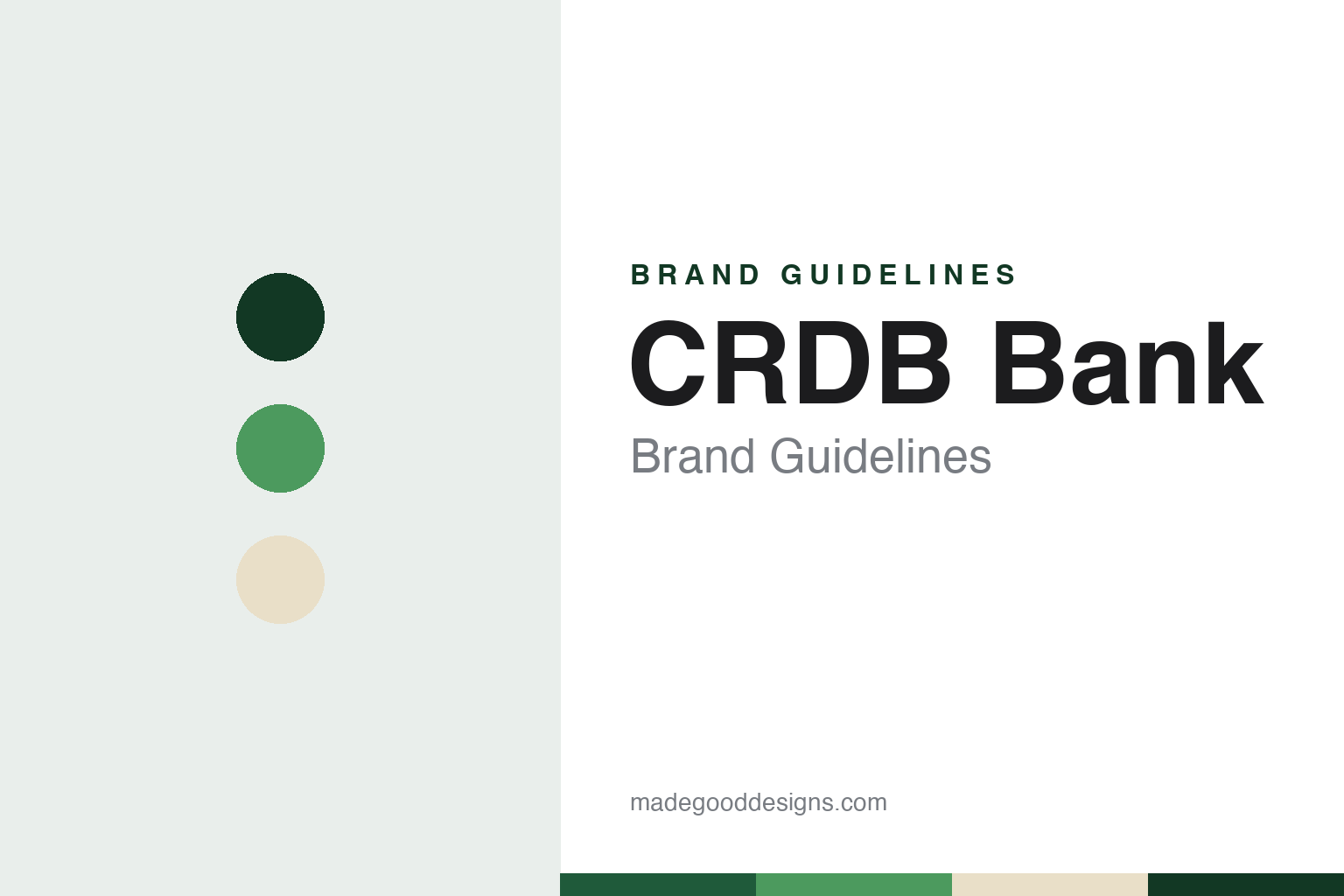
CRDB Bank Brand Guidelines
The co-operative bank that became a listed regional group.
Aa
Two constants: a green and warm sand palette and a rounded geometric sans register. Abstract homage — not a CRDB Bank product or mark; no logo, card or signage is reproduced.
From co-operative bank to listed lender
A rural development bank, privatised in 1996.
CRDB Bank is a Tanzanian commercial bank with its head office in Dar es Salaam, licensed by the Bank of Tanzania. Its initials come from an earlier name. English Wikipedia says it was founded in July 1984 as the Cooperative Rural Development Bank; the International Finance Corporation, in an investment disclosure published in February 2015, gives the former name as the Cooperative and Rural Development Bank. Today the bank still sells Fahari Kilimo accounts, which it describes as designed for individual farmers, co-operatives, farmer associations and farmer groups.
The modern company dates from 1996. As Tanzania privatised state-owned firms, the bank was privatised that year as CRDB (1996) Limited, English Wikipedia says, and the IFC disclosure records that the Danish International Development Agency (DANIDA) took a 30 per cent stake through the Danish Investment Fund. The bank now tells its own story from that point: its group page says it has been “pioneering inclusive growth since 1996,” and when it opened an office in Dubai in January 2026, Khaleej Times described it as “founded 30 years ago.”
Its shares were listed on the Dar es Salaam Stock Exchange on 17 June 2009, according to English Wikipedia, and trade under the symbol CRDB. In its 2015 disclosure the IFC named the Danish fund as the largest shareholder, with 21.5 per cent, and said the bank had operated independently since privatisation, with the fund playing “a supportive but discreet role.” The same document described CRDB as the largest commercial bank in Tanzania by asset size. The IFC’s own equity investment in the bank was signed in June 2015 and made that August, its project page records.
Colour
Burundi, DR Congo and a Dubai office.
CRDB has grown into a group. English Wikipedia lists CRDB Microfinance Services, set up in 2004 to work through savings and credit co-operatives and community banks rather than lend directly; CRDB Bank Burundi, established in December 2012; CRDB Insurance Company, set up in May 2023; and CRDB Bank DR Congo, opened in Lubumbashi in July 2023. Tanzania’s Daily News, reporting the group’s nine-month results in October 2026, described a group operating in Tanzania with subsidiaries in Burundi and the Democratic Republic of Congo, an international presence in Dubai, and the CRDB Insurance and CRDB Bank Foundation businesses. The bank calls itself the first local bank to expand beyond Tanzania’s borders.
The Dubai step came in January 2026, when CRDB opened a representative office at the Dubai International Financial Centre. Khaleej Times reported it as the first time a Tanzanian bank had set up a presence there, and quoted group chief executive Abdulmajid Nsekela: “CRDB Bank was built to finance Tanzania’s growth. As Tanzania became a gateway, the Bank became regional.” The bank’s own news pages also record a memorandum of understanding signed with Japan’s Sumitomo Mitsui Banking Corporation in Yokohama in August 2025.
At home, many product names are in Swahili. The bank’s website lists the Malkia account, designed for women; Junior Jumbo, for children; Biashara, a business account for small and medium-sized enterprises; and Jijenge mortgages. Two accounts are aimed at football supporters: the CRDB Simba Account and the CRDB Yanga Account, for Simba and Yanga fans. Day-to-day banking runs through the SimBanking mobile app, the TemboCard and a network of agents branded CRDB Wakala, who serve customers on the bank’s behalf. The group page counts 242 branches, more than 650 ATMs and 33,000 agents.
Since 2021, according to English Wikipedia, CRDB has run CRDB Al Barakah Banking, a unit offering Shariah-compliant accounts and financing, which added Takaful insurance in 2024. The bank also offers a Tanzanite account for Tanzanians living abroad, and Premier Banking for personal clients.
Typography
How banks in East and West Africa present themselves.
Banks in East and West Africa tend to present themselves through short, bold names. Many trade under abbreviations or compact wordmarks, often set in strong single colours such as orange, green, red or blue, and the same mark has to work on a branch fascia, a cash machine, a mobile banking app and a sponsored event banner. Some groups operate in many countries at once, so one identity has to read clearly in English, in French and in local languages.
Language is part of the voice. Many bank websites in the region are written mainly in English, with French in francophone markets, while taglines, product names and campaign lines can borrow from Swahili, Yoruba, Hausa, Amharic or other local languages; Guaranty Trust, for example, named its online entertainment channel NdaniTV after the Swahili word for “inside,” the company says. Photography on bank websites usually leans on branches, city skylines and customers at work rather than abstract imagery.
Bank websites in the region tend to follow a common structure. Pages on current and savings accounts sit beside pages on loans for small and medium-sized businesses, mobile money, short USSD codes for banking from a basic phone, and agent banking through shops and kiosks. Investor sections carry annual reports and sustainability reports, often designed with as much care as the consumer pages.
Sponsorship and community programmes carry much of the brand work. Banks fund fashion and food festivals, arts programmes, school essay competitions, sports tournaments and foundations, and announce them through the national press. For a designer, the useful lesson is how a short name, one strong colour and a consistent tone hold together across branches, apps, reports and events in many markets.
Aa
A rounded, friendly sans for a bank that names its products in Swahili. (Specimen set in Manrope, a sans STAND-IN; NOT the CRDB Bank logo.)
CRDB Bank
“The bank that listens.”
The bank’s website carries its line in the page title: “The bank that listens.” Its group page sets out a purpose, “Improve livelihoods and deliver sustainable impact,” and four values: Achieve Together, Behave Responsibly, Learning Continuously and Deliver Impact. Several names draw on tembo, the Swahili word for elephant: the TemboCard, the Tembo Points rewards scheme for SimBanking users and the bank’s Tembo News investor bulletin. The website runs in English and Swahili.
Ownership is spread widely. English Wikipedia, citing the bank’s shareholding statement for 30 June 2026, lists the Danida Investment Fund as the largest holder, at 21.0 per cent, followed by Tanzanian and Ugandan pension funds, with more than 100,000 smaller shareholders making up the rest. The group page lists strategic investments in the Co-operative Bank of Tanzania, the Tanzania Mortgage Refinance Company, the Dar es Salaam Stock Exchange and the African Export-Import Bank.
Size is reported by others. English Wikipedia, citing Business Insider Africa, described CRDB as the largest commercial bank in Tanzania as of September 2022, and puts NMB Bank second by assets. In October 2026 the Daily News reported that Global Finance had given CRDB its Tanzania country award for 2026, and that the group employed 4,811 people.
For a design guide, CRDB Bank shows how a name from a co-operative era can carry a listed regional group, with everyday Swahili product names doing much of the brand’s work. Compare NMB Bank, its large Tanzanian peer, and Co-op Bank, Kenya’s co-operative-owned lender. For this guide we use a field green, a leaf green and a warm sand with a sans, an unofficial interpretation; no product or logo is reproduced.
Explore & save
Keep CRDB Bank’s identity on hand — save it to a board in the Made Good inspiration library.
CRDB Bank identity set
Pin the CRDB Bank green and warm sand palette and the rounded geometric sans register to your own board.