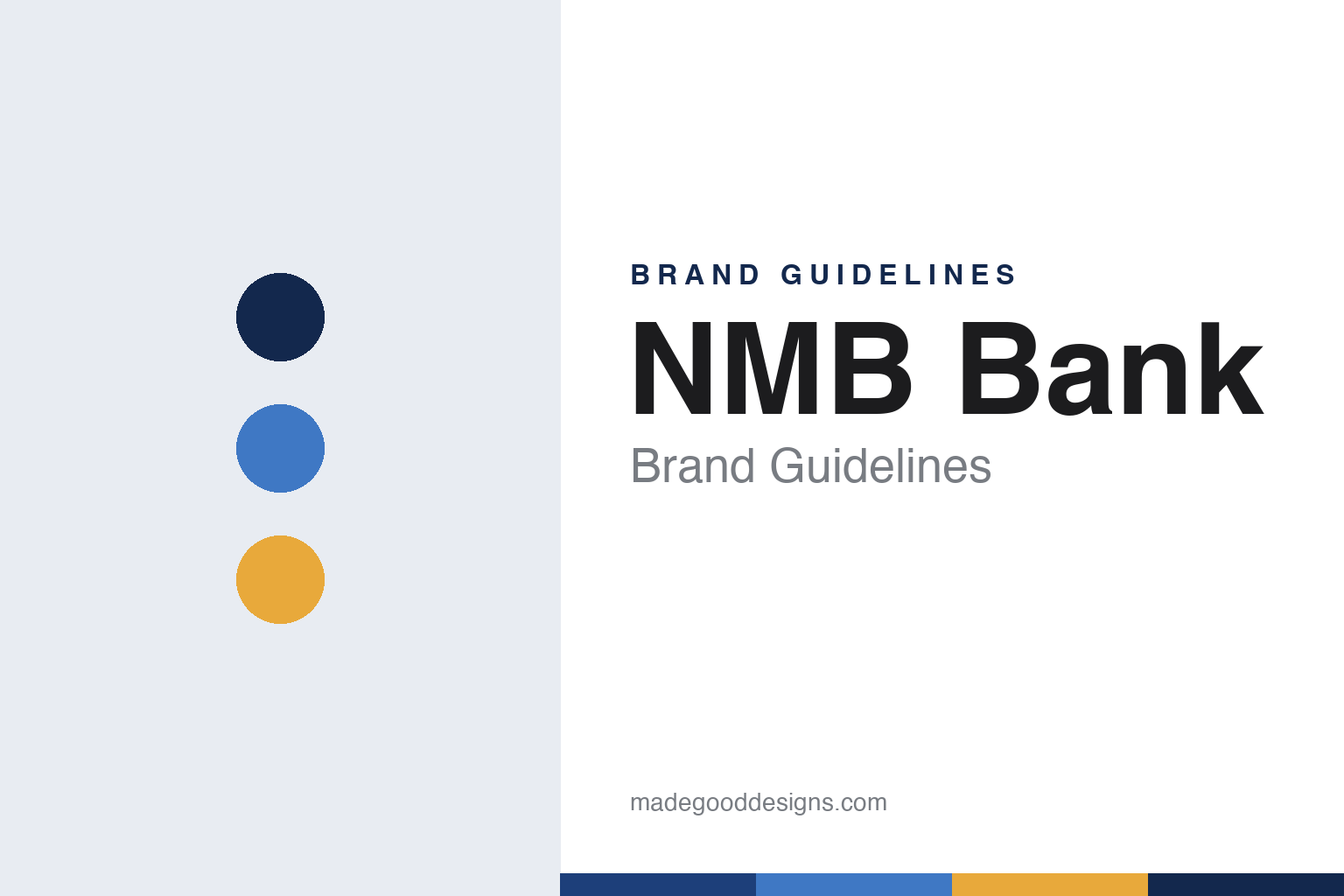
NMB Bank Brand Guidelines
The 1997 microfinance bank that became a national retail lender.
Aa
Two constants: a blue and marigold palette and an open humanist sans register. Abstract homage — not an NMB Bank product or mark; no logo, card or signage is reproduced.
National Microfinance Bank
Born from the 1997 break-up of the National Bank of Commerce.
NMB Bank is a Tanzanian commercial bank, headquartered in Dar es Salaam and licensed by the Bank of Tanzania. Its initials stand for National Microfinance Bank. The bank says it was established under the National Microfinance Bank Limited Incorporation Act of 1997, following the break-up of the old National Bank of Commerce by an Act of Parliament. Three entities came out of that split, according to the bank: NBC Holdings Limited, National Bank of Commerce (1997) Limited and National Microfinance Bank Limited.
The new bank started narrowly. At first, its history page says, it could only provide payment services and savings accounts, with limited lending, before it became a full universal retail bank. When the Dutch newspaper AD reported Rabobank’s investment in August 2005, it described NMB in similar terms: mainly an infrastructure for payments, with savings products on a limited scale and lending at an early stage. AD put its network then at more than 100 branches, with about 1,400 staff.
That 2005 deal was the privatisation. NMB says the government sold 49 per cent of its shareholding that year to a consortium led by Rabobank, the Dutch co-operative bank. AD, reporting Rabobank’s announcement of 25 August 2005, said Rabobank itself was taking 25 per cent and, together with three Tanzanian partners, controlled a 49 per cent stake; the agreement also committed Rabobank to technical assistance in developing the bank. A second step followed in 2008, when the government sold another 21 per cent to the Tanzanian public in an initial public offering. The shares are listed on the Dar es Salaam Stock Exchange under the ticker NMB.
Colour
Branches, agents and a London bond.
The shareholder list has changed since then. The bank’s investor pages now name among its top shareholders Arise B.V., which they describe as an investment company owned by Norfund, Norfinance, FMO and Rabo Partnerships, alongside the Government of Tanzania through the Treasury Registrar and a broad base of domestic and international institutional and retail investors.
Reach has been a constant theme in coverage of the bank. In a November 2015 interview with World Finance, its then managing director, Ineke Bussemaker, said NMB had 173 branches and was the only bank present in 98 per cent of government districts, and described the growth of its banking agents after the Bank of Tanzania published agency-banking guidelines in 2012. English Wikipedia, citing The Citizen, counted 230 branches across mainland Tanzania and Zanzibar in September 2023. In August 2026 Zawya reported that NMB served more than 10 million customers through 248 branches and an agency network, and called it Tanzania’s largest commercial bank by customer numbers. English Wikipedia places it second among Tanzanian commercial banks by assets, behind CRDB Bank, as of 2023.
The bank has also tried new formats. In 2020 it put ATMs at Tanzania’s three main international airports, in Dar es Salaam, Zanzibar and Kilimanjaro, that pay out US dollars, euros and pounds, ATM Marketplace reported. In August 2026 NMB raised funds through a Tanzanian-shilling bond listed on the London Stock Exchange and issued by the International Finance Corporation. Zawya called it the first such transaction in East Africa and said the money would support lending to small businesses, women-led businesses, farmers and entrepreneurs.
Typography
How banks in East and West Africa present themselves.
Banks in East and West Africa tend to present themselves through short, bold names. Many trade under abbreviations or compact wordmarks, often set in strong single colours such as orange, green, red or blue, and the same mark has to work on a branch fascia, a cash machine, a mobile banking app and a sponsored event banner. Some groups operate in many countries at once, so one identity has to read clearly in English, in French and in local languages.
Language is part of the voice. Many bank websites in the region are written mainly in English, with French in francophone markets, while taglines, product names and campaign lines can borrow from Swahili, Yoruba, Hausa, Amharic or other local languages; Guaranty Trust, for example, named its online entertainment channel NdaniTV after the Swahili word for “inside,” the company says. Photography on bank websites usually leans on branches, city skylines and customers at work rather than abstract imagery.
Bank websites in the region tend to follow a common structure. Pages on current and savings accounts sit beside pages on loans for small and medium-sized businesses, mobile money, short USSD codes for banking from a basic phone, and agent banking through shops and kiosks. Investor sections carry annual reports and sustainability reports, often designed with as much care as the consumer pages.
Sponsorship and community programmes carry much of the brand work. Banks fund fashion and food festivals, arts programmes, school essay competitions, sports tournaments and foundations, and announce them through the national press. For a designer, the useful lesson is how a short name, one strong colour and a consistent tone hold together across branches, apps, reports and events in many markets.
Aa
An open, legible sans for a bank that leans on branches, agents and mobile banking. (Specimen set in Plus Jakarta Sans, a sans STAND-IN; NOT the NMB Bank logo.)
NMB Bank
Swahili product names and seasonal savings drives.
Like its Tanzanian peers, NMB gives much of its range Swahili names. Its website lists NMB Mkononi for mobile banking, NMB Wakala for agents, Lipa Mkononi for payments and the Mshiko Fasta quick loan. Accounts include NMB Mtoto for children, NMB Kikundi for groups and the Jiwekee fixed account; for agriculture it offers a Kilimo account, outgrower loan schemes and warehouse receipt financing.
Its marketing runs through seasonal campaigns. In November 2026, The Citizen reported the launch of a three-month savings promotion, “Bonge la Mpango – Weka Ushinde 2026,” running from 1 November 2026 to 31 January 2027, which the bank’s chief of retail banking presented as a way to encourage a savings culture. Bank staff at the launch pointed customers to loans that can be taken without visiting a branch.
The bank describes itself plainly. Its history page calls NMB “one of the largest commercial banks in Tanzania,” serving individuals, small and medium-sized businesses, government services, large businesses and agricultural lending. Its managing director, Ruth Zaipuna, was quoted by Zawya on the London bond, saying shilling financing lets businesses grow without exposure to foreign exchange risk.
The name needs care. NMB Bank is also the name of an unrelated commercial bank in Nepal, and NMB is a bearing brand of Japan’s MinebeaMitsumi; this guide covers only the Tanzanian bank.
For a design guide, NMB Bank shows how a state savings bank can grow into a listed retail lender whose brand rests on reach: branches, agents and mobile banking. Compare CRDB Bank, its larger Tanzanian peer by assets, and Equity Bank, another East African lender built on wide access. For this guide we use a harbour blue, a lake blue and a marigold with a sans, an unofficial interpretation; no product or logo is reproduced.
Explore & save
Keep NMB Bank’s identity on hand — save it to a board in the Made Good inspiration library.
NMB Bank identity set
Pin the NMB Bank blue and marigold palette and the open humanist sans register to your own board.