Inter&Co Brand Guidelines
A Belo Horizonte lender that rebuilt itself as a digital bank.
Aa
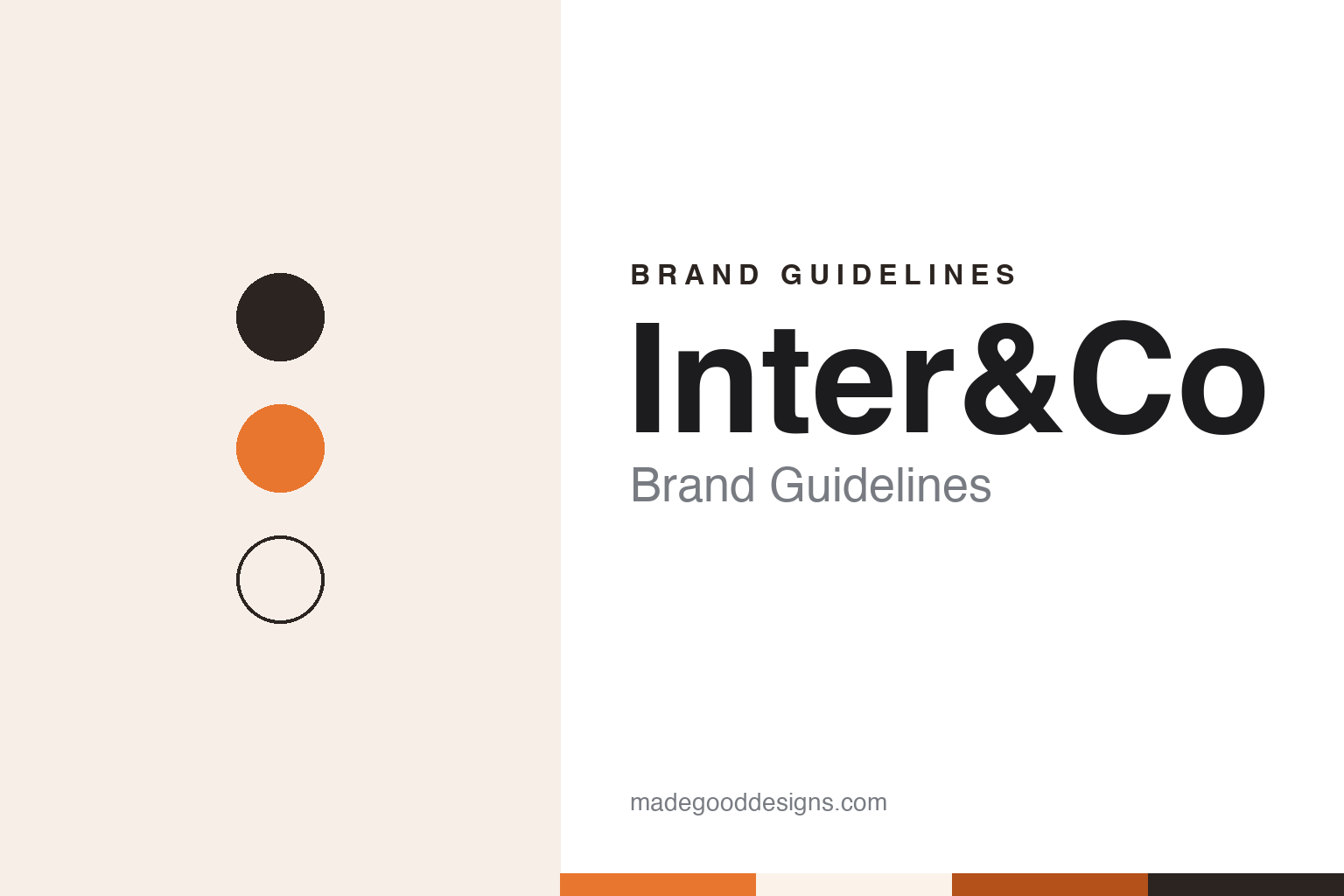
Two constants: an orange, clay and espresso palette and a geometric sans register. Abstract homage — not an Inter&Co asset; no logo, card or app screen is reproduced.
Intermedium
A credit company from Minas Gerais.
Inter began in 1994 in Belo Horizonte, the capital of the Brazilian state of Minas Gerais, as a finance company called Intermedium. Portuguese Wikipedia says it was founded by members of the Menin family, the owners of the homebuilder MRV Engenharia; English Wikipedia names Rubens Menin as co-founder and gives the date as 26 January 1994. CNN Brasil, itself controlled by Rubens Menin, described him in June 2022 as the founder and chairman of MRV and the controlling shareholder of Inter.
The early business had nothing to do with apps. Portuguese Wikipedia says the company was set up to fund property lending but grew mainly in payroll-deducted loans and lending to mid-sized companies. The company’s own history, on its investor-relations site, lists the steps: lending to businesses from 1999, payroll-deducted credit from 2001 and property credit from 2007. In 2008 it received a licence from the Central Bank of Brazil to operate as a multiple bank, which both the company and Portuguese Wikipedia treat as a turning point.
Through the following years the group added financial businesses one at a time. The company says it created Inter Seguros in 2012 and a securities distributor, Inter DTVM, in 2013, authorised by the Central Bank and registered with Brazil’s securities regulator. For two decades, its own history says, Intermedium remained a regional institution.
Colour
A free digital account and a new name.
The change came with a current account opened and run from a phone. Portuguese Wikipedia dates the launch of Inter’s fee-free digital account to the end of 2014; the company dates it to 2015 and calls it the first fully digital current account in Brazil with no fees, a claim made by the company itself. It says it had 80,000 digital customers by 2016, when it also added foreign exchange and a combined debit and credit card on the Mastercard network.
The name followed. On 9 June 2017 Banco Intermedium became Banco Inter, InfoMoney reported that day, 23 years after the original brand was created. The company said the old Latin-derived name no longer suited the bank and was hard to write, pronounce and use in marketing. It kept the first syllable so that the change would not jar, and its president said customers had already been calling it Banco Inter as a nickname. The new mark appeared on the shirts of São Paulo FC, which the bank sponsored, from 11 June 2017, InfoMoney reported.
In 2018 the bank listed its shares on the B3 exchange in São Paulo; the company calls it the first digital bank to go public there. In 2019 it opened an investment platform for individuals and began building what it calls a super app, adding an in-app shopping marketplace, Inter Shop, with cashback offers. In 2020, Portuguese Wikipedia says, it repositioned the brand, dropping the word “Banco” to become simply Inter, a single app combining financial and non-financial services.
Acquisitions widened the range. In 2021, the company says, it bought 60 percent of Meu Acerto, 45 percent of Granito, later renamed Inter Pag, and the American remittance fintech Usend, its first step into the United States. The company completed its acquisition of Granito in July 2024.
Typography
Design and documentation.
Latin American banks tend to present themselves through a few strong signals rather than many small ones. A bold wordmark or a simple symbol, set in one dominant colour, does most of the work: reds, blues, oranges and yellows recur across the region, sometimes chosen to echo a national flag, as English Wikipedia says of Banco do Brasil’s blue and yellow. Some banks go further and commission their own typefaces, as Bradesco did with Bradesco Sans in 2020, according to the Brazilian site B9.
The copy is written in Spanish or Portuguese first, and the photography is local: branches, city streets, customers at work and families at home. Product pages are built around the same practical headings almost everywhere — accounts, cards, credit, insurance and the bank’s own digital apps.
Banks in the region also present a public side that goes beyond banking products. Financial-inclusion programmes, foundations and cultural institutes appear alongside the commercial pages; Fundação Bradesco has worked in education since 1956, and the Centro Cultural Banco do Brasil runs cultural centres in several Brazilian cities. Sport sponsorship, from national teams to motor racing, carries the colours further still.
Many of these banks are listed companies, so annual and integrated reports are part of the identity too, setting out history, ownership and governance in a consistent house style. This guide sets out what can be checked about each bank — when and where it was founded, who owns it and how it presents itself — and treats its palette as our own interpretation rather than an official specification.
Aa
A geometric sans for a bank that dropped the word “Banco.” (Specimen set in Sora, a sans STAND-IN; NOT the Inter&Co logo.)
Inter&Co
Times Square in orange.
The holding company name, Inter&Co, arrived with a move to New York. On 23 June 2022 Inter began trading on the Nasdaq, CNN Brasil reported; the shares and units that had traded on the B3 since 2018 were migrated to Inter&Co on the American exchange under the ticker INTR. At the debut, the same report says, Times Square turned orange as screens showed the Inter logo, a dated record of the brand’s orange. Inter then had more than 20 million customers, the report added.
The United States became a second market. In 2022, the company says, it launched a Global Account for dollar remittances; in February 2023 it acquired YellowFi, and in May 2023 its broker Inter Securities obtained a licence from the Financial Industry Regulatory Authority. English Wikipedia says Inter&Co set up its American head office in Miami in 2023. The group’s main base remains Belo Horizonte.
Sport carried the name further. In September 2023 Inter&Co became the official financial institution of Orlando City SC and the Orlando Pride, and on 18 January 2024 the clubs announced a long-term agreement to name their stadium Inter&Co Stadium. In that announcement the club described Inter&Co as the first financial institution with Latin American roots to own the naming rights of a major stadium in the United States. English Wikipedia says that in July 2026 the venue was renamed Inter.co Stadium, the name now shown on the club’s website.
The scale today is the company’s own account: it says it passed 43 million customers in 2025. The founding family remains in charge; CNN Brasil named Rubens Menin as the controlling shareholder in 2022.
For a design guide, Inter&Co shows how a regional lender can reinvent itself through a name change, a single colour and a phone app. Compare Nubank, another Brazilian digital bank, and Itaú, one of Brazil’s large private banks. For this guide we use a signal orange, a clay orange and espresso with a sans, an unofficial interpretation; no product or logo is reproduced.
Explore & save
Keep Inter&Co’s identity on hand — save it to a board in the Made Good inspiration library.
Inter&Co identity set
Pin the Inter&Co orange, clay and espresso palette and the geometric sans register to your own board.