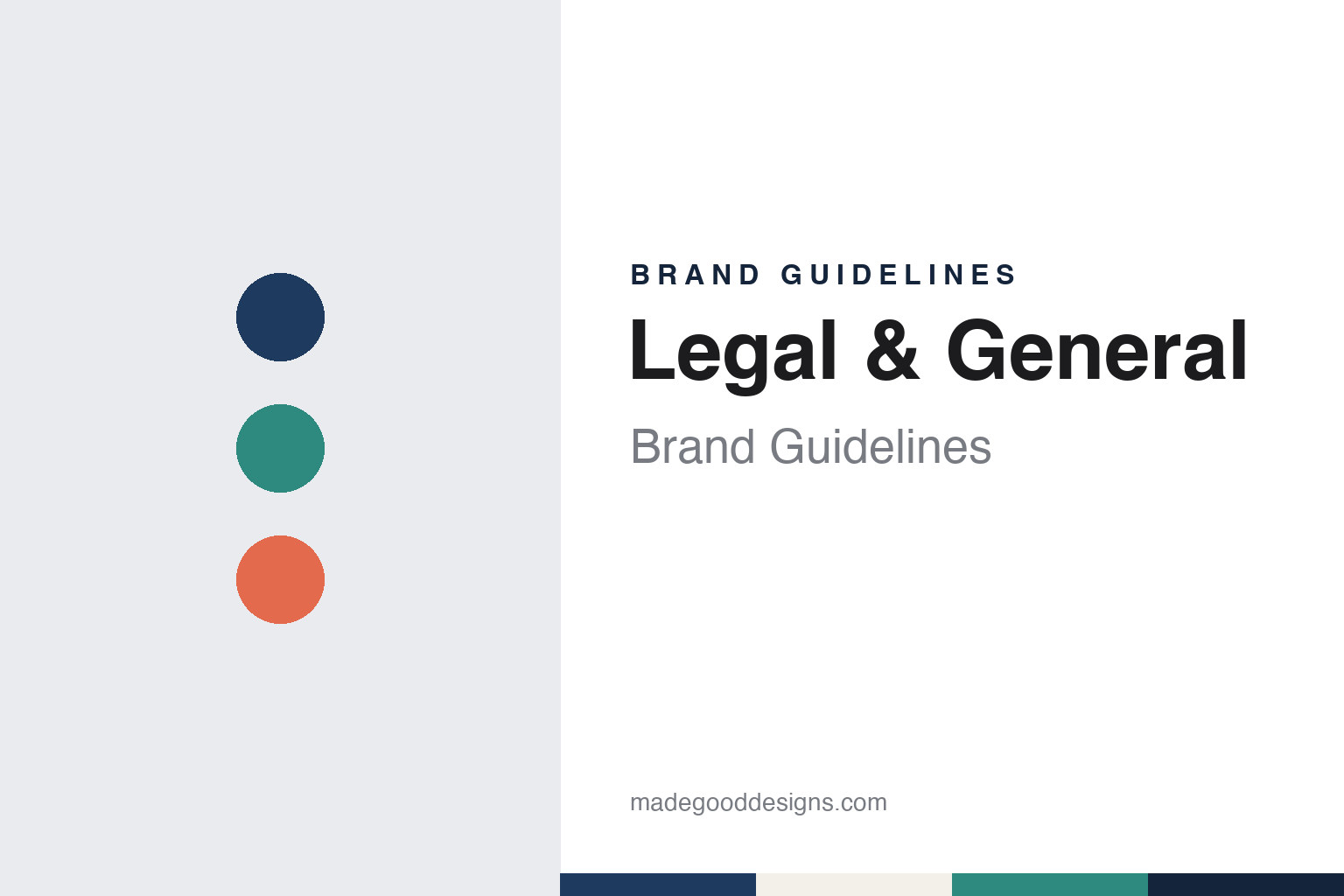
Legal & General Brand Guidelines
Six lawyers in 1836, a Temple Bar emblem, then an umbrella.
Aa
Two constants: a navy, teal and coral palette and a friendly geometric sans register. Abstract homage — not a Legal & General asset or mark; no logo or umbrella symbol is reproduced.
New Law Life
Six lawyers and a coffee shop off Chancery Lane.
Legal & General began in June 1836, when six lawyers founded a life assurance society in London. English Wikipedia names John Adams and five other lawyers and places the first meeting in a coffee shop on Chancery Lane, the street at the heart of legal London. The society’s first name was the New Law Life Assurance Society, and at the start it was open only to members of the legal profession.
The name changed to the Legal & General Life Assurance Society to show that policies were open to the general public, while share ownership stayed with lawyers, English Wikipedia says. The company’s own history adds that its first investments went into Britain’s early railways and into property, and it presents that long-term investing habit as a thread running through the business ever since.
The firm reached abroad early. The company says it first entered the American market in the 1940s by buying the pensions business of the Metropolitan Life Insurance Company of New York; English Wikipedia dates that purchase to the 1930s, so the two accounts differ. In the 1940s the main office moved from Temple Bar House in the City of London to a remodelled former school at Kingswood in Surrey, which stayed a major site until it closed in 2018, English Wikipedia says.
In the 1970s, the company says, it listed on the London Stock Exchange and set up Legal & General Investments, the forerunner of today’s asset management arm. The society itself became a wholly owned part of Legal & General Group plc in that decade, according to English Wikipedia.
Colour
From Temple Bar to an open umbrella.
The visual story of Legal & General runs from architecture to a household object. English Wikipedia says the earlier logo carried an image of Temple Bar, the old gateway between the City of London and Westminster, together with the founding date, and that this emblem lives on in the logo of the staff social and athletic committee.
The umbrella replaced it, but its start date depends on the source. The company’s history says its umbrella logo was launched in the 1970s as the star of its very first television advert. English Wikipedia says the umbrella logo used today was introduced in June 1984 by the company’s then chief press officer. Either way, the umbrella has been the group’s main symbol for decades, and it is the mark most people meet on policy letters, pension statements and advertising.
Television has played a large part. Between 1991 and 1994 Legal & General sponsored the regional weather forecasts on the ITV network, English Wikipedia says, an obvious fit for a brand built around an umbrella. Today the company mostly calls itself L&G on its own site, keeping the full name for the listed parent, Legal & General Group Plc.
The business behind the mark changed shape in the 1980s. English Wikipedia records the creation of Legal & General America in 1981 and the purchase of GELICO, renamed Banner, while the company says it grew its US life business, bought a Dutch life insurer and became a founding member of the FTSE 100 index. In 1995 it launched its Mortgage Club, and in 2006 it opened Legal & General Investment Management America.
Typography
How European insurers present themselves.
European insurers sell something that cannot be seen or held, so their identities do a great deal of the work. Many rely on a short wordmark or a simple symbol, often drawn in a single strong colour such as orange, blue, red or green, and repeated on offices, apps, letters and roadside-assistance vans. Several of these marks have been redrawn in recent years with softer shapes, lowercase letters or brighter tones meant to read well on small screens.
The language tends to be plain. Product pages for home, car, life and pension cover usually lead with short sentences about what is included, what a customer can expect when making a claim and how to get in touch, and campaign lines often speak directly to the reader. Photography leans towards customers, families, homes and everyday moments rather than abstract imagery, and many groups add illustration systems and short animations to explain how a policy or pension works.
Sponsorship is another common thread. Insurers attach their names to running events, football teams, sailing races, stadiums, music festivals and museums, which puts the colour and symbol in front of large audiences far from any policy document. Some also run foundations or corporate art collections that hold exhibitions under the group name.
The paperwork matters too. Listed insurers publish annual reports, sustainability reports and investor presentations that follow the same typography and colour rules as their marketing, and these documents are often the clearest public record of how a brand is applied in long-form layouts, charts and tables. For a designer, the useful lessons sit in that consistency: one mark, a short palette and a calm, readable voice used across many countries and channels.
Aa
A friendly geometric sans for a brand known by an umbrella. (Specimen set in Manrope, a sans STAND-IN; NOT the Legal & General logo or typeface.)
L&G today
Pensions, annuities and a sharper focus.
The modern group has narrowed what it does. In 2003 it sold Legal & General Bank to Northern Rock, English Wikipedia says, and its general insurance business, mainly home cover, went to Allianz; Business Insurance reported on 3 January 2020 that Allianz had completed the purchase. Since then the group has focused on pensions, annuities, life cover and investment.
Workplace pensions are a large part of that. The company says it introduced the L&G Mastertrust in 2013 as one of the first UK master trusts, after auto-enrolment began in 2012. In 2018 it launched Legal & General Affordable Homes, and in 2021 it combined its life, annuity and workplace businesses into a single Retail division. Pension risk transfer, where the company takes on the pensions owed by an employer’s scheme, has become a headline activity: L&G describes its 2023 buy-in with the Boots Pension Scheme as the largest such deal by premium in UK history. In 2024 it merged its investment management and alternative assets arms into one Asset Management business, English Wikipedia says.
L&G calls its most recent big move the biggest deal in its history. In February 2025 L&G agreed to sell its US insurance business, covering US protection and pension risk transfer through Banner Life, to the Japanese mutual insurer Meiji Yasuda. A company announcement on 2 February 2026 confirmed that the sale had completed and said Meiji Yasuda would take a 5 per cent economic interest in L&G as part of a long-term partnership.
For a design guide, Legal & General shows how a single, simple object can carry a financial brand for decades, with a heritage emblem kept alive in a staff logo. Compare the Norwich Union story in our Aviva brand guidelines and the mutual model in our Royal London brand guidelines. For this guide we use canopy navy, harbour teal and warm coral with a friendly geometric sans, an unofficial interpretation; no product or logo is reproduced.
Explore & save
Keep Legal & General’s identity on hand — save it to a board in the Made Good inspiration library.
Legal & General identity set
Pin the Legal & General navy, teal and coral palette and the friendly geometric sans register to your own board.