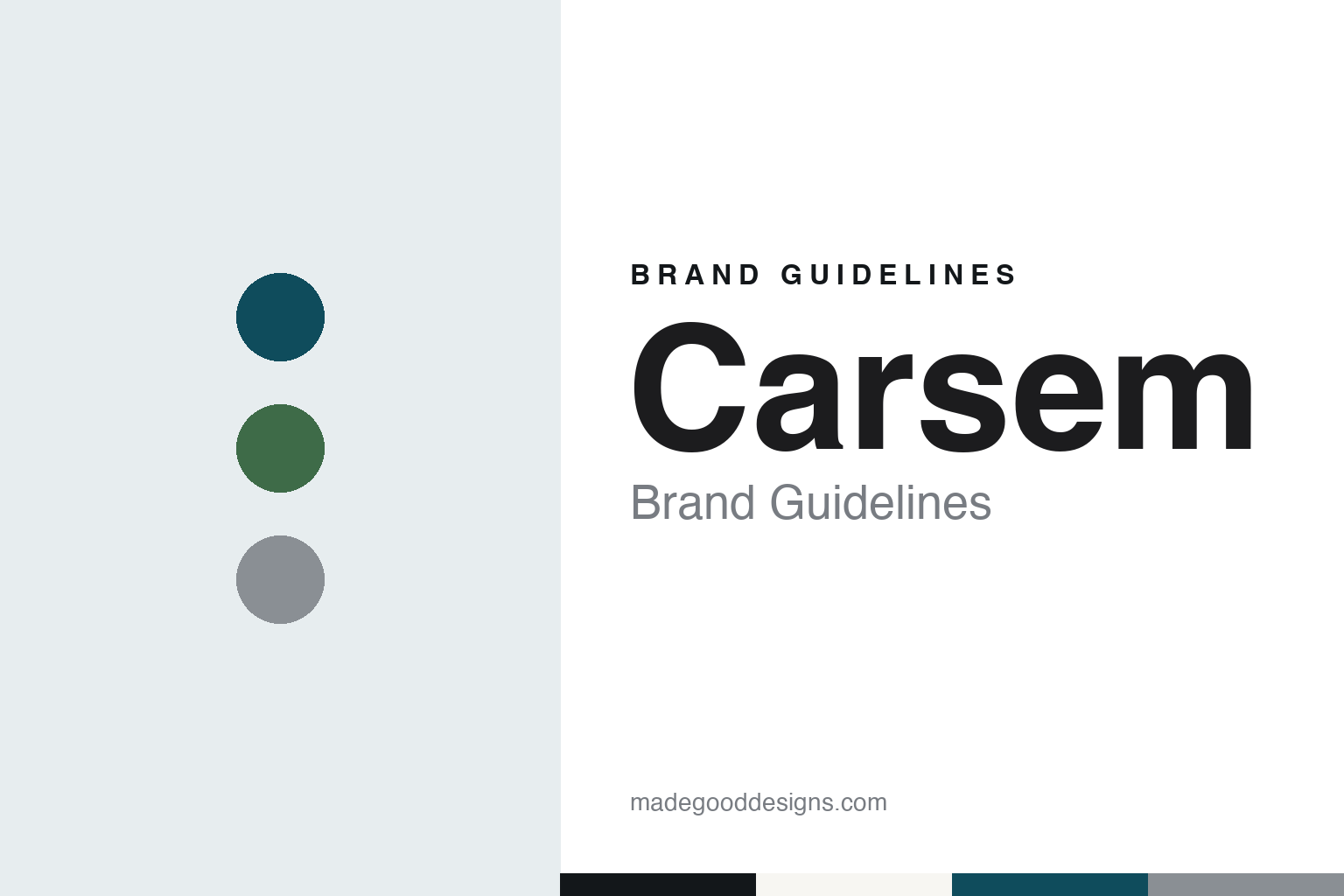
Carsem Brand Guidelines
An Ipoh chip packager since 1972, under Hong Leong since 1984.
Aa
Two constants: a teal, green and tin-grey palette and a sturdy serif register. Abstract homage — not a Carsem product or mark; no package, logo or nameplate is reproduced.
Ipoh, 1972
A factory, a conglomerate and a renamed paper company.
Carsem dates itself to 1972. The company says its first factory, the M-Site in Ipoh, Perak, was founded that year and was acquired by the Hong Leong Group in June 1984. The group managing director’s letter on its website opens with the same date, saying that the parent company’s journey began in 1972. Carsem describes Hong Leong, founded in 1963, as one of Malaysia’s largest conglomerates, with interests in financial services, manufacturing, distribution and property.
The listed parent has a longer and quite different history. Malaysian Pacific Industries (MPI) says it was incorporated on 5 October 1962 as Federal Paper Products Limited, became a public company in 1969, took the name Malaysian Pacific Industries on 25 May 1983 and joined the Kuala Lumpur Stock Exchange on 29 September 1983. Its subsidiaries, it says, make, assemble, test and sell integrated circuits, semiconductor devices, electronic components and leadframes; MPI names Carsem and Dynacraft as its businesses.
The ownership chain is set out by the companies themselves. MPI’s group structure, as at 30 June 2021, showed a 70% interest in Carsem (M) Sdn Bhd, the Malaysian operating company, and full ownership of Carsem Semiconductor (Suzhou); the same table listed a second Chinese company, Carsem Advanced Technology (Suzhou), as pre-operating. Carsem says its Ipoh factories are about 90 minutes’ drive from Penang and two hours from Kuala Lumpur. Hong Leong Manufacturing Group lists MPI among its companies, as an investment holding company listed on the Main Board of Bursa Malaysia whose subsidiaries provide outsourced packaging and test services. Carsem’s website names Manuel Zarauza as group managing director.
Colour
Two Ipoh sites and two in Jiangsu.
Carsem calls itself a provider of turnkey packaging and test services to the semiconductor industry and says it has nearly 9,000 employees. Its Ipoh base has two sites. The company says the M-Site handles assembly only, while the S-Site, which began operating in April 1992, carries out assembly and final electrical test for both factories.
China followed in the 2000s. Carsem Suzhou, in Jiangsu province west of Shanghai, began production in July 2004, according to the company, and concentrates on the micro leadframe package, or MLP, in the QFN format, and on laminate products. A second Jiangsu plant, Carsem Suxiang, began production in May 2025; Carsem says its first phase has a construction area of 77,000 square metres and that it assembles and tests SOP, QFP and TO packages, flip chip, intelligent power modules and MLP.
The catalogue is organised by package family and by use. Carsem’s assembly pages cover MLP, its Micro range of SOIC and transistor packages, copper clip and flip chip, together with MEMS and sensor “hubs” for environmental, inertial, magnetic and optical devices. Its application pages are grouped under automotive, communications and industrial markets, and its test pages include wide-bandgap applications.
The company lists its recognition on its own awards page. For 2020 it names supplier awards from customers including Littelfuse, Maxscend and Analog Devices, and employer awards in Malaysia and Suzhou in 2019 and 2020. All Carsem factories, the company says, hold IATF 16949, ISO 9001 and ISO 14001 certification and take part in the Sony Green Partner programme.
Typography
Packaging and test.
Chip packaging and test companies sit between the chipmaker and the finished device. The trade calls them OSATs, for outsourced semiconductor assembly and test: they take silicon made by others, mount it, connect it, seal it and check that it works. Their customers are other technology companies, so they rarely speak to the public, and their imagery is built for engineers, buyers and investors.
That imagery leans on close-ups. Company pages and annual reports return again and again to macro shots of packaged chips and the substrates beneath them, to fine arcs of gold or copper wire bonds linking a die to its frame, and to wafers catching the light. Methods carry the names that a consumer brand would give to products: flip chip, fan-out, system in package, 2.5D and chiplet packaging.
The second register is the factory. Rows of test handlers, operators in white cleanroom suits, and long, low factory campuses in places such as Kaohsiung, Penang and Jiangsu stand for scale and reliability. Plants are often known by codes and numbers rather than names, and maps of sites across Asia, Europe and the Americas do much of the storytelling. Trade shows such as SEMICON are where these companies meet their customers face to face.
This guide sets out what can be checked about each company — who founded it, who owns it, where it works and what its record shows — and marks clearly what rests only on the company’s own word. The palettes and type here are our own interpretation, not the companies’ marks.
Aa
A sturdy serif for a long-established industrial name. (Specimen set in Source Serif 4, a serif STAND-IN; NOT the Carsem logo.)
Carsem
A third country: Nonthaburi, 2026.
The most recent step took Carsem into Thailand. On 18 September 2025, The Star reported that MPI had agreed to buy Infineon Technologies (Thailand), an assembly and test company with a plant at Nonthaburi, from the Infineon units Spansion LLC, Spansion Inc and Cypress Semiconductor Corp. The paper noted that Infineon was already a customer of the MPI group.
The sale was completed on 4 February 2026, eeNews Europe reported two days later. MPI took over operations with all production-related employees, and Infineon secured a long-term supply agreement as part of the deal; the magazine said MPI runs its packaging and test business under the Carsem brand, “active for more than 50 years,” serving power management, silicon carbide and gallium nitride devices and custom sensors. Evertiq reported the completion on 5 February 2026. Both reports said the sale did not mean Infineon was leaving Thailand: the German chipmaker had broken ground on a new back-end plant of its own at Samut Prakan, south of Bangkok, in January 2025, and presented the two moves as a way of balancing in-house production with outsourced partners.
The plant now appears on Carsem’s website as Carsem Bangkok. The company says the site began assembly in 1989 and full turnkey production for memory products in 1990, and that it assembles TSOP, FBGA, multi-chip, flip-chip BGA and LGA packages for NOR and NAND memory, RAM, microcontrollers and IoT devices. MPI now lists Carsem Semiconductor (Bangkok) among its key subsidiaries, alongside the Malaysian company and the two Suzhou companies.
For a design guide, Carsem shows how a manufacturing brand can sit inside a listed parent with a different name and a conglomerate above that, while the plants carry the brand. Compare Unisem, another Ipoh packager, and ASE Technology. For this guide we use a deep teal, a substrate green and tin grey with a serif, an unofficial interpretation; no product or logo is reproduced.
Explore & save
Keep Carsem’s identity on hand — save it to a board in the Made Good inspiration library.
Carsem identity set
Pin the Carsem teal, green and tin-grey palette and the sturdy serif register to your own board.