Cadence Brand Guidelines
The San Jose company born of a 1988 merger that sells the software chips are drawn in.
Aa
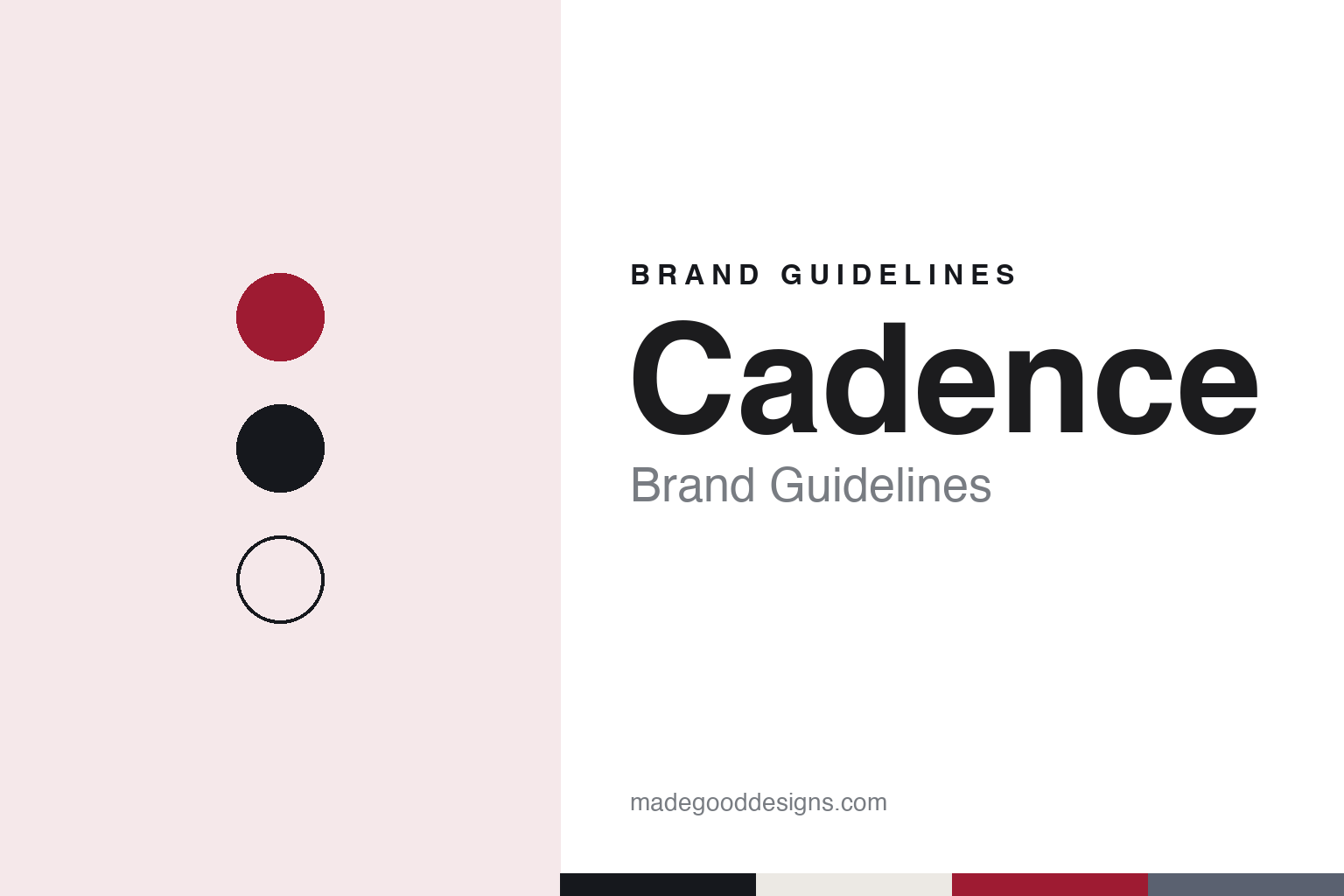
Two constants: a crimson, graphite and grey palette and a geometric sans register. Abstract homage — not a Cadence product or mark; no software screen, logo or nameplate is reproduced.
SDA and ECAD
Two young design-software firms join in 1988.
Cadence is the product of a merger. English Wikipedia says the story begins in 1983 in San Jose, California, with Solomon Design Automation (SDA), an electronic design automation company whose co-founders included James Solomon, Richard Newton, Kenneth Keller and Alberto Sangiovanni-Vincentelli. The second half was ECAD, a public company co-founded in 1982 by Ping Chao, Glen Antle and Paul Huang. In 1988 the two merged to form Cadence Design Systems, with Joseph Costello as chief executive and president, and the combined company traded on the New York Stock Exchange.
Electronic design automation, or EDA, is the software used to draw, simulate and check integrated circuits and circuit boards before anything is made. Wikipedia describes Cadence’s products as software, hardware that runs its chip-design software, and licensed design IP. English Wikipedia describes the company today as an American multinational “technology and computational software company,” headquartered in San Jose, and notes that its name is stylised in lower case with a long mark over the first “a.”
Growth through purchase followed quickly. Wikipedia lists Gateway Design Automation in 1989, Valid Logic Systems in 1991, Ambit Design Systems in 1998, and both OrCAD and Quickturn Design Systems in 1999 — the Quickturn deal, Wikipedia says, came amid a rival takeover attempt by Mentor Graphics. Further purchases included Verisity in the mid-2000s, Tensilica in 2013, AWR in 2019 and the drug-discovery software maker OpenEye Scientific in 2022.
Colour
From full-custom layout to emulators.
The product list is long, and English Wikipedia groups it by stage of the design process. For custom and analogue chips there is the Virtuoso platform, later renamed Virtuoso Studio, and the Spectre circuit simulator. Digital design runs through tools such as Genus synthesis and Innovus place-and-route, with Tempus and Voltus for signoff. Verification includes JasperGold formal tools and the Xcelium simulator, and the Palladium and Protium hardware platforms emulate or prototype whole chip designs before they are made; Wikipedia traces Palladium to the Quickturn purchase.
Cadence also sells to board and package designers. Its Allegro platform covers chips, packages and printed circuit boards together, while the OrCAD and PSpice line, Wikipedia says, is aimed at smaller teams and individual engineers. On the IP side, the company licenses interface, memory and analogue blocks and the Tensilica family of digital signal processors for audio, vision and communications work.
The range has widened beyond chips. Wikipedia describes thermal, electromagnetic and fluid-dynamics tools, a 2024 purchase of BETA CAE Systems, and the Millennium M1, a hardware and software system for simulation launched in February 2024. In February 2026 the trade site Evertiq reported that Cadence had completed its purchase of the Design and Engineering business of Sweden’s Hexagon AB, which brought the MSC Software portfolio, including MSC Nastran and Adams, into the company; the deal had been announced in September 2025.
Artificial intelligence now runs through the marketing. Wikipedia notes the Cerebrus machine-learning tool of 2021, which uses reinforcement learning to tune the digital design flow, and Reuters reporting in 2023 that Cadence was both supplying tools for designing AI chips and adding AI to its own software.
Typography
How chip-design companies present themselves.
Chip-design software and semiconductor IP are hard things to picture. The products are programs, licences and blocks of circuitry that customers place inside their own chips, so the companies that sell them have to borrow images from the work itself. The most common is the chip floor-plan: a die seen from above, its functional blocks lit in bright colour, or the stacked metal routing layers of a layout drawn as glowing lines on a dark ground.
Abstract circuit lines do much of the remaining work. Thin traces, right-angled paths and grids of contact points stand in for a product that no one can hold, and they travel easily from a website banner to a trade-show wall. Alongside them come pictures of people at work: engineers in front of multi-monitor layouts, waveforms and schematics on the screens, the design shown in progress rather than finished.
The trade has its own stages. The Design Automation Conference is where, according to English Wikipedia, Mentor Graphics introduced its first product in 1982, and booths there and at the RISC-V Summit carry the same chip renders, circuit patterns and demonstration screens. Keynote stages follow a familiar pattern too: a chief executive in front of a roadmap slide, with process nodes, product generations and partner names set out across the screen.
This guide looks past those shared images to what can be checked about each company: who founded it, who owns it now, which tools or IP it is known for, and which events in its history — mergers, takeovers, export-control cases — shaped the name it trades under. Where a claim rests only on a company’s own word, we say so.
Aa
A geometric sans for a company whose name is set in lower case. (Specimen set in Manrope, a sans STAND-IN; NOT the Cadence logo.)
Cadence
Disputes, controls and a growing reach.
Two legal episodes stand out in the record. From 1995 to 2002 Cadence was in a long dispute with Avanti Corporation, which traded as Avant!, over claims that Cadence code had been taken; English Wikipedia says Avanti denied it, that Avanti executives eventually pleaded no contest, and that Avanti was later bought by Synopsys, which settled the remaining claims.
The second is recent. On 28 July 2025 the US Department of Justice announced that Cadence had agreed to plead guilty to a charge of conspiracy to commit export-control violations. According to the Department’s release, Cadence sold EDA hardware, software and design IP between February 2015 and April 2021 to the National University of Defense Technology in China, which had been added to the US Commerce Department’s Entity List in February 2015, and the US Attorney said the company had admitted using a front company to do so. The Commerce Department’s Bureau of Industry and Security resolved a parallel civil case the same day, and the Department said Cadence had put an export compliance programme in place.
Earlier that summer, in late May 2025, the three companies that Design & Reuse called the world’s three leading EDA providers — Synopsys, Cadence and Siemens EDA — were ordered to halt exports of EDA tools to China; on 4 July 2025 the site reported that the restrictions had been lifted.
On leadership, Wikipedia lists Joseph Costello until 1997, then Jack Harding, Ray Bingham and Mike Fister; Lip-Bu Tan, a board member since 2004, became acting chief executive in 2008 and was confirmed in January 2009. Anirudh Devgan, president since 2017, took over as chief executive on 15 December 2021. The brand also appears away from the lab: in May 2022, Wikipedia says, the McLaren Formula 1 team announced a multi-year partnership with Cadence.
For a design guide, Cadence shows how a company that sells invisible software builds its identity around a short, lower-case name and the products engineers use every day. Compare Synopsys, which Wikipedia calls its primary market rival, and Siemens EDA, the former Mentor Graphics. For this guide we use a crimson, graphite and grey with a sans, an unofficial interpretation; no product or logo is reproduced.
Explore & save
Keep Cadence’s identity on hand — save it to a board in the Made Good inspiration library.
Cadence identity set
Pin the Cadence crimson, graphite and grey palette and the geometric sans register to your own board.