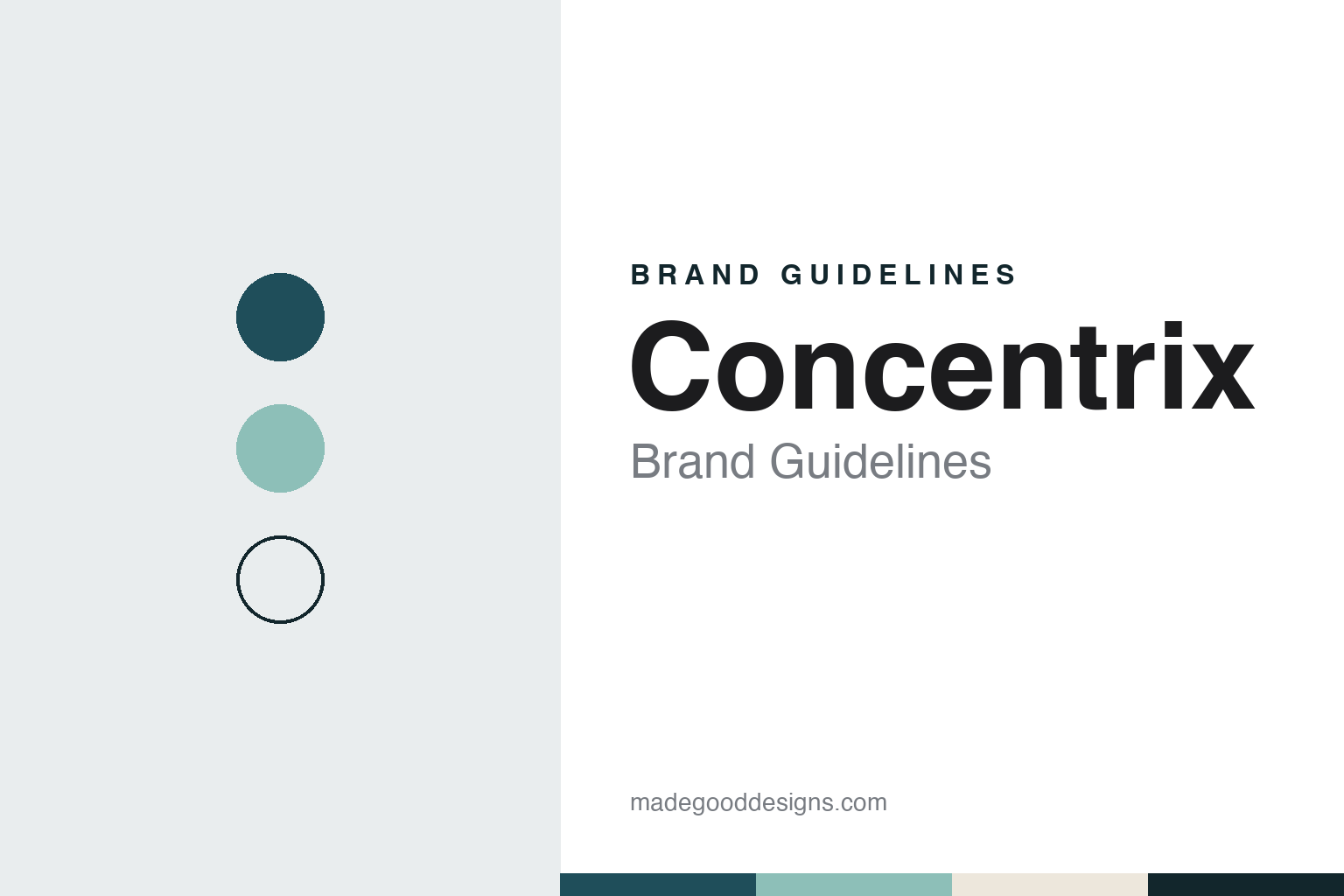
Concentrix Brand Guidelines
A distributor’s outsourcing arm that became a company in its own right.
Aa
Two constants: a teal, sea-glass and sand palette and a clean low-contrast sans register. Abstract homage — not a Concentrix asset; no logo, wordmark or campaign image is reproduced.
Inside SYNNEX
An outsourcing arm grown inside a technology distributor.
Concentrix grew up inside another company. The technology distributor SYNNEX acquired Concentrix in 2006, Financier Worldwide noted in 2018, and ran it as its customer-relationship outsourcing subsidiary for the next fourteen years. The company describes its own start modestly: its careers site says Concentrix began “20+ years ago with just a handful of people” and grew from “a scrappy startup” into a large technology and services group. Its headquarters are in Newark, California, English Wikipedia says.
Much of its scale came through acquisitions made while SYNNEX was the owner. English Wikipedia says Concentrix bought eight companies after 2006, among them the Minacs Group. The largest step came in 2018. In July that year Financier Worldwide reported that SYNNEX had agreed to buy Convergys, a US call-centre operator, and planned to combine it with Concentrix to create what the two companies called a “premier global customer engagement services company.” English Wikipedia says the deal was completed on 5 October 2018.
Independence followed two years later. On 1 December 2020 SYNNEX completed the spin-off of Concentrix as a separate company listed on Nasdaq, English Wikipedia says, citing SYNNEX’s announcement. English Wikipedia names Christopher Caldwell as chief executive.
The company’s record includes one widely reported public contract. From 2014 Concentrix reviewed tax-credit claims in the UK for HM Revenue and Customs under a payment-by-results arrangement intended to catch incorrect or fraudulent claims. In September 2016 the Guardian reported that HMRC would not renew the contract after complaints about wrongly stopped claims, and that the Treasury had found 120 cases that did not fully comply with the contract’s requirements; and in February 2017 the BBC reported that 87% of the 36,000 appeals lodged against Concentrix decisions had been upheld, and that HMRC would review up to 23,000 further cases from claimants who had not appealed. The parliamentary committee behind that review had described the appeals process as complex and daunting, the BBC added.
Colour
Webhelp, and one name again.
The merger that reshaped Concentrix was with Webhelp. The name began in Toronto in 1999 as a human-assisted online search service; in 2000 two French entrepreneurs, Olivier Duha and Frédéric Jousset, launched a French business under licence, and that business later grew into an independent French outsourcing group controlled from 2019 by the Belgian investment company Groupe Bruxelles Lambert, English Wikipedia says.
Concentrix announced the combination in March 2023, and the deal closed in September 2023. On 28 September that year the Global Sourcing Association reported that Concentrix had completed the purchase earlier that week, that the combined business would be led by Chris Caldwell, and that it was expected in due course to take a new name and identity.
In the end it kept the older name. By June 2024 the group was operating only as Concentrix, and on 2 June it showed its new logo in a drone show at an employee music festival in the Philippines, Outsource Accelerator reported. The magazine said the logo draws on the idea of concentric circles, keeping clients and employees at the centre — the same idea the name itself suggests.
The company now presents itself in the language of software as much as of call centres. Its website describes Concentrix as designing, building and running “integrated human + AI operations” inside large enterprises; it highlights ISO 42001:2023 certification for AI governance and a “Leader” rating from the analyst firm NelsonHall, and says more than 160 companies in the Fortune Global 500 are clients. Outsource Accelerator put the number of countries in which it operates at more than 70 in 2024, and its clients at more than 2,000.
Its products now carry their own names. The website promotes iX Hero, which it presents as an AI tool for customer service and lists alongside awards the company says it has won, and it describes the group’s business as “billions of human + AI interactions every year.” Those are the company’s own descriptions; the analyst ratings and awards it shows are part of the same pitch to clients.
Typography
How outsourcers present themselves.
Customer-experience and business-process outsourcing companies sell work that is mostly invisible: the call answered, the chat handled, the post reviewed, the invoice processed. Their branding has to make that work look human and dependable, and the sector has settled on a familiar visual vocabulary to do it.
The first element is people. Websites and recruitment pages lean on photographs of smiling agents in headsets, often in bright open-plan centres, alongside employee-wellbeing imagery and team events. The pictures speak to two audiences at once: clients who want reassurance about quality, and the large numbers of job-seekers these companies hire. Pages built around a company’s own workplace rankings, such as Great Place to Work lists, serve the same double purpose.
The second element is reach. World maps dotted with delivery sites, counts of countries and languages, and lists of client sectors appear across the category, because scale and geographic spread are much of what is being sold. In recent years a third element has joined them: chat bubbles, abstract network lines and illustrations of AI assistants, as companies present their services as a mix of people and software rather than headcount alone. Several now display AI-governance certifications, such as ISO/IEC 42001, as prominently as their awards.
Trust signals complete the picture: analyst-ranking badges, industry awards and appearances at trade events such as Customer Contact Week. Because many of these companies have grown through mergers, their identities are also unusually changeable, with familiar names shortened, combined or replaced. This guide sets out what can be checked about each company — who founded it, who owns it and how its name and identity have changed — and marks what rests only on the company’s own word.
Aa
A clean low-contrast sans for a name built on circles. (Specimen set in DM Sans, a sans STAND-IN; NOT the Concentrix logo.)
Concentric circles
A name that was always the brand.
Concentrix is an unusual case in a sector where names change often. It was bought by a technology distributor in 2006, enlarged by Convergys and then by Webhelp, and at each stage the Concentrix name survived. When the Webhelp merger raised the prospect of a new identity, the group chose to return to its own name and to redraw the logo around the meaning already in it: circles sharing a centre.
The visual material around the 2024 relaunch also shows where the company’s workforce is concentrated. The new logo was shown to staff in the Philippines, at one of the company’s family-day festivals, and the company has a long presence in Europe too: Outsource Accelerator reported in 2024 that Concentrix had operated in Poland since 2005 and employed more than 2,000 people there.
For a design guide, Concentrix shows how an existing name can carry a merger when its meaning is simple enough to draw. Compare Teleperformance, the Paris group that bought Majorel in 2023, and Accenture, another services company that took a new name. For this guide we use a deep teal, sea glass and sand with a sans, an unofficial interpretation; no product or logo is reproduced.
Explore & save
Keep Concentrix’s identity on hand — save it to a board in the Made Good inspiration library.
Concentrix identity set
Pin the Concentrix teal, sea-glass and sand palette and the clean low-contrast sans register to your own board.