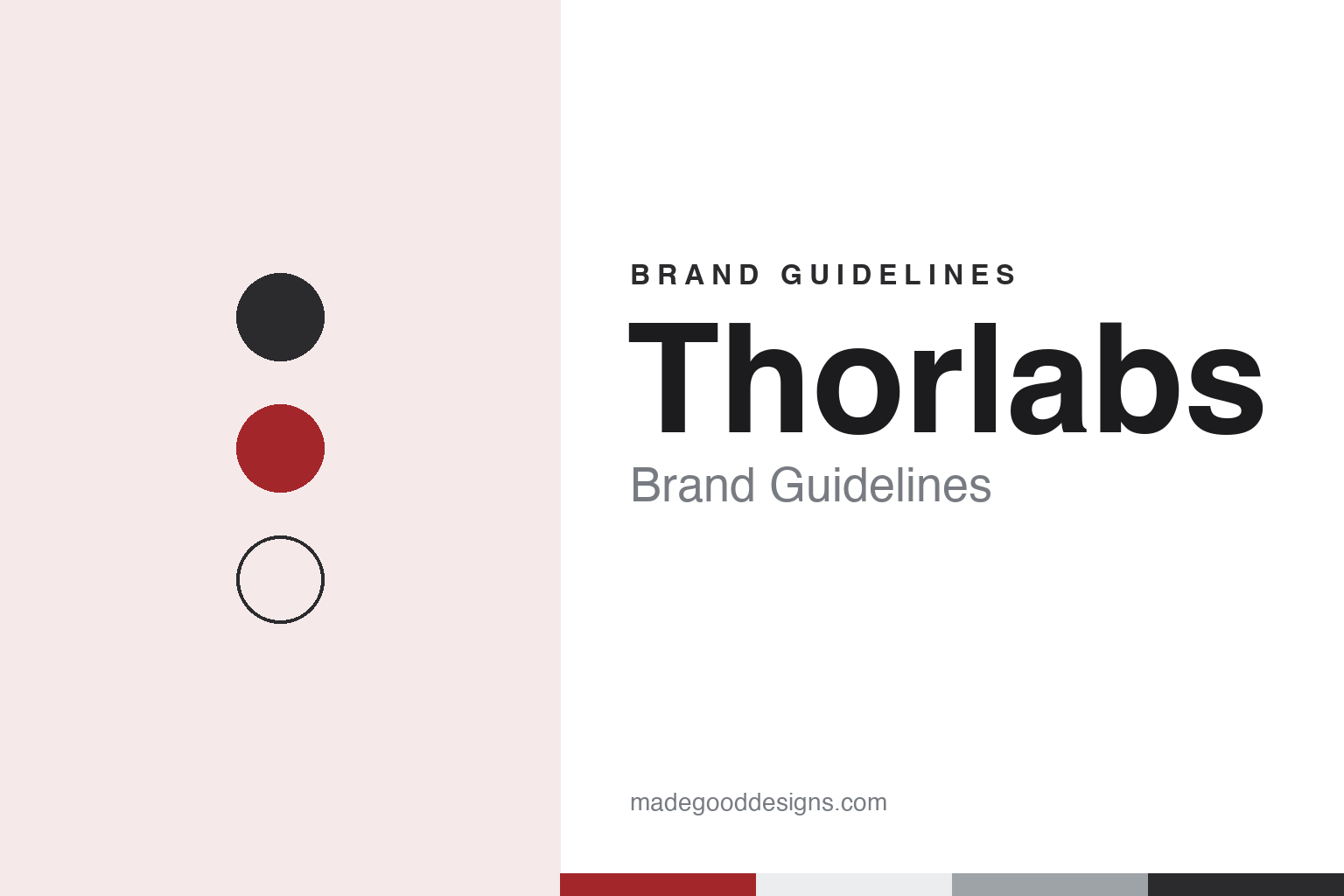
Thorlabs Brand Guidelines
The New Jersey optics catalogue maker named after a dog.
Aa
Two constants: a red, graphite and grey palette and a catalogue sans register. Abstract homage — not a Thorlabs product or mark; no instrument, logo or nameplate is reproduced.
A spare bedroom
A milling machine, Bell Labs and a dog called Thor.
Thorlabs began as a sideline. English Wikipedia says Alex Cable, then working at Bell Labs, bought a milling machine and used it to design and build optomechanical parts in his spare time, and that he left Bell Labs to run the business full-time in November 1989. He started it in a spare bedroom in Freehold, New Jersey, and named it after his black Labrador, Thor. Bell Labs was among its first customers.
The company’s own description, quoted by Laser Focus World in August 2015, says Thorlabs “was founded in 1989 to serve the laser and electro-optics research market.” For years it sold mainly through a printed catalogue; Wikipedia says the company now puts the emphasis on selling catalogue products and talking to customers through its website, and that it aims to ship products on the day an order arrives.
Growth followed the telecom boom and survived its end. Wikipedia says telecom companies made up 45 percent of Thorlabs’ business before that market collapsed in the early 2000s, and that a generous returns policy meant that in at least one quarter of the crash the company received more product back than it shipped. In 2003 and 2004 it expanded into Europe by buying companies in Germany, Sweden and the United Kingdom.
Thorlabs is still privately held, with Cable as chief executive, Wikipedia says; in January 2025 optics.org named Jennifer Cable as the company’s president. Wikipedia also records that Cable has said he is not against a stock-market listing at some point.
Colour
Made in-house, bought in when needed.
Thorlabs sells a very wide range. Wikipedia describes its products in fibre optics, lasers, optical instrumentation, optomechanics, photonics and vibration isolation, puts the range at about 20,000 different products, and says about 90 percent of them are made in-house and that roughly 30 percent were created in response to, or inspired by, customer requests. The company says its products serve research, life-science, medical and industrial customers. Cable has said he sees more value in a business that designs, makes and distributes than in pure distribution, and Wikipedia says he declined to move manufacturing to China, in order to keep delivery times short.
That vertical integration was built partly through acquisitions. In March 2009 Thorlabs bought the optoelectronic component maker Covega of Jessup, Maryland, from Gemfire; it became Thorlabs Quantum Electronics. Wikipedia lists the Burleigh life-science line in 2011, and the Octavius ultrafast lasers and Maxion Technologies’ quantum cascade and interband cascade lasers in 2012. In 2013 came the iGuide mid-infrared fibre line, the scientific camera maker DVC, which became Thorlabs Scientific Imaging, and the cytometry maker CompuCyte. The company said at the time that the Maxion and iGuide purchases were part of an effort “to become a vertical manufacturer” of infrared equipment, Wikipedia records. Corning’s quantum cascade laser line followed in 2014 and Norland’s fibre-optic products in 2018. In August 2015 Laser Focus World reported an agreement to buy Vytran, a New Jersey maker of equipment to taper and fuse optical fibre, from NKT Photonics.
By then, the same report said, Thorlabs’ facilities included semiconductor fabrication of Fabry–Perot, DFB and VCSEL lasers, towers for drawing glass optical fibre, epitaxial-growth reactors, glass and metal fabrication, and thin-film coating. In January 2025 optics.org reported that Praevium Research of Santa Barbara, a developer of tunable MEMS-VCSEL lasers used in swept-source optical coherence tomography and a Thorlabs partner since 2008, had become part of Thorlabs. On 1 October 2025 Thorlabs announced the acquisition of Nu Opto, an acousto-optic component maker in Melbourne, Florida.
Partnerships are part of the model. Wikipedia says Thorlabs’ Strategic Partnership Program supports start-up manufacturers with shared knowledge and resources in exchange for an equity stake, and that it helps the company follow emerging technologies. In May 2007 Thorlabs won a Laser Focus World/Phast Innovation Award for its Adaptive Scanning Optical Microscope, Wikipedia says.
Typography
Light, lenses and laboratories.
Photonics companies sell things most people never see. Their lasers sit inside machine tools, their transceivers inside data-centre racks, and their detectors inside instruments, telescopes and physics experiments. So the way they present themselves leans on a small set of images that make light visible: a laser beam crossing a dark optical table, the glowing end of a fibre, a row of pluggable transceiver modules lined up for a switch, or a photomultiplier tube and a sensor chip photographed under studio light against black.
The catalogue matters as much as the advertisement. Many makers of optics and components publish long product catalogues of lenses, mirrors, mounts, filters, tubes and diodes, each part with a drawing, a part number and a page of specifications. That catalogue habit gives much of the sector a shared look: clean technical photography, plenty of white or black space, careful diagrams and an engineering sans or a restrained serif, with colour used sparingly, often for a single accent.
The trade shows are where the industry gathers in person. Photonics West, LASER World of PHOTONICS and OFC, the optical fibre communication conference, are among the events where companies show new lasers, modules and detectors, and their stands and press releases often borrow the same visual language of beams, fibres and glowing chips. Company histories also lean on science: makers of detectors and light sources often point to the research projects and observatories that have used their parts.
This guide sets out what can be checked about each brand — who founded it, who owns it, what it has bought or sold and what it makes — and marks clearly what rests only on the company’s own word. Pending deals are described as pending, with the date they were announced.
Aa
A plain catalogue sans for a lab-bench brand. (Specimen set in Inter Tight, a sans STAND-IN; NOT the Thorlabs logo.)
Thorlabs
A headquarters on a former silk-mill site.
In October 2010 Thorlabs broke ground on a new headquarters in Newton, on a brownfield site once owned by the Sterling Silk Company and abandoned since 1993, and the three-storey building opened in March 2012, bringing manufacturing, research, sales and customer service together, Wikipedia says. The earlier headquarters in Andover Township stayed in use as the company’s machine shop. In 2019 Thorlabs began building new facilities in Newton, the United Kingdom and Germany.
Outside the United States, Wikipedia lists offices in Brazil, Canada, China, France, Germany, Japan, Sweden and the United Kingdom. In May 2014 Thorlabs opened a research and manufacturing subsidiary in Montreal, Thorlabs Canada, in partnership with École Polytechnique de Montréal and the University of Montreal; the same year it opened an optoelectronics facility in Ann Arbor, Michigan. The company says it employs more than 3,000 people and runs facilities ranging from traditional machine shops and optics production to compound-semiconductor fabrication and packaging.
For a design guide, Thorlabs shows how a company built on a catalogue of laboratory parts can carry one short name across a very wide product range. Compare Edmund Optics, another optics supplier, and Coherent, a US laser maker. For this guide we use a bench red, graphite and an anodised grey with a sans, an unofficial interpretation; no product or logo is reproduced.
Explore & save
Keep Thorlabs’s identity on hand — save it to a board in the Made Good inspiration library.
Thorlabs identity set
Pin the Thorlabs red, graphite and grey palette and the catalogue sans register to your own board.