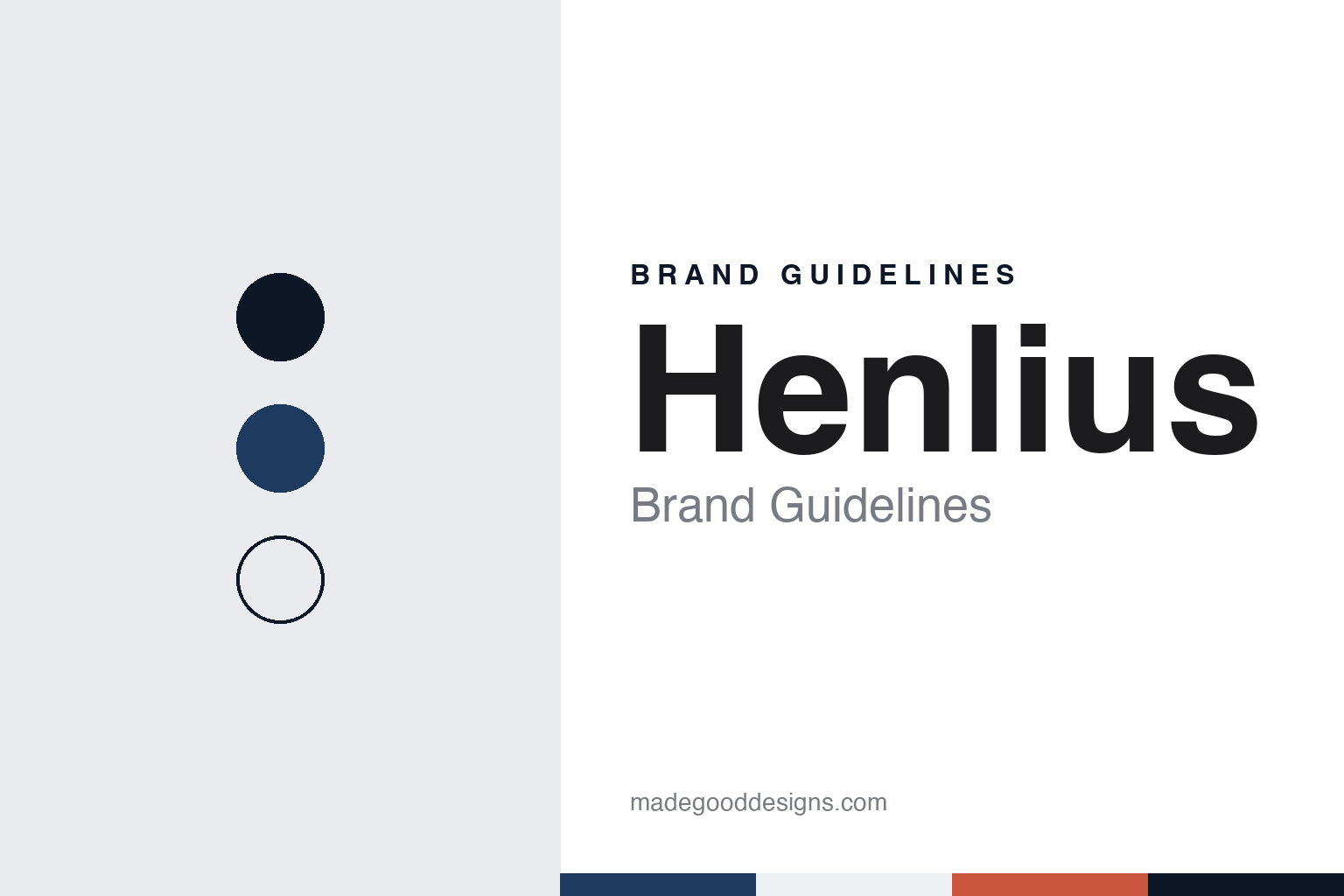
Henlius Brand Guidelines
Fosun’s 2010 Shanghai biologics unit, from Zercepac to a buyout that failed.
Aa
Two constants: a Henlius indigo, porcelain and coral palette and a technical sans register. Abstract homage — not a Henlius product or mark; no pack, logo or label is reproduced.
A Fosun Unit
A drug group and a team of scientists from abroad.
Henlius is the short name of Shanghai Henlius Biotech, known in Chinese as 复宏汉霖. It was set up in Shanghai in February 2010 by Shanghai Fosun Pharmaceutical and a team of overseas scientists, Yicai Global reported in June 2019, when it named Scott Liu as the company’s chief executive. In July 2020 the same outlet described Henlius as a company formed in 2010 as the biomedical unit of Fosun Pharma, and in January 2025 it called Henlius “the company’s biologics platform,” developing monoclonal antibody drugs.
The company says its first facility began operating in 2016. It listed on the main board of the Hong Kong Stock Exchange in September 2019 under the code 2696, according to the company and Yicai Global. In its own profile, Henlius now calls itself a global, innovation-driven biopharmaceutical company with more than 4,000 employees and operations across China, the United States and Japan.
Ownership stayed with Fosun. In June 2024 a Fosun Pharma unit, Fosun New Pharma, offered to take Henlius private by buying the shares it did not already own. Minority shareholders voted the plan down in January 2025, and Fosun Pharma told Yicai Global on 23 January 2025 that it had dropped the proposal; at that point it owned 59.6 percent of Henlius through three subsidiaries, and the Hong Kong listing remained. In April 2025 Fosun Pharma agreed to buy further unlisted shares from minority holders, which Yicai Global said would lift its stake to 63.4 percent. The company says it was added to the Stock Connect list of eligible securities in 2026.
The name doubles as a statement of values. On its website Henlius spells its seven corporate values out of the letters of its own name: honesty, execution, nurturing, leadership, innovation, uncompromising on quality, and science and strategy oriented.
Colour
Rituximab first, then trastuzumab in Europe.
Henlius built its early business on biosimilars, copies of existing antibody medicines approved after comparison with the original. Its first proprietary product was HANLIKANG, a rituximab, approved in China in 2019; the company describes it as the first biosimilar approved in China and the first China-manufactured biosimilar approved there.
Its trastuzumab, developed as HLX02, carries three names: HANQUYOU in China, Zercepac in Europe and HERCESSI in the United States. The European Commission approved Zercepac in July 2020, Yicai Global reported on 29 July 2020, quoting the company’s statement that it was the first China-developed monoclonal antibody biosimilar to enter the European Union market. The same report said the British drugmaker Accord Healthcare would handle sales in the EU and the wider European Economic Area. The company gives 2024 as the year of the HERCESSI approval in the United States.
Other biosimilars followed in China: the adalimumab HANDAYUAN in 2020, which the company calls its first product for autoimmune diseases, and the bevacizumab HANBEITAI in 2021, according to its milestone list. Henlius says two denosumab products, BILDYOS and BILPREVDA, were approved in the United States and Europe in 2025. Its pertuzumab, POHERDY, was approved by the US Food and Drug Administration in November 2025, by the European Commission in April 2026 and by China’s drug regulator in May 2026, the company says, adding that it was the first pertuzumab biosimilar approved in the United States and the European Union.
The company has since moved toward its own medicines. Its anti-PD-1 antibody serplulimab is sold in China as HANSIZHUANG, approved there in 2022, and in Europe as Hetronifly, approved in 2025, according to the company, which calls serplulimab its core product. Henlius says it now has 10 products approved in more than 60 countries and regions, with four approvals from the US FDA and five from the European Commission; it says the cash flow from its biosimilars supports its work on new drugs.
Typography
Design and documentation.
Biosimilar makers sell medicines that most people only ever meet as a pack in a pharmacy or a hospital ward, so their public image is built from the places where those medicines are made. Their websites and reports favour gleaming steel bioreactors, vials moving along blue-lit filling lines, scientists in gowns and hoods, and close-ups of prefilled syringes and autoinjector pens. The pictures signal scale and control rather than any single product.
The category is young. The European Medicines Agency’s record shows that the marketing authorisation for Celltrion’s Remsima, a biosimilar of the antibody infliximab, was issued on 10 September 2013, and English Wikipedia describes it as the first biosimilar monoclonal antibody approved by the EMA. Since then a group of companies in Asia, Europe and North America has built ranges of biosimilars, each sold under a brand name of its own, alongside the corporate names covered in this guide.
Their messaging leans on access. Celltrion states a mission of “a healthier tomorrow where no patients are left untreated”; Samsung Bioepis says it makes “quality-assured biologic medicines more accessible, more quickly.” Celltrion’s brand page ties its green to trust. Trade meetings such as the GRx+Biosims conference and the BIO International Convention are where the sector’s companies present their pipelines and meet partners.
This guide sets out what can be checked about each maker — who founded it, who owns it, and which approvals and deals dated sources record — and marks clearly what rests only on the company’s own word.
Aa
A clean technical sans for a Shanghai biologics maker. (Specimen set in IBM Plex Sans, a sans STAND-IN; NOT the Henlius logo.)
Henlius
Plants in Xuhui and Songjiang, partners abroad.
Henlius makes its medicines in Shanghai. The company lists a site in the Xuhui district, which it says holds GMP certification from China, the EU and several PIC/S member authorities, and two sites in Songjiang; the newer Songjiang site covers about 130,000 square metres and combines drug substance production, liquid filling, prefilled syringes and antibody-drug conjugate work, the company says. Yicai Global reported in June 2019 that Henlius had begun building the Songjiang plant, citing a site of 133,330 square metres. The company gives its total capacity as 84,000 litres and says its second facility obtained US GMP certification in 2024.
Much of its reach abroad runs through partners. Accord sells Zercepac in Europe, according to Yicai Global’s 2020 report, and the company lists Abbott, Eurofarma and Fosun Pharma among HANLIKANG’s business partners. On 17 August 2026 Yicai Global reported that Henlius had signed an agreement with Sandoz covering up to 10 biosimilars or drug substances, with Sandoz holding commercial rights outside China and Henlius responsible for development and manufacturing; Sandoz said one of the first assets would be a proposed cetuximab biosimilar in clinical development. In April 2025 the same outlet reported that Henlius planned to build its own commercial team in Japan.
For a design guide, Henlius shows a Chinese biologics maker presenting itself less as a copier of existing antibodies than as a global drug company, with a name that also serves as its list of values. Compare Bio-Thera, the Guangzhou antibody maker, and Sandoz, its 2026 licensing partner. For this guide we use a deep indigo, a near-black ink, a pale porcelain and a coral accent with a sans, an unofficial interpretation; no product or logo is reproduced.
Explore & save
Keep Henlius’s identity on hand — save it to a board in the Made Good inspiration library.
Henlius identity set
Pin the Henlius indigo, porcelain and coral palette and the technical sans register to your own board.


