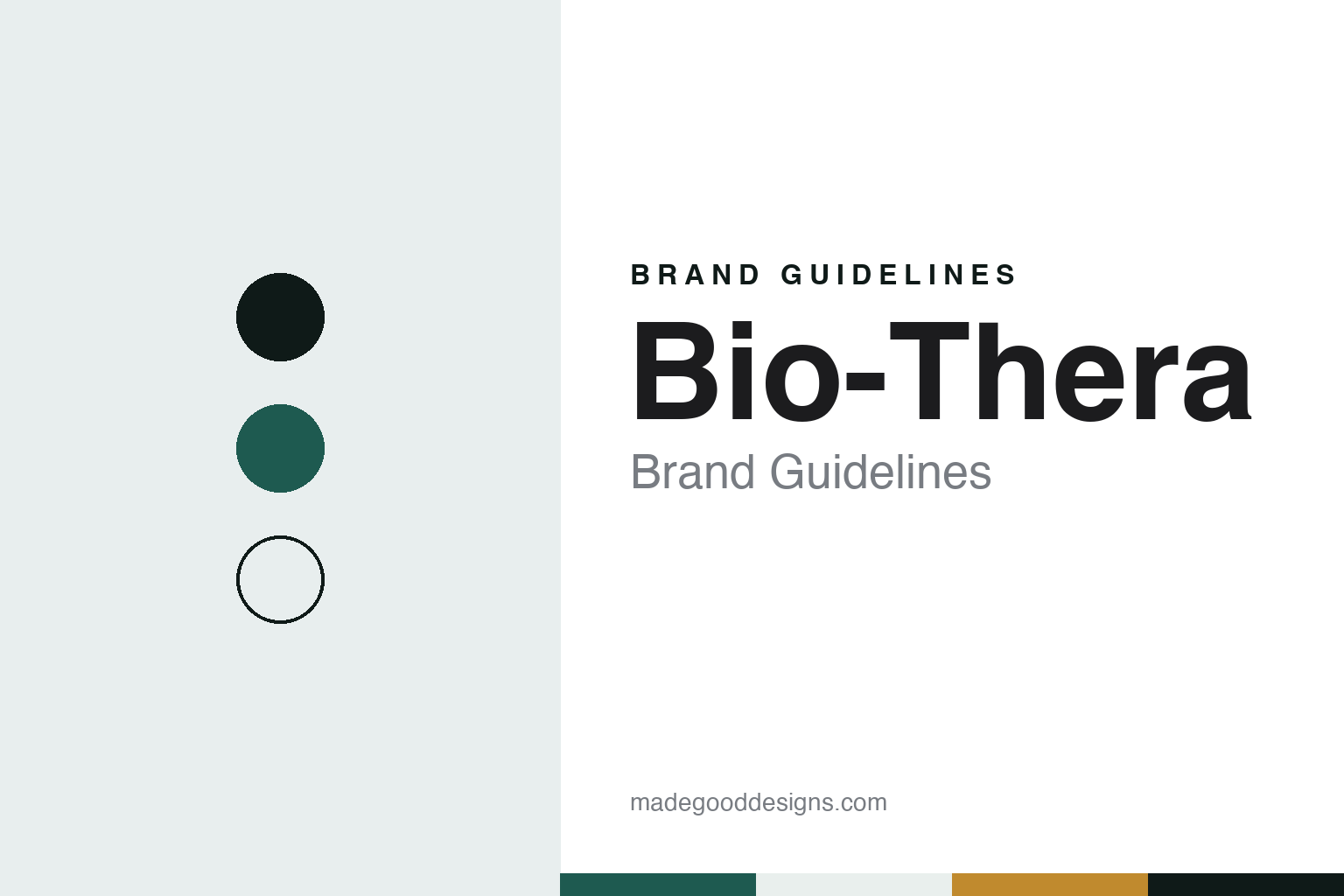
Bio-Thera Brand Guidelines
A 2003 Guangzhou antibody maker with “Innovation for Life” as its line.
Aa
Two constants: a Bio-Thera green, mist and amber palette and a measured serif register. Abstract homage — not a Bio-Thera product or mark; no pack, logo or label is reproduced.
Guangzhou, 2003
A Guangzhou biotech company and its 2020 listing.
Bio-Thera Solutions, known in Chinese as 百奥泰, is a Guangzhou drug company that develops antibody medicines, both new molecules and biosimilars of existing ones. The Shanghai Stock Exchange’s company snapshot gives its founding date as 28 July 2003 and its home as Guangzhou, and the financial news site EqualOcean also gave 2003 as the founding year in a February 2020 report.
The company’s own timeline begins with that July 2003 registration as a Guangzhou biotechnology company. In 2009, it says, its chief executive, Dr Li Shengfeng, was selected for a national talent programme, and in 2011 the science ministry named it an incubation base for human antibody drugs. In March 2019 it changed its registered name to a joint-stock company form, ahead of a stock market listing.
That listing came on 21 February 2020, when Bio-Thera began trading on the STAR Market of the Shanghai Stock Exchange under the code 688177, according to the exchange and EqualOcean. EqualOcean reported that the company had applied under the STAR Market’s fifth listing standard, a route open to companies that had not yet made a profit. The company’s website still gives the STAR Market code and Guangzhou as its base.
The company’s line is “Innovation for Life,” which appears on its website alongside a mission to develop new medicines and biosimilars for cancer, autoimmune, cardiovascular and eye diseases. It says its innovation centre moved to Guangzhou International Bio Island in July 2025, after ground was broken there for a research and marketing headquarters in 2018.
Colour
Adalimumab at home, tocilizumab in America.
Bio-Thera’s first approved product was an adalimumab biosimilar, sold in China as 格乐立, or QLETLI in English. EqualOcean reported in February 2020 that it was due to reach the Chinese market early that year; the company says China’s drug regulator approved it in November 2019 and that commercial sales began in January 2020. The UK regulator approved QLETLI in September 2025, the company says.
Its bevacizumab biosimilar, POBEVCY in China, was approved there in November 2021, according to the company, which says the same molecule was approved in the United States as Avzivi in December 2023 and in the European Union in July 2024; its Brazilian brand name is Bevyx. The company lists Sandoz as its partner for this product in the United States, Europe, Canada and other markets from September 2021.
Its tocilizumab was developed as BAT1806. The US Food and Drug Administration approved it as Tofidence, the first tocilizumab biosimilar approved by the agency, The Center for Biosimilars reported on 5 October 2023. The report said Tofidence was developed and would be manufactured by Bio-Thera and marketed by Biogen, which held exclusive commercial rights in all countries outside China, Hong Kong, Macau and Taiwan, and that the product had been approved in China in January 2023. The company calls Tofidence the first monoclonal antibody developed and manufactured by a Chinese drug company to win FDA marketing approval, and says European approval followed in June 2024. In April 2025, it says, Organon acquired the exclusive US commercial rights to the intravenous form of Tofidence.
More recent approvals, according to the company, include an ustekinumab sold as STARJEMZA in the United States, approved in May 2025, and as USYMRO in Europe, approved by the European Commission in August 2025. Alongside biosimilars it has an innovative drug, bevifibatide, sold in China as BETAGRIN since June 2024, and a pipeline that it says focuses on antibody-drug conjugates and immunotherapies.
Typography
Design and documentation.
Biosimilar makers sell medicines that most people only ever meet as a pack in a pharmacy or a hospital ward, so their public image is built from the places where those medicines are made. Their websites and reports favour gleaming steel bioreactors, vials moving along blue-lit filling lines, scientists in gowns and hoods, and close-ups of prefilled syringes and autoinjector pens. The pictures signal scale and control rather than any single product.
The category is young. The European Medicines Agency’s record shows that the marketing authorisation for Celltrion’s Remsima, a biosimilar of the antibody infliximab, was issued on 10 September 2013, and English Wikipedia describes it as the first biosimilar monoclonal antibody approved by the EMA. Since then a group of companies in Asia, Europe and North America has built ranges of biosimilars, each sold under a brand name of its own, alongside the corporate names covered in this guide.
Their messaging leans on access. Celltrion states a mission of “a healthier tomorrow where no patients are left untreated”; Samsung Bioepis says it makes “quality-assured biologic medicines more accessible, more quickly.” Celltrion’s brand page ties its green to trust. Trade meetings such as the GRx+Biosims conference and the BIO International Convention are where the sector’s companies present their pipelines and meet partners.
This guide sets out what can be checked about each maker — who founded it, who owns it, and which approvals and deals dated sources record — and marks clearly what rests only on the company’s own word.
Aa
A measured serif for a Guangzhou antibody maker. (Specimen set in Source Serif 4, a serif STAND-IN; NOT the Bio-Thera logo.)
Bio-Thera
Steel bioreactors in Yonghe, partners worldwide.
Bio-Thera makes its antibodies in Guangzhou. The company says its Antibody Industrial Park in the Yonghe Development Zone covers about 40,000 square metres and has 66,500 litres of working capacity, spread across stainless-steel bioreactors of 6,000, 4,000 and 3,500 litres and single-use bioreactors of 2,000 and 500 litres. The site also has a small reactor for antibody-drug conjugates, a vial filling line, a prefilled syringe line and a freeze-drying line, the company says, and it plans a further 72,000 litres at a new Yonghe Innovation Industrial Base. It says its plant meets the quality system standards of China’s NMPA, the US FDA, the European EMA and Brazil’s ANVISA, and its timeline records that the antibody park passed an EU Qualified Person audit in August 2017.
Bio-Thera reaches many foreign markets through licensing. Its timeline lists agreements with Biogen for tocilizumab outside China in April 2021, with Hikma for ustekinumab in the United States in August 2021, with STADA for European markets in 2024 and 2025, and with Intas for the United States in February 2025, among others. Its website shows a wall of partner names, from Dr. Reddy’s and Gedeon Richter to Organon and SteinCares in Latin America.
For a design guide, Bio-Thera shows a Guangzhou company that leads with a single slogan, “Innovation for Life,” and lets a long list of regulators’ approvals and partners’ names do the rest of the work. Compare Henlius, the Shanghai biologics maker owned by Fosun Pharma, and Sandoz, its bevacizumab partner. For this guide we use a deep green, a near-black ink, a pale mist and an amber accent with a serif, an unofficial interpretation; no product or logo is reproduced.
Explore & save
Keep Bio-Thera’s identity on hand — save it to a board in the Made Good inspiration library.
Bio-Thera identity set
Pin the Bio-Thera green, mist and amber palette and the measured serif register to your own board.