ICBC Brand Guidelines
A 1984 spin-off from the central bank that grew into a bilingual banking name.
Aa
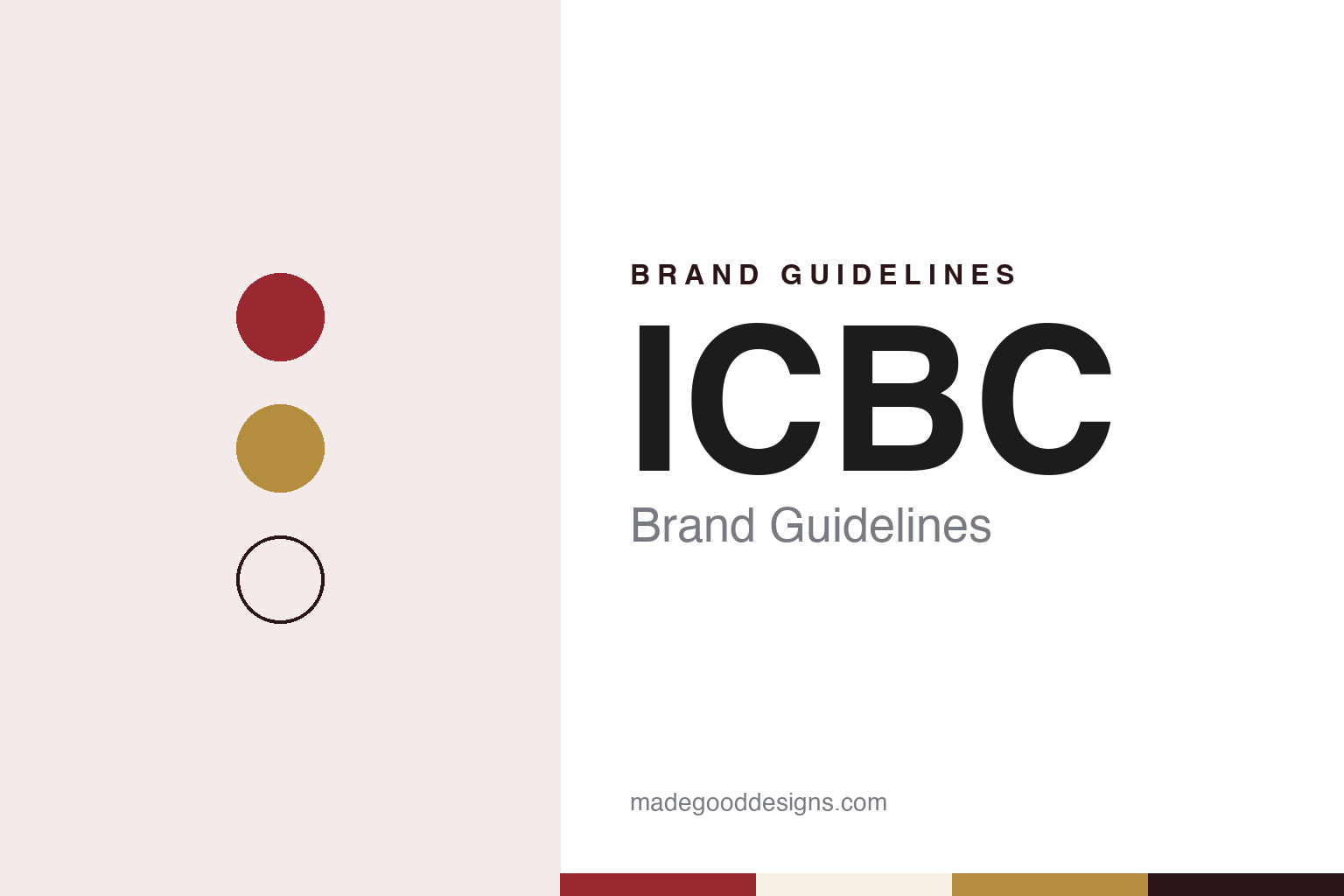
Two constants: an ICBC seal red, ink and gold palette and a Formal serif register. Abstract homage — not an ICBC product or mark; no logo, card or signage is reproduced.
One institution, two brands
A 1984 spin-off from the central bank.
ICBC — the Industrial and Commercial Bank of China — was established on 1 January 1984, the bank says on its website. It was carved out of the People’s Bank of China, which until then had acted both as the country’s central bank and as a lender to businesses and savers. On 17 September 1983, according to the history page on ICBC’s website, the State Council decided that the People’s Bank would act only as the central bank, and that a new Industrial and Commercial Bank of China would take over the industrial and commercial credit and savings business the People’s Bank had handled until then.
The separation began with a sign on the door. In October 1983, ICBC’s history says, the People’s Bank told its provincial, municipal and regional branches that from 1 January 1984 they should add the “brand-plate” of the Industrial and Commercial Bank of China, under a transitional rule it describes as “one institution, two brands; separate capital, two sets of accounts.” The branches were then separated region by region, and by the beginning of 1985, the bank says, the split was finished across almost the whole country.
The new bank started small at the top. In October 1983 the People’s Bank approved a head office of 14 departments and 500 staff, ICBC’s history says. English Wikipedia describes ICBC as the fourth of the specialised state banks created in China’s banking reform of the late 1970s and early 1980s, and says its early focus was taking in deposits and lending them on. Chinese Wikipedia adds that the head office first occupied the third to sixth floors of a clothing company’s factory building in Beijing’s Xicheng District, moved in December 1986, and settled at its present headquarters in June 1998.
Colour
A joint-stock company, a dual listing and branches abroad.
ICBC opened its first overseas branch in Singapore in 1993, English Wikipedia says, followed by a branch in Luxembourg in 1999 that became its European headquarters in 2011. Chinese Wikipedia says its Hong Kong representative office was upgraded to a branch in November 1995, and in 2000 ICBC bought the Union Bank of Hong Kong and renamed it ICBC (Asia), according to English Wikipedia.
The state bank was then rebuilt as a company. On 28 October 2005 it was restructured into a joint-stock limited company, and on 27 October 2006 it listed on the Shanghai Stock Exchange and the Stock Exchange of Hong Kong on the same day, the bank says. English Wikipedia calls it the first company to debut on both exchanges simultaneously. Goldman Sachs, Dresdner Bank and American Express took stakes as strategic investors in April 2006, ahead of the listing. Its main shareholders remain state bodies: at the end of 2021, English Wikipedia says, Central Huijin Investment held 34.7 percent and the Ministry of Finance 31.1 percent.
Expansion abroad continued through purchases. ICBC announced in October 2007 that it would take a 20 percent stake in South Africa’s Standard Bank, Chinese Wikipedia says. It agreed in August 2011 to buy 80 percent of Standard Bank’s Argentine arm, a purchase English Wikipedia dates to November 2012, and on 1 February 2015 it completed the purchase of Standard Bank’s London markets business, now called ICBC Standard Bank. In 2015 it bought Turkey’s Tekstilbank and formed ICBC Turkey. Closer to home, Chinese Wikipedia says, ICBC took over the business of Bank of Jinzhou in October 2025 and completed the merger on 15 November 2025.
Chinese Wikipedia sorts the bank’s work into four lines: corporate banking, including inclusive finance for small businesses; personal banking, including private banking and bank cards; asset management, including wealth management, custody and pensions; and financial-markets business.
Typography
Design and documentation.
China’s large banks present themselves to two audiences at once. Most carry a Chinese name and an English one, and many shorten the English to initials, so a single identity has to work in Chinese characters, in Latin letters and in a short acronym on cards, apps and branch fronts. Red and blue dominate the sector’s colours, and marks are often built around Chinese characters or around round forms that recall coins and seals, though the meaning of a particular mark should be checked against the bank’s own account rather than assumed.
Much of the visual record comes from the banks’ own channels. Their websites set out a mission, a motto and a list of values, usually in both languages, and divide services into retail or personal banking, corporate banking, inclusive finance for small businesses and wealth management. Branch photography, with signage over glass frontages and service halls, is a staple of annual reports and investor pages.
The phone has become a second front door. The big banks run mobile-banking apps and, in several cases, separate lifestyle or payments apps, and they report online user numbers alongside branch counts. Many also link their cards to UnionPay, the national card network.
The paper trail is long and dated. Banks listed in Shanghai and Hong Kong publish annual reports, interim results and ESG reports in Chinese and English, and several issue green bonds or publish separate green-finance reports. For design research, those documents give dated, citable evidence of how an identity is applied, from cover design to typography and photography, and they are the most reliable place to check a claim about a bank’s name, history or scale.
Aa
A formal serif for a bank whose name began on a branch plate. (Specimen set in Noto Serif SC, a serif STAND-IN; NOT the ICBC logo.)
ICBC
Integrity, prudence and a plate on the door.
ICBC sets out its culture on its website in short English lines: a mission of “excellent services to clients,” returns to shareholders, success for employees and contribution to society, and the motto “Integrity Leads to Prosperity,” backed by five values — integrity, humanity, prudence, innovation and excellence. Chinese Wikipedia gives the Chinese form of the motto as 工于至诚,行以致远, which opens with 工, the first character of the bank’s Chinese short name, 工行.
Its environmental commitments are dated. In 2008, English Wikipedia says, ICBC became the first Chinese bank to adopt the Equator Principles, a set of social and environmental standards for financial institutions launched in 2003, and it has also adopted China’s Green Credit Policy of 2007; the bank publishes Green Finance Reports on its website. Its role abroad has grown as well. In June 2026 the People’s Bank of China authorised ICBC and South Africa’s Standard Bank Group to act jointly as the renminbi clearing bank for Africa, and on 19 October 2026 the two banks set out ten measures in Beijing to widen renminbi payments, financing and clearing across the continent, China Daily reported on 20 October 2026. The paper described it as the first time a Chinese and a foreign bank had been jointly authorised for such a role in a region.
Not every headline has been about expansion. In November 2023 ICBC’s US financial-services unit was hit by a ransomware attack that left it unable to clear a large number of US Treasury trades for a time, English Wikipedia says, citing Bloomberg. Scale claims should be read with their sources and dates: English Wikipedia describes ICBC as one of the largest banks in the world by total assets, a position it gives the bank from 2012, and says the Financial Stability Board has listed it as a systemically important bank since the board’s first list.
For a design guide, ICBC shows how a state bank’s identity began as a plate added to existing branch doors and grew into a bilingual name used from Singapore to Luxembourg and Buenos Aires. Compare China Construction Bank, another big Chinese state bank with the same main shareholder, and Bank of China. For this guide we use a seal red, a deep ink and a coin gold with a serif, an unofficial interpretation; no product or logo is reproduced.
Explore & save
Keep ICBC’s identity on hand — save it to a board in the Made Good inspiration library.
ICBC identity set
Pin the ICBC seal red, ink and gold palette and the Formal serif register to your own board.