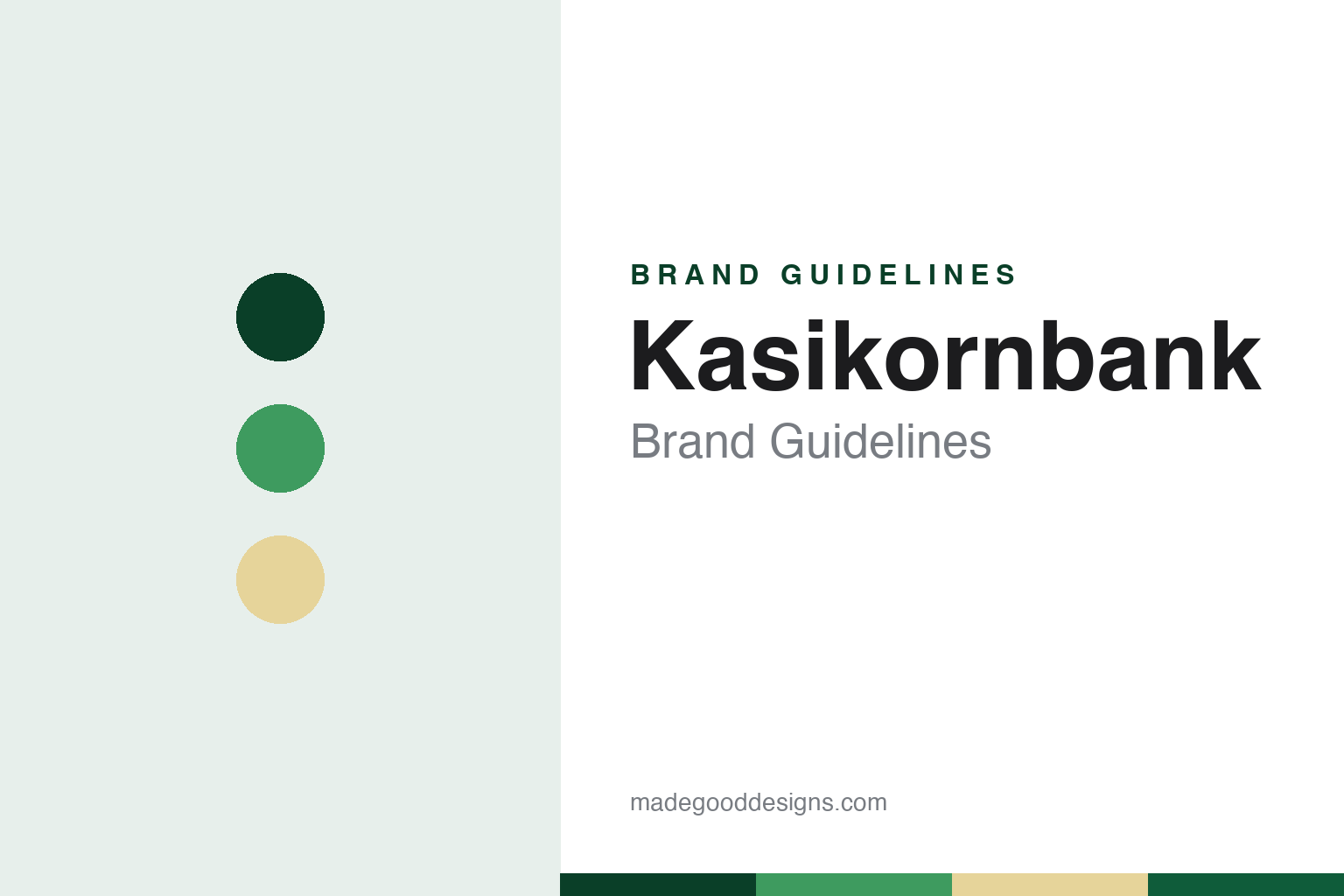
Kasikornbank Brand Guidelines
A farmers’ bank from Suea Pa Road that renamed itself KBank.
Aa
Two constants: a deep green, leaf green and rice gold palette and a geometric sans register. Abstract homage — not a Kasikornbank asset or mark; no logo, card or app screen is reproduced.
Thai Farmers Bank
A Lamsam family bank on Suea Pa Road.
Kasikornbank began as the Thai Farmers Bank. It was founded on 8 June 1945 by Choti Lamsam together with relatives in the Lamsam family, most of them Thais of Chinese descent, and started with 21 staff, Thai Wikipedia says. In its early years it lent mainly to customers who made their living from farming. Its first office stood in the Chinese trading district on Suea Pa Road and is now the bank’s Suea Pa Road main branch; its first branch was at Hat Yai, in Songkhla province. Thai Wikipedia places the founding in the late period of the Second World War. The sources used for this guide do not say how the bank operated in the months before the war ended in August 1945.
By the 1960s it had grown. English Wikipedia says that by 1962 it ranked as Thailand’s ninth-largest commercial bank, with 36 branches. In 1967 it opened branches in London, Hamburg and New York, and that September it moved its head office from Suea Pa Road, where it had stayed for about 22 years, to Silom, Thai Wikipedia says. Later head offices followed on Phahon Yothin Road in 1983 and at Rat Burana in 1995. The bank moved back to Phahon Yothin in May 2021 and, according to the same source, returned to Rat Burana from 31 July 2026.
English Wikipedia credits the bank with several firsts in Thailand, among them the country’s first credit card service, the “Multi-Purpose Credit Card,” in 1973, and the first issue by a Thai bank of floating-rate certificates of deposit on the London market, in 1980. Its shares were listed on the Stock Exchange of Thailand on 11 February 1976, and it registered as a public company limited on 13 May 1993, Thai Wikipedia says.
Colour
From TFB to KBank, in three scripts.
The bank took its present English name on 8 April 2003, when Thai Farmers Bank PCL became Kasikornbank PCL and its official short name changed from TFB to KBank, English Wikipedia says. The new English name follows the bank’s Thai name, which English Wikipedia romanises as Thanakhan Kasikon Thai. The same source notes that the name is often stylised in capitals, and the bank’s own releases write it as KASIKORNBANK.
The identity was then extended into other scripts. In 2007 the bank introduced a logo in three languages, Thai, Chinese and English, English Wikipedia says, and in 2012 it changed the name of its China business to Kāi Tài Yínháng. The same year it became, by English Wikipedia’s account, the first bank through which Myanmar workers could send money home, and added a Burmese menu to its ATMs.
Products followed the same practical line. English Wikipedia lists the K-My Debit Card of 2009, which let customers personalise their cards, off-hours foreign-exchange dealing from 2010, and green bonds issued in 2018, which it calls a landmark for Thailand.
The bank’s retail business now leans on its app and its partners. In August 2023 KBank spun off Kasikorn Investure (KIV), a holding company for 14 companies, to widen its retail financial services with partners; in its release, published on ThaiPR.net, the bank cited more than 20 million customers and its K PLUS mobile app among the resources it would share with them. In November 2025 a Reuters report carried by the Bangkok Post described KBank as Thailand’s second-largest lender. Its chief executive told Reuters the bank was leaning on artificial intelligence and careful lending as the economy slowed, had adjusted its credit policy since 2022, and was not actively studying acquisitions of fintech companies.
Typography
How Southeast Asian banks present themselves.
Southeast Asian banks speak to a wide range of customers at once: city professionals and market traders, exporters and farmers, families in the capital and small businesses in provincial towns. Their identities are built to read clearly on a branch sign, a card and a phone screen. Strong symbols and wordmarks are common, often set in deep blues, greens, purples or golds, and many marks carry a symbol with local meaning: Bangkok Bank, for example, has used the royal lotus as its emblem since 1972, according to Thai Wikipedia.
Names often work in more than one language. Many banks pair a name in the local language with an English name or a short set of initials, and some add a Chinese name for business in China; Kasikornbank introduced a logo in Thai, Chinese and English in 2007, English Wikipedia says. Photography of branches, city skylines and everyday customers carries much of the visual message on websites and in campaigns.
Digital channels sit at the centre of the brand. Bank websites give prominent space to everyday banking, loans and mobile apps, such as Bangkok Bank’s Bualuang mBanking and Kasikornbank’s K PLUS, and to QR payments for shops and market stalls. Many banks also present programmes for small businesses, farmers and communities with less access to banking, and an increasing number present themselves as regional banks, linking customers across borders through subsidiaries in neighbouring countries.
Reporting is the other half of the identity. Listed banks publish annual and sustainability reports, and these documents often carry the most considered typography and photography a bank produces. This guide looks at each brand’s history and what can be checked about how it presents itself, and treats the colours and type shown here as an unofficial interpretation rather than official brand assets.
Aa
A geometric sans — set for Thai, Chinese and English names side by side. (Specimen set in Kanit, a sans STAND-IN; NOT the Kasikornbank logo.)
Across the region
Laos, China, Vietnam and an Indonesian bank renamed.
KBank’s overseas business runs mainly through subsidiaries and branches in Asia. English Wikipedia says it opened a branch in Chengdu in 2013, its second in China, upgraded its Chinese business to a locally incorporated bank in 2017, and set up a full-service locally incorporated bank in Laos in 2014. It was granted a licence for a branch in Ho Chi Minh City on 19 January 2021, and the branch opened that August. The same source lists branches in the Cayman Islands, Hong Kong and Phnom Penh.
In Indonesia KBank built its stake over several years. It bought 9.99% of Bank Maspion in 2017 and took majority control in 2022 with a holding of 67.5%, rising to 84.55% after a capital injection in 2023, RetailNews Asia reported in September 2026; filings from 31 July 2026 showed the Thai group and its units holding 89.48% in all. Nikkei Asia had reported the majority purchase on 30 May 2022, describing Kasikornbank as Thailand’s second-largest bank by assets. The Indonesian bank was renamed PT Bank Kasikorn Indonesia Tbk and formally launched as KBank Indonesia, aiming to connect Indonesian clients with trade and investment flows involving Thailand, Vietnam and China, RetailNews Asia reported; it had rolled out a mobile banking platform called MEB in 2024.
For a design guide, Kasikornbank shows how a bank can keep its Thai name, rename itself in English and add a Chinese name, and set all three in one logo. Compare Bangkok Bank, founded a few months earlier in the same city, and Siam Commercial Bank. For this guide we use a deep green, a leaf green and a rice gold with a geometric sans, an unofficial interpretation; no product or logo is reproduced.
Explore & save
Keep Kasikornbank’s identity on hand — save it to a board in the Made Good inspiration library.
Kasikornbank identity set
Save the Kasikornbank deep green, leaf green and rice gold palette and the geometric sans register to your own board.