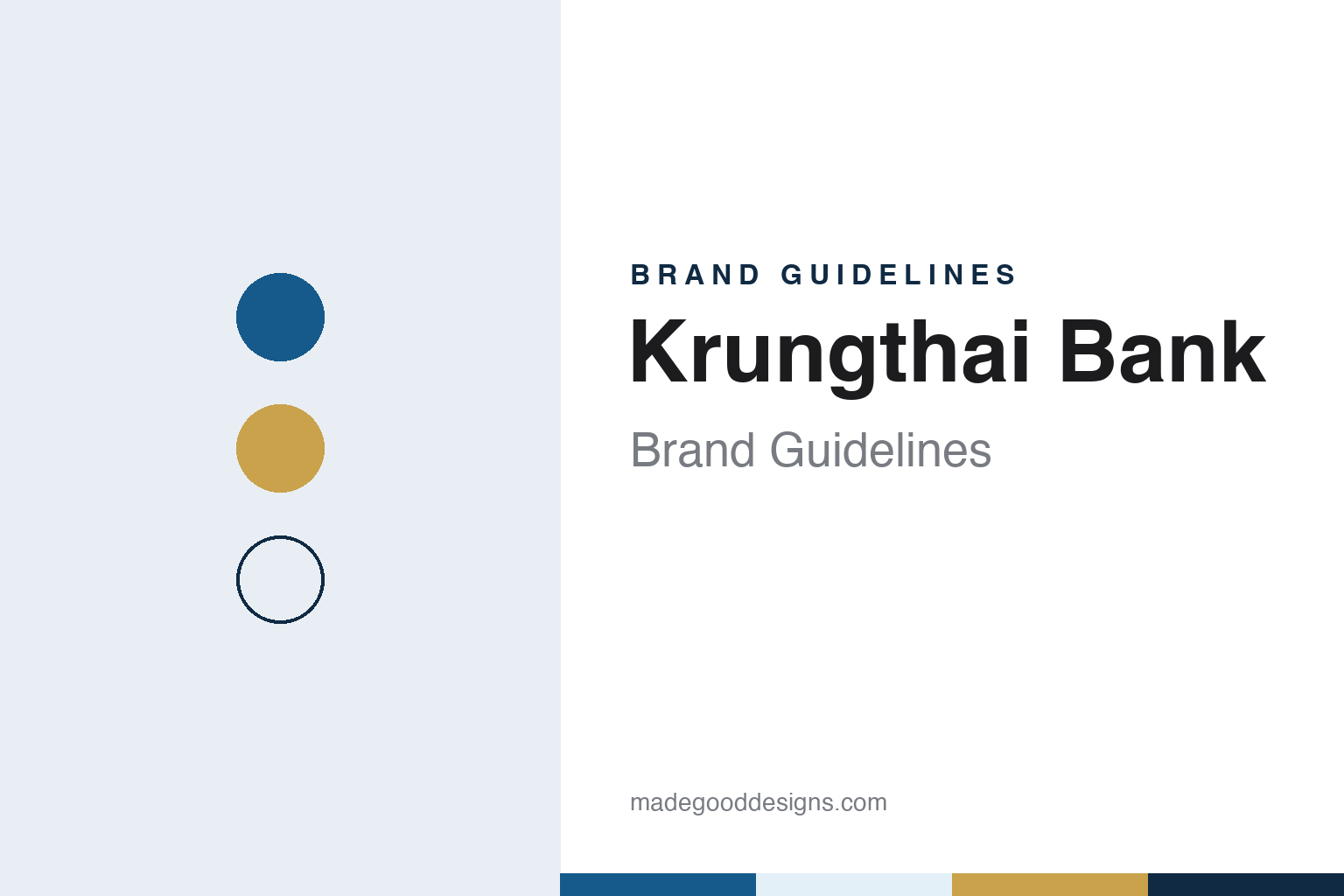
Krungthai Bank Brand Guidelines
A 1966 merger, a mythical wind-eating bird and an app called Paotang.
Aa
Two constants: a blue, sky and gold palette and a public-service sans register. Abstract homage — not a Krungthai Bank product or mark; no logo, bird emblem or card design is reproduced.
Two state banks
A provincial bank and a farmers’ bank become one.
Krungthai Bank was created by merger. English Wikipedia says it came into being on 14 March 1966 when two government-owned banks, Kaset Bank and Monton Bank, were combined under the name Krungthai Bank Limited. Thai Wikipedia says the Ministry of Finance ordered the merger because it took the view that the state should hold a single commercial bank rather than two.
Both predecessors had their own histories. Thai Wikipedia says the older one was founded on 27 January 1942, during the Second World War, as the Thai Bank Company, a state-backed bank set up to take over business left behind when foreign banks stopped operating in Thailand, with a particular role in financing the rice trade. In July 1945 it was renamed Monton Bank, in English the Provincial Bank, to avoid confusion with the new name of the central bank and to match its role in supporting trading firms in the provinces. The second, Kaset Bank, or the Agricultural Bank, was founded on 26 April 1950 by a group of officials and merchants to serve farming customers. Thai Wikipedia says both banks later ran into financial difficulty, received capital from the Ministry of Finance and had become majority state-held by the mid-1960s.
The merged bank first used Kaset Bank’s head office on Yaowarat Road in Bangkok’s Chinatown. Thai Wikipedia says it moved its head office to Sukhumvit Road in 1982, where it remains, and that the Yaowarat building still serves as a branch, with part of it converted into the Krungthai Art Gallery. Over the following decades the bank took on other lenders: Siam Bank in 1987, and in 1998, after the Asian financial crisis, the sound assets and deposits of Bangkok Bank of Commerce, which ceased operating, and the business of Bangkok Metropolitan Bank. In 2005 its Islamic banking services were transferred to the Islamic Bank of Thailand.
Colour
A listed bank with a public role.
Krungthai Bank reached the stock market early. Thai Wikipedia says the bank registered with the Stock Exchange of Thailand on 26 June 1989 and began trading on 2 August 1989; English Wikipedia describes it as the first state enterprise to list its shares on the exchange. It registered as a public company in 1994. The Ministry of Finance remains the major shareholder through the Financial Institutions Development Fund (FIDF), a state-managed fund under the Bank of Thailand; English Wikipedia gives the fund’s holding as 55.31 percent.
That ownership shapes the bank’s everyday work. English Wikipedia says Krungthai lends to businesses supported by public programmes, including One Tambon One Product (OTOP) loans and education loans, and that most government agencies use it for disbursements such as tax refunds and pension payments. Thai Wikipedia adds salaries for civil servants and payouts for state welfare cards to that list. English Wikipedia counted 924 domestic branches in May 2024, the largest number of any commercial bank in Thailand by its count, and branches abroad in Phnom Penh, Vientiane and Mumbai.
The bank’s digital face arrived in 2018. Thai Wikipedia dates the launch of Krungthai NEXT, an app for the bank’s own account holders, and Paotang, an open app that any Thai citizen can register for, to October 2018; English Wikipedia places the first launch in January of that year. Paotang became a channel for government programmes and later for buying government savings bonds. Bangkok Post reported on 31 October 2024 that Krungthai had been named Derivatives House of the Year, Thailand at the AsiaRisk Awards 2024, organised by Risk.net, and noted its Government Bond Wallet on Paotang alongside a Bond Wallet and a Gold Wallet.
Typography
How the category presents itself.
Southeast Asian banks speak to a wide range of customers at once: city professionals and market traders, exporters and farmers, families in the capital and small businesses in provincial towns. Their identities are built to read clearly on a branch sign, a card and a phone screen. Strong symbols and wordmarks are common, often set in deep blues, greens, purples or golds, and many marks carry a symbol with local meaning: Bangkok Bank, for example, has used the royal lotus as its emblem since 1972, according to Thai Wikipedia.
Names often work in more than one language. Many banks pair a name in the local language with an English name or a short set of initials, and some add a Chinese name for business in China; Kasikornbank introduced a logo in Thai, Chinese and English in 2007, English Wikipedia says. Photography of branches, city skylines and everyday customers carries much of the visual message on websites and in campaigns.
Digital channels sit at the centre of the brand. Bank websites give prominent space to everyday banking, loans and mobile apps, such as Bangkok Bank’s Bualuang mBanking and Kasikornbank’s K PLUS, and to QR payments for shops and market stalls. Many banks also present programmes for small businesses, farmers and communities with less access to banking, and an increasing number present themselves as regional banks, linking customers across borders through subsidiaries in neighbouring countries.
Reporting is the other half of the identity. Listed banks publish annual and sustainability reports, and these documents often carry the most considered typography and photography a bank produces. This guide looks at each brand’s history and what can be checked about how it presents itself, and treats the colours and type shown here as an unofficial interpretation rather than official brand assets.
Aa
A clear public-service sans for Thai and Latin text. (Specimen set in Sarabun, a sans STAND-IN; NOT the Krungthai Bank logo.)
Krungthai Bank
The Vayupaksa bird and a new virtual bank.
The bank’s emblem ties it to the state. English Wikipedia says the merged bank took as its logo an image of the Vayupaksa, a mythical bird said to feed on the wind, which is also the symbol of the Ministry of Finance. The short name Krungthai, written as one word in English, and the initials KTB appear across its branches and apps. No official colour specification is cited here; the tones on this page are our own reading.
The newest part of the group is a virtual bank. The Paypers reported on 4 November 2026 that CLICX, a virtual bank formed by Krungthai Bank with the mobile operator AIS and PTT Oil and Retail Business (OR), had reached operational readiness in line with the Bank of Thailand’s timetable. It said CLICX aims to serve freelancers, daily earners and small entrepreneurs, offering nano-loans and digital personal loans, and plans to place its services inside the three partners’ mobile, retail and payment channels.
Taken together, the bank’s public role and its apps give it a broad audience: civil servants collecting salaries, farmers and small businesses taking loans through public programmes, and citizens using Paotang for state schemes and savings bonds. The 1942 and 1950 origins of its two predecessors, the Yaowarat head office turned gallery and the 1989 listing give the brand a long institutional story to draw on.
For a design guide, Krungthai Bank shows how a state-linked bank can use a shared national emblem, a plain bilingual name and an open app to address almost every household in a country, while keeping the look of a listed commercial bank. Compare it with Bangkok Bank and Siam Commercial Bank, two Bangkok neighbours. For this guide we use harbour blue, sky wash and rice gold with a sans, an unofficial interpretation; no product or logo is reproduced.
Explore & save
Keep Krungthai Bank’s identity on hand — save it to a board in the Made Good inspiration library.
Krungthai Bank identity set
Pin the Krungthai Bank blue, sky and gold palette and the public-service sans register to your own board.