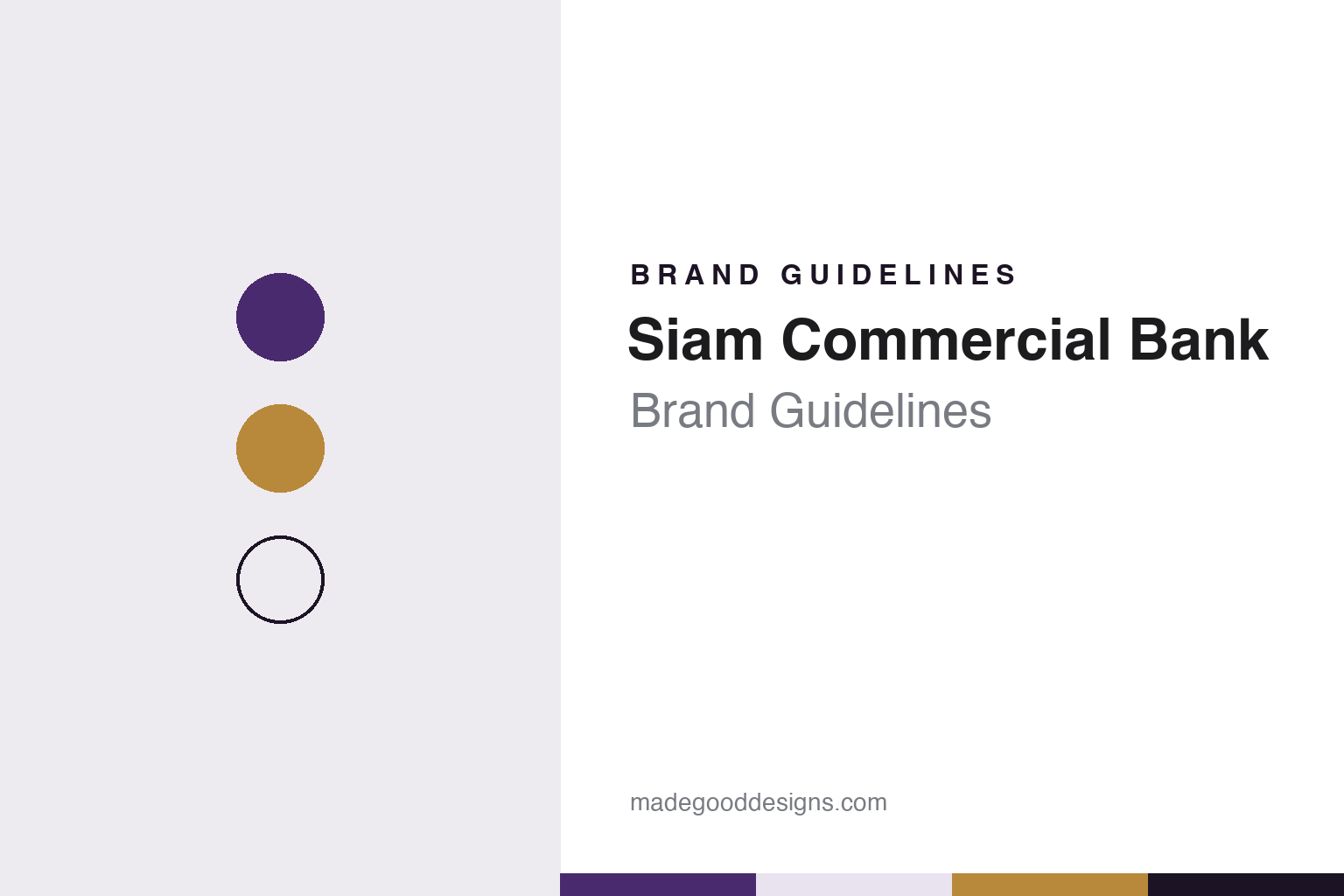
Siam Commercial Bank Brand Guidelines
A 1904 “Book Club”, a royal charter and a holding company called SCB X.
Aa
Two constants: a plum, lilac and gold palette and a bilingual sans register. Abstract homage — not a Siam Commercial Bank product or mark; no logo, emblem or card design is reproduced.
The Book Club
A bank that started under a quieter name.
Siam Commercial Bank started life under a deliberately modest name. English Wikipedia says the Book Club was set up on 4 October 1904 by Prince Jayanta Mongkol, a brother of King Chulalongkorn, who wanted Siam to have a banking system of its own rather than relying on the branches of foreign banks. Thai Wikipedia adds that the plain name was chosen so that foreign observers would not learn of the plan to found a Siamese bank before anyone knew whether it would work.
The experiment grew, and the king granted a royal charter for a company called, in Thai, Bank Siam Kammachon. The bank itself says it was “established by royal charter on January 30, 1906 as the first Thai bank”. English Wikipedia gives the same day as 30 January 1907. The two dates describe one event: Thai Wikipedia records it as 2449 in the old Thai calendar, whose year then began in April, which corresponds to January 1907 in the Gregorian count.
The early milestones are set out in the Thai Wikipedia timeline. The bank opened in the Book Club’s old premises, moved its head office to Talat Noi on the Chao Phraya river in 1910, opened its first branch in 1912 and its first regional branch, at Thung Song in the south, in 1920. Chiang Mai followed in 1927 and Lampang in 1930; the Lampang branch is described there as the oldest regional branch still trading from its original building. In 1911, English Wikipedia says, King Vajiravudh granted the bank the right to display the royal Garuda as a royal warrant.
The war years are part of the record. In January 1939 the Thai name became Thanakhan Thai Phanit and the English name changed to “The Thai Commercial Bank”, following the change of the country’s name. In 1942 the bank appointed its first Thai managing director, in 1943 it opened a fourth regional branch at Nakhon Ratchasima, and in 1946 it went back to the English name Siam Commercial Bank, which Thai Wikipedia says was familiar to foreign customers and reflected the bank’s roots.
Colour
Machines, apps and a museum.
For much of the twentieth century the bank’s story was one of steady growth and early technology. Thai Wikipedia lists electronic current-account posting machines in 1962, a new head office on New Petchburi Road in 1971 and a listing on the Stock Exchange of Thailand in 1976. English Wikipedia says that in 1983 SCB introduced Thailand’s first automated teller machines and founded the Thai Bank Museum, a collection of banking history that sits naturally beside a bank that dates its charter to the reign of King Chulalongkorn.
The bank became a public company in 1993 and moved its head office in 1996 to SCB Park Plaza at Ratchayothin in northern Bangkok, where it remains. The Asian financial crisis of 1997 reached Thai banks hard. Thai Wikipedia says SCB responded in 1998–1999 by restructuring debt, cutting costs and raising new capital through share offers to existing shareholders and foreign investors, and that the bank came through the period. By 2010, it adds, the network had reached 1,000 branches.
Digital banking followed. English Wikipedia lists SCB E PASSBOOK, an account without a paper passbook, in 2016; a rebuilt SCB EASY app with cardless ATM withdrawals in 2017; and, in 2018, an end to fees on transactions made through the app. Thai Wikipedia adds that the bank closed its older internet-banking service, SCB Easy Net, in July 2023 and moved those customers to the app. The bank’s own pages describe it as a universal bank serving retail, corporate and SME customers, with home loans, credit cards and remittances, and they set out a long-running strategy called SCB Transformation under the vision of becoming “The Most Admired Bank”.
Scale is given here only as sources state it. In June 2025 Fitch Ratings, in a rating note carried by ThaiPR.net, called SCB one of the largest commercial banks in Thailand, with a deposit market share of about 14 percent. English Wikipedia counted 643 domestic branches in May 2024.
Typography
How the category presents itself.
Southeast Asian banks speak to a wide range of customers at once: city professionals and market traders, exporters and farmers, families in the capital and small businesses in provincial towns. Their identities are built to read clearly on a branch sign, a card and a phone screen. Strong symbols and wordmarks are common, often set in deep blues, greens, purples or golds, and many marks carry a symbol with local meaning: Bangkok Bank, for example, has used the royal lotus as its emblem since 1972, according to Thai Wikipedia.
Names often work in more than one language. Many banks pair a name in the local language with an English name or a short set of initials, and some add a Chinese name for business in China; Kasikornbank introduced a logo in Thai, Chinese and English in 2007, English Wikipedia says. Photography of branches, city skylines and everyday customers carries much of the visual message on websites and in campaigns.
Digital channels sit at the centre of the brand. Bank websites give prominent space to everyday banking, loans and mobile apps, such as Bangkok Bank’s Bualuang mBanking and Kasikornbank’s K PLUS, and to QR payments for shops and market stalls. Many banks also present programmes for small businesses, farmers and communities with less access to banking, and an increasing number present themselves as regional banks, linking customers across borders through subsidiaries in neighbouring countries.
Reporting is the other half of the identity. Listed banks publish annual and sustainability reports, and these documents often carry the most considered typography and photography a bank produces. This guide looks at each brand’s history and what can be checked about how it presents itself, and treats the colours and type shown here as an unofficial interpretation rather than official brand assets.
Aa
A bilingual sans for Thai and Latin text. (Specimen set in Bai Jamjuree, a sans STAND-IN; NOT the Siam Commercial Bank logo.)
Siam Commercial Bank
A Garuda warrant, a refreshed mark and a holding company.
The visual identity has a long thread and a modern finish. The royal Garuda granted in 1911 gives the bank an emblem with deep roots, and Thai Wikipedia records that in 2010 the bank refreshed its corporate identity and logo to make them simpler and more modern, in the same year its network passed 1,000 branches. No official colour specification is cited here; the tones on this page are our own reading.
The company structure changed in 2021 and 2022. Thai Wikipedia says the bank announced in 2021 that it would place itself and its subsidiaries under SCB X Public Company Limited, converted from an existing holding company, and that shareholders swapped bank shares for holding-company shares between March and April 2022. The process was completed in May 2022; the bank’s shares left the exchange and the SCB ticker passed to the holding company. Fitch’s June 2025 note describes SCB X as the group’s holding company and Siam Commercial Bank as its main bank subsidiary, accounting for about 95 percent of group assets. Subsidiaries listed on Thai Wikipedia include the card and personal-loan business CardX, the brokerage InnovestX and the technology company SCB TechX.
One new venture is still pending. The Korea Herald reported on 30 March 2026 that SCB X had filed to set up Bank X as a new subsidiary for a virtual bank planned with Korea’s Kakao Bank and WeBank Technology Services, after the Bank of Thailand approved the consortium in July 2025; operations were expected to begin later, and the bank had not opened at the time of writing.
For a design guide, Siam Commercial Bank shows how a bank with a royal charter, a Garuda warrant and a century of branch architecture can carry that heritage into an app-first service and a holding-company brand without losing its name. Compare it with Kasikornbank and Bangkok Bank, its Bangkok neighbours. For this guide we use royal plum, lilac mist and temple gold with a sans, an unofficial interpretation; no product or logo is reproduced.
Explore & save
Keep Siam Commercial Bank’s identity on hand — save it to a board in the Made Good inspiration library.
Siam Commercial Bank identity set
Pin the Siam Commercial Bank plum, lilac and gold palette and the bilingual sans register to your own board.