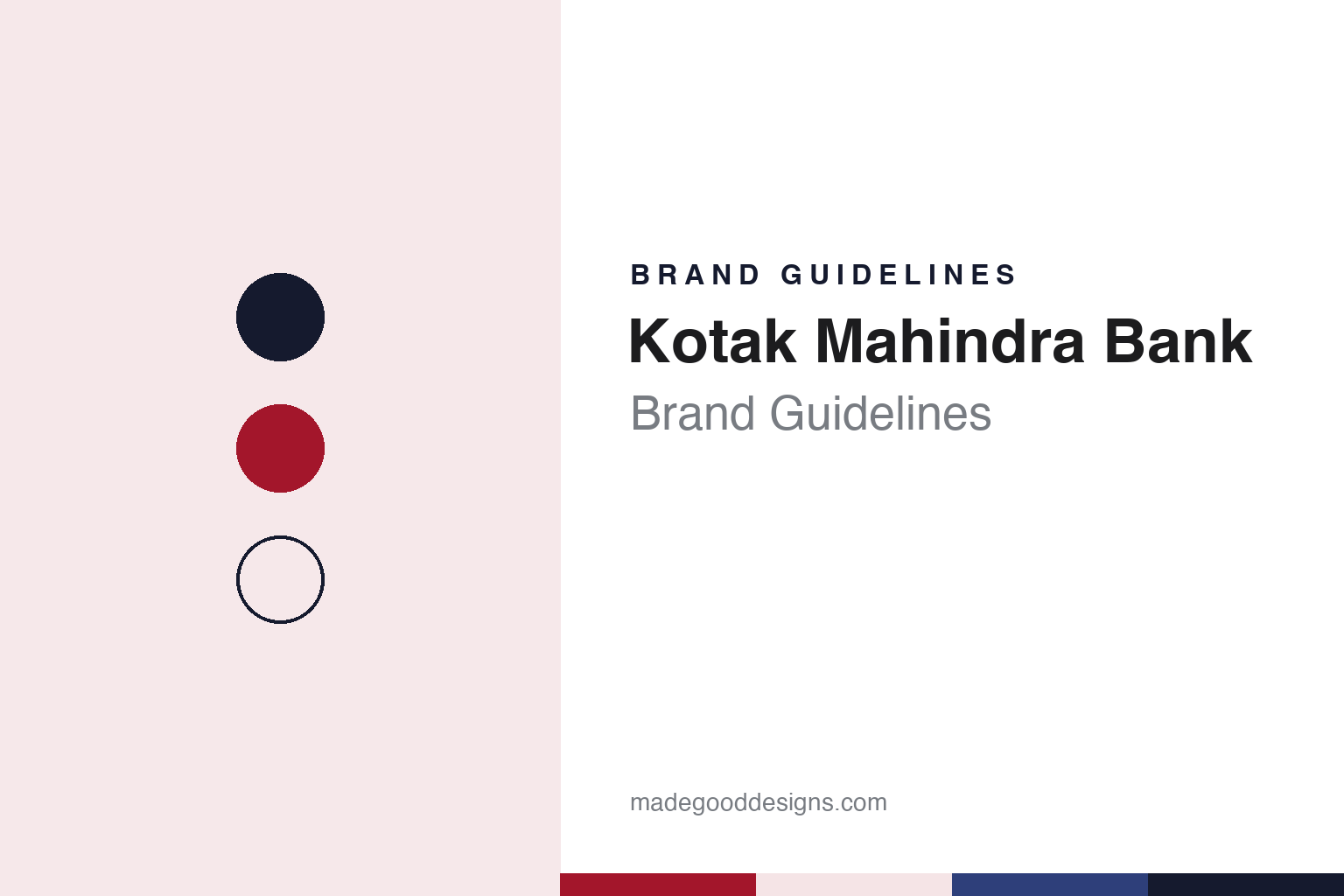
Kotak Mahindra Bank Brand Guidelines
A 1985 finance firm, a 2003 banking licence and a digital account named 811.
Aa
Two constants: a deep red and navy palette and a geometric sans register. Abstract homage — not a Kotak Mahindra Bank product or mark; no logo, card or branch sign is reproduced.
From bill discounting to a bank
A finance company that became a bank.
Kotak Mahindra Bank began as a finance company, not a bank. In 1985 Uday Kotak founded Kotak Capital Management Finance in Mumbai, and its first business was bill discounting, the bank’s own timeline says. English Wikipedia records that an early investment from the Mahindra family the following year gave the company the second half of its name, and it became Kotak Mahindra Finance; the bank’s timeline adds lease and hire purchase to the early work.
Through the 1990s the company grew into a group of financial businesses. English Wikipedia lists a car-finance joint venture with Ford Credit International and an investment-banking company started in partnership with Goldman Sachs, both in 1996; a mutual-fund arm in 1998; and a life-insurance venture with Old Mutual in 2001. The partners later sold out: the bank bought Ford Credit’s share in 2005, Goldman Sachs’ holdings in 2006 and Old Mutual’s stake in April 2017, the same article says.
The decisive change came in February 2003, when the Reserve Bank of India granted Kotak Mahindra Finance a banking licence and the company was renamed Kotak Mahindra Bank. The bank describes itself as the first non-banking finance company in India to convert into a commercial bank, and English Wikipedia gives the same description. Its headquarters remain in Mumbai.
Colour
A merger, a number and a brand line.
The bank’s largest step in size was a merger. In 2014 it announced that it would take over ING Vysya Bank, the Indian bank controlled by the Dutch ING Group; the bank’s own timeline says the Reserve Bank approved the merger with effect from 1 April 2015. English Wikipedia says ING Group took a stake in Kotak as part of the deal.
Its most visible product name came two years later. In March 2017 the bank launched Kotak 811, an account opened online, which it calls a full-service digital banking ecosystem. English Wikipedia says the name refers to 8 November, the date of the 2016 demonetisation announcement, and that the account helped the bank double its customer numbers by September 2018. The number now runs across the range, from the Kotak811 credit card to a metal debit card of the same name.
The group also changed its insurance holdings. On 19 June 2024 Zurich Insurance announced that it had completed the purchase of a majority stake in Kotak’s general-insurance company, a statement the bank carries on its own site, leaving Zurich as the majority owner of that business. Other deals filled gaps in lending: the group bought the vehicle-finance portfolio of Volkswagen Finance India in 2021, and in February 2023 it signed agreements to buy Sonata Finance, a microfinance company that it said had 502 branches across ten states; English Wikipedia records that purchase as completed in 2023. In 2014 it also took a 15 percent stake in the Multi Commodity Exchange of India, the bank’s timeline says.
The verbal identity was refreshed in 2025. On 25 February 2025 the bank introduced a new group brand philosophy, “Hausla Hai Toh Ho Jayega” — roughly, “if you have the courage, it can be done” — aimed, it said, at the “Aspirational Indian.” On 6 July 2026 it followed with “Hausla 2.0”, which it describes as the second chapter of the same brand platform. The line is in Hindi, while the rest of the bank’s product names are in English.
Typography
How Indian banks present themselves.
Indian banks tend to present themselves through a short name and a bold symbol. The State Bank of India’s keyhole, drawn at the National Institute of Design in Ahmedabad and adopted in 1971, replaced a banyan tree, The Hindu BusinessLine reported, and in 2017 the bank cut its long name to the letters SBI beside that symbol, The Economic Times reported. Across the sector, blues, reds and oranges are common in bank marks, usually pairing one symbol with a short wordmark.
Language is part of the identity. The keyhole came with matching lettering of the bank’s name in nine Indian languages, according to BusinessLine, and Indian bank signs and websites commonly set Hindi and English names side by side, with regional scripts added in different states. Names change too: UTI Bank became Axis Bank in 2007 because other organisations used the UTI name, Mint reported, and the merger of five associate banks into SBI on 1 April 2017 took their names off branch signboards, The Hindu reported.
Bank websites follow a common pattern. Pages on savings accounts, loans and cards sit beside digital banking apps, branch and cash-machine locators, and photographs of branches and staff. Financial inclusion has a long history in the sector’s self-presentation: BusinessLine dates its start to the nationalisation of fourteen banks in 1969, and government schemes such as the Pradhan Mantri Jan Dhan Yojana appear in the State Bank of India’s website menus. The websites of both the State Bank of India and Axis Bank now sit at addresses ending in .bank.in.
Annual reports and corporate social responsibility programmes complete the picture, setting out branch networks, rural reach and foundation work. This guide sets out what can be checked about each bank — when it was founded, how its name and ownership changed, and what is documented about its symbol — and marks clearly what rests only on the bank’s own word.
Aa
A geometric sans — clean, wide letterforms for a digital-first bank. (Specimen set in Manrope, a sans STAND-IN; NOT the Kotak Mahindra Bank logo or typeface.)
Kotak Mahindra Bank
Regulators, a deal and a digital channel.
The bank’s digital channel was briefly restricted. On 24 April 2024 the Reserve Bank of India, using its powers under Section 35A of the Banking Regulation Act, 1949, directed the bank to stop onboarding new customers through its online and mobile banking channels and to stop issuing fresh credit cards; English Wikipedia says the regulator cited deficiencies in the bank’s IT systems, and that existing customers were not affected. On 12 February 2025 the Reserve Bank lifted the restrictions after the bank had carried out remedial measures and commissioned an external audit, approved in advance by the regulator, to validate them, according to the regulator’s statement as published by FintechBizNews. The bank said it welcomed the decision.
Its newest deal is still in progress. On 30 June 2026 Kotak and Deutsche Bank announced a definitive agreement for Kotak to acquire Deutsche Bank’s retail banking, affluent private banking and wealth management business in India, which served around 150,000 customers with about 1,000 employees, according to Deutsche Bank’s media release. The purchase was agreed in June 2026 and had not been completed at the time of writing.
The group today spans banking, securities, asset management, life insurance and lending, English Wikipedia says, with an international branch at the Dubai International Financial Centre, regulated by the Dubai Financial Services Authority, according to the bank, and further branches listed by English Wikipedia in GIFT City and London. Like other Indian banks it has moved its website to a .bank.in address, and the older kotak.com address now forwards there.
For a design guide, Kotak Mahindra Bank shows how a finance company can turn a date into a product name and a Hindi phrase into a brand platform. Compare HDFC Bank, another Mumbai private-sector bank, and ICICI Bank. For this guide we use a deep red, a night navy and a pale rose with a geometric sans, an unofficial interpretation; no product or logo is reproduced.
Explore & save
Keep Kotak Mahindra Bank’s identity on hand — save it to a board in the Made Good inspiration library.
Kotak Mahindra Bank identity set
Pin the deep red, navy and rose palette and the geometric sans register to your own board.