Pimax Brand Guidelines
The wide-FOV maximalist.
Aa
Two constants: a panoramic-amber palette and a maximalist-sans register. Abstract homage — not a Pimax product or mark; no headset, visor or logo is reproduced.
The wide-FOV maximalist
Pimax is the Shanghai maker chasing the widest field of view and highest resolution, whose ambitions sometimes outrun its shipping.
Pimax brings the round its maximalist node — the Chinese company that competes not on comfort or price but on sheer numbers, the widest field of view and the highest resolution it can build. Its answer to a round about who owns the VR headset and where it is made is a plain one, with a caveat about ambition: a private Shanghai company, made in China, whose specs sometimes outrun its shipping.
Its identity is the wide-FOV maximalist. The ultra-wide field of view, the very high resolution and the ambition-outrunning-delivery caveat are the story here. A headset, maximalist. The wide-FOV maximalist.
(Honest notes, so the products, the ownership and a reputation are framed carefully. Pimax sells high-specification PC and hybrid headsets as its heroes — the Crystal, the 8K Crystal Super, the lighter Crystal Light, earlier 8K models and the Dream Air — with a signature ultra-wide field of view up to around 200 degrees and very high resolution per degree; we report its specification claims as its own. On ownership: Pimax Innovation is a private, venture-backed company based in Shanghai, founded in November 2015 by Zhibin Weng. On a caveat we handle carefully: Pimax has a widely-reported reputation for shipping delays, over-promised specifications and customer refund and warranty complaints across 2023 and 2024, which we frame as reported rather than assert as fact, and we do not restate its unverified spec claims as settled. On a concrete example: its 12K QLED headset, announced in 2021, remained unreleased as of early 2026, blocked by panel and bridge-chip availability, so we present it as unreleased, not shipping. On nationality: Chinese, not Western. On where it is made: China. Its designs, the Pimax and Crystal names and its wide-body form are IP we describe but do not reproduce; these tones are an unofficial interpretation.)
Colour
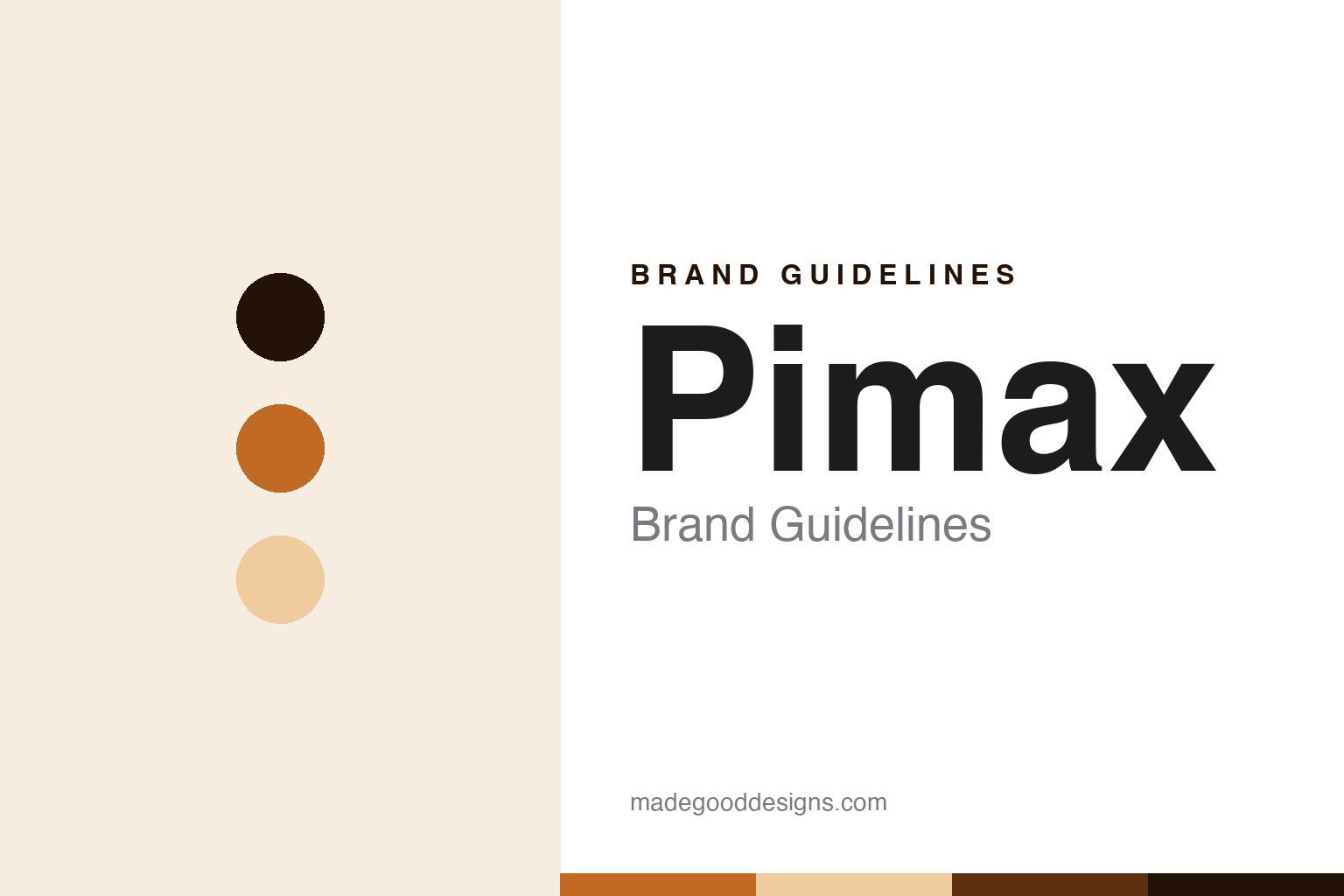
Pimax lives in a panoramic amber. Click a swatch to copy the hex.
Pimax’s identity is maximalist, ambitious and spec-led — a panoramic amber, an ink, a pale sand, a deep rust, and a paper. The palette leans panoramic amber and pale sand: a warm, expansive register that nods to a wide field of view rather than a loud logo colour. It signals the wide-FOV maximalist — maximalist, ambitious and spec-led. The honest caveat: with no published brand hex, these values are an original, unofficial interpretation, not first-party colours.
The lesson is a panoramic amber signals a maximalist, ambitious identity. Pimax’s world is a headset that fills your whole field of view. For designers, it is a reminder that a warm panoramic amber and a soft pale sand can carry a hardware brand — an expansive tone held as colour, not a product shot. Because these tones can fail as small text, keep type dark and let the colour live in the accents, palette and band. The takeaways: date it to 2015 and name Weng; lead with the wide FOV and high resolution; frame the delay-and-complaint reputation as reported, not asserted; and present the 12K as unreleased.
Typography
The register is a maximalist sans — maximalist, ambitious, spec-led.
Pimax’s identity carries a maximalist, ambitious, spec-led spirit — an enthusiast brand that pushes numbers, not a mainstream one. A maximalist sans captures the mood: bold, technical and confident, the register of a spec-chasing headset. Set in a panoramic-amber palette, the maximalist sans feels maximalist and ambitious — exactly the personality Pimax carries. It behaves like a made, technical thing rather than a loud logo, mirroring a wide lens-flare arc and a dense pixel grid. (Pimax’s real products, the names and the form are things we describe but do not reproduce, and the exact typeface is not ours to use.) Because it is not ours to use, the honest description is “a maximalist-sans brand,” shown here in a stand-in. The type behaves like the brand: maximalist, ambitious and spec-led.
Aa
A maximalist-sans brand — maximalist and ambitious. (Specimen set in Manrope, a maximalist-sans STAND-IN; NOT the Pimax logo or the wide-body form.)
The VR headset
Pimax stands for the wide-FOV maximalist.
Pimax brings the round its maximalist node. A panoramic-amber palette, a maximalist sans and a 2015 founding make one thing — the wide-FOV maximalist — the whole identity: maximalist, ambitious and spec-led. The ultra-wide field of view is the pitch, and the high resolution is the proof — with the caveat that ambition can outrun delivery. The point is a Chinese company that competes on numbers, in a round about who owns the VR headset and where it is made.
Put to work, the identity is the brand told straight, the ambition credited and the caveat kept honest. A brand in this spirit would date it to 2015 and name Weng, lead with the wide FOV, and frame the delay reputation as reported. A reader in this spirit would keep the facts right: Pimax sells the Crystal line and Dream Air as heroes; it is a private Shanghai company founded in 2015 by Zhibin Weng; its differentiator is ultra-wide FOV and high resolution; its 12K remains unreleased; and it has a reported reputation for delays and complaints. Pimax sits fifth in the round, after HTC Vive. The honest editorial moves are to date it and name Weng, to lead with the wide FOV, to frame the delay reputation as reported, and to present the 12K as unreleased.
For designers and brand-builders, Pimax continues the VR headset: compete on maximal specs — and frame reputation and vaporware honestly. The lessons: chasing the extreme end of a spec, here field of view and resolution, is a real enthusiast identity; ambition that outruns shipping is part of the honest story, framed as reported rather than asserted; announced-but-unreleased products, the 12K, must be presented as unreleased, not shipping; and unverified spec claims should not be restated as settled. It is also a reminder to stay precise: Pimax is the Shanghai maker chasing the widest field of view and highest resolution, whose ambitions sometimes outrun its shipping — with the palette here an unofficial interpretation. The hook is that maximalism: Pimax builds for enthusiasts who want the widest possible field of view and the highest resolution, a Shanghai company whose ambition is genuine and whose reach sometimes exceeds its grasp — its headline 12K, announced in 2021, still unreleased years later. Read that way, Pimax is less a mainstream brand than a wide-FOV maximalist: maximalist, ambitious, spec-led. The lesson for a brand is that maximal ambition and honest reputation-framing reinforce each other, and presenting the 12K as unreleased keeps the story earned. Pimax made the-wide-FOV-maximalist the identity — proof that maximal specs can carry a round.
Explore & save
Keep Pimax’s identity on hand — save it to a board in the Made Good inspiration library.
Pimax identity set
Pin the panoramic-amber palette and the maximalist-sans register to your own board.