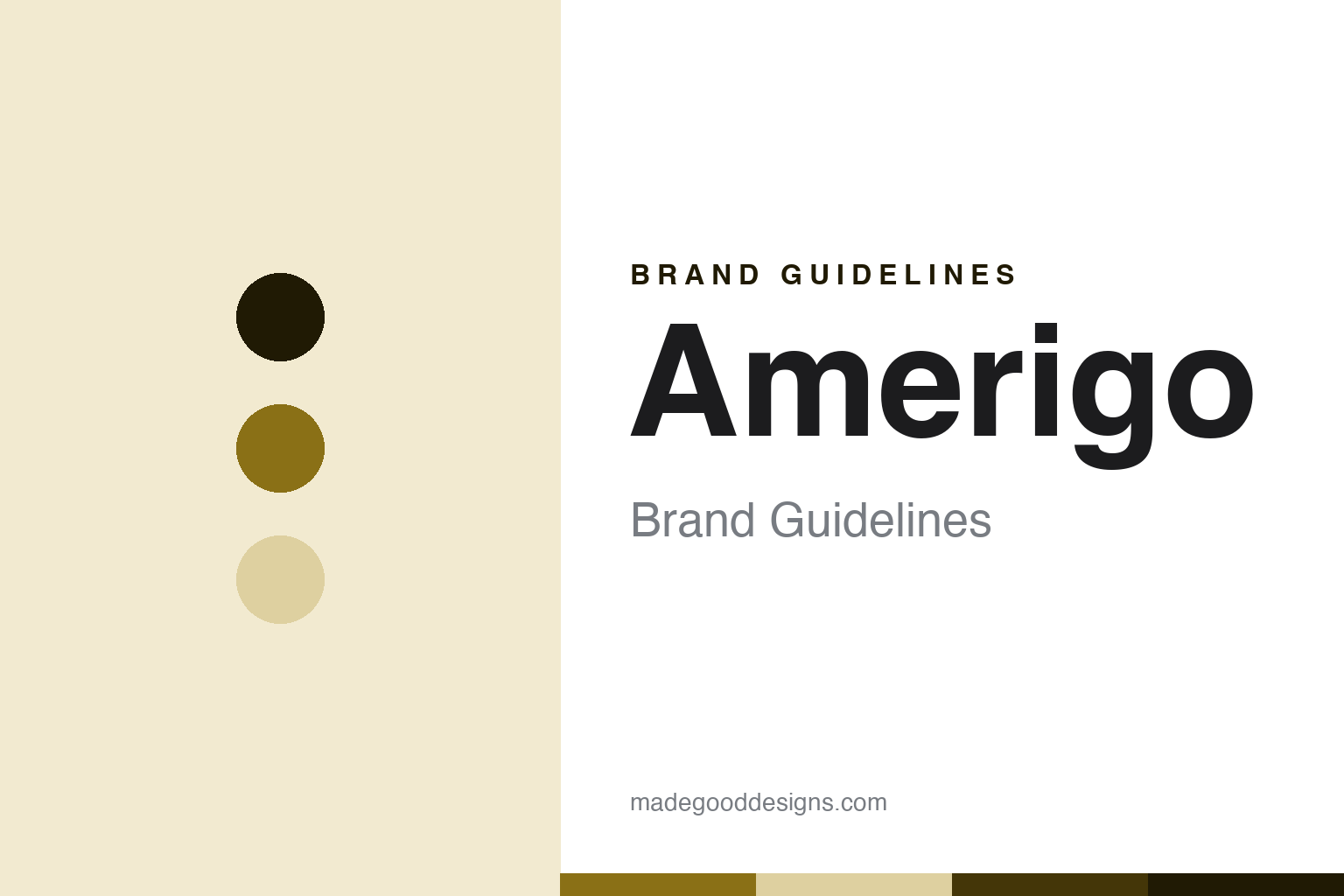
Amerigo Brand Guidelines
The designer who left the page.
Aa
Two constants: an Amerigo-brass palette and an absorbed-brand-sans register. Abstract homage — not an Amerigo product or mark; no saddle, tree or panel is reproduced.
The designer who left the page
Amerigo is an Italian-made saddle brand born of a Swiss–Italian collaboration in 1998 — and the Swiss designer who shaped it no longer appears on the pages that now sell it.
Amerigo closes the saddle round as its absorbed node, and it is the round’s quietest and most instructive story. Nothing dramatic happened. No sale was announced, no split, no statement. A brand simply moved fully inside its parent, and the designer who gave it its character stopped being mentioned. Its answer to a round about who owns and where-makes the saddle is an authorship that faded rather than transferred: the designer who left the page.
Its identity is the designer who left the page. The 1998 founding, the wool-flocked panel and a quiet absorption are the story here. The saddle. The designer who left the page.
(Honest notes, so the ownership, the authorship, the making and the limits of what can be said are framed accurately. On ownership, the correction that matters most: Amerigo is not a manufacturer in its own right and has no factory of its own. It is one of two in-house brands of the Italian group at Valdagno in the province of Vicenza — the parent’s own words — alongside its sibling brand, and the two are made by the same hands in the same works. On authorship: the brand began in 1998 as a Swiss–Italian collaboration, and the design concept and worldwide brand management were run from the Swiss designer’s own company at Herisau in eastern Switzerland; the brand’s own catalogue of a few years ago credited both companies on its cover and called Herisau the nerve centre. On what changed, carefully: the parent’s current Amerigo pages contain no mention of the designer, his company, Herisau, Switzerland or the 1998 date. That is a documented absence, not a documented ending. No split has been announced, and the designer’s own site still lists the brand. So the accurate statement is that the current scope of his role is not stated on the brand’s present-day pages — not that the partnership ended. On the making: designed and made in Italy at the Valdagno works, though the brand’s own catalogue says Italian and French leathers, so Italian-made does not mean entirely Italian-materialled. On a naming trap worth flagging for buyers: one of the words that appears in retailer listings as if it were a model name is in fact a leather type. Its marks are IP we describe but do not reproduce; there is no official brand hex.)
Colour
Amerigo lives in an Amerigo brass. Click a swatch to copy the hex.
Amerigo’s identity is Italian-made, Swiss-designed and absorbed — an Amerigo brass, an ink, a pale wheat, a deep bronze, and a paper. The palette leans Amerigo brass and deep bronze: a tack-room register that stands in for a wool-and-timber saddle rather than a loud logo colour. It signals the designer who left the page — Italian-made, Swiss-designed and absorbed. The honest caveat: with no official brand hex, these values are an unofficial interpretation, not first-party colours.
The lesson is a brand can lose its author without anyone deciding to remove him. This is worth sitting with, because it is how most authorship actually disappears — not by erasure but by attrition. A site gets rebuilt. The new template has no room for a partner company. The catalogue that credited two names goes out of print. A configurator replaces a story. Nobody ever decides that the designer should go; the pages are simply rewritten by people solving a different problem, and one version later he is gone. For anyone maintaining a brand, that is the practical warning: authorship lives in the pages you happen to keep, so if a founder or designer matters to the identity, someone has to own that fact through every redesign or it will quietly lapse. Because a strong hue can fail as small text, keep type dark and let the colour live in the accents, palette and band. The takeaways: date the brand to 1998; name the parent as the maker; describe the Swiss role in the past tense and say why; and never cite the obvious-looking domain, which is a parked listing for sale.
Typography
The register is an absorbed-brand sans — Italian-made, Swiss-designed, quiet.
Amerigo’s identity carries an Italian, traditionalist spirit — wool flocking and a wooden spring tree against a lighter composite sibling line. An absorbed-brand sans captures the mood: neutral, catalogue-like and unsentimental, the register of a brand now presented through a parent’s configurator rather than its own voice. Set in an Amerigo-brass palette, the absorbed-brand sans feels managed rather than authored — which is, precisely, the story. It behaves like a flocked, stitched thing rather than a loud logo, mirroring a wool panel and a tree arc. (Amerigo’s real products, its panel systems and the name itself are things we describe but do not reproduce, and the exact typeface is not ours to use.) Because it is not ours to use, the honest description is “an absorbed-brand-sans brand,” shown here in a stand-in. The type behaves like the brand: Italian-made, Swiss-designed and quiet.
Aa
An absorbed-brand-sans brand — neutral and catalogue-like. (Specimen set in Manrope, an absorbed-brand-sans STAND-IN; NOT the Amerigo logo or products.)
The absorbed node
Amerigo stands for the designer who left the page.
Amerigo closes the round as its absorbed node. An Amerigo-brass palette, an absorbed-brand sans and a 1998 founding make one thing — the designer who left the page — the whole identity: Italian-made, Swiss-designed and quiet. The 1998 collaboration is the frame, the wool-flocked panel is the substance, and the vanished credit is the signature. The point is a brand whose authorship has faded from its own marketing without any announcement, closing a round about who owns and where-makes the saddle on the subtlest version of the question.
Put to work, the identity is the absence reported honestly rather than dramatised. A brand in this spirit would date the brand to 1998, name the Italian parent as owner and maker, place manufacture at Valdagno in the province of Vicenza, describe the Swiss designer’s role in the past tense while stating plainly that no ending has been announced and that his own site still lists the brand, and decline to say the partnership is over. A reader in this spirit would keep the facts right: Amerigo makes wool-flocked saddles; the brand dates to 1998; it is owned and produced by an Italian group; and it is a brand, not a factory. Amerigo closes the round, after Prestige Italia. The honest editorial moves are to date the brand, to name the maker, to describe the absence, and to resist the conclusion it invites.
For designers and brand-builders, Amerigo closes the absorbed node: an absence in the record is evidence of an absence, not evidence of an event. The lessons: a category can close with a brand rather than a manufacturer, here Amerigo, which has no works of its own and is made alongside its sibling brand in the same Italian factory; an origin is dated to 1998 and described as a Swiss–Italian collaboration, initiated — by the brand’s own account — by a call from the Italian side to the Swiss designer’s company rather than by a Swiss maker founding an Italian brand; an authorship is reported in the past tense with its limits stated, because the parent’s current pages omit the designer, his company, Herisau, Switzerland and the founding year entirely, while no split has ever been announced and his own site still lists the brand; a making is placed at Valdagno with a materials caveat, since the brand’s own catalogue describes Italian and French leathers rather than Italian alone; and a product story is kept straight, a traditional wooden spring tree with wool-flocked independent panels set against a lighter composite-tree sibling line, so the old claim that every one of its saddles has a wooden tree is now out of date. Two practical cautions close it out. The obvious domain for this brand is a parked listing offered for sale, so the brand’s real home is the parent’s site and nothing else should be cited. And claims about what good saddle fit does for a horse’s health are the designer’s and the company’s own; they are attributed here and never asserted as veterinary fact. The hook is that quiet: Amerigo is the designer who left the page, the Italian-made brand whose Swiss author is no longer mentioned by the company that sells it. Read that way, Amerigo is less a single saddle than the designer who left the page: Italian-made, Swiss-designed, quiet. The lesson for a brand is that if authorship matters, someone has to carry it through every redesign. Amerigo made the-designer-who-left-the-page the identity — proof that an absorbed brand can still close a round.
Explore & save
Keep Amerigo’s identity on hand — save it to a board in the Made Good inspiration library.
Amerigo identity set
Pin the Amerigo-brass palette and the absorbed-brand-sans register to your own board.