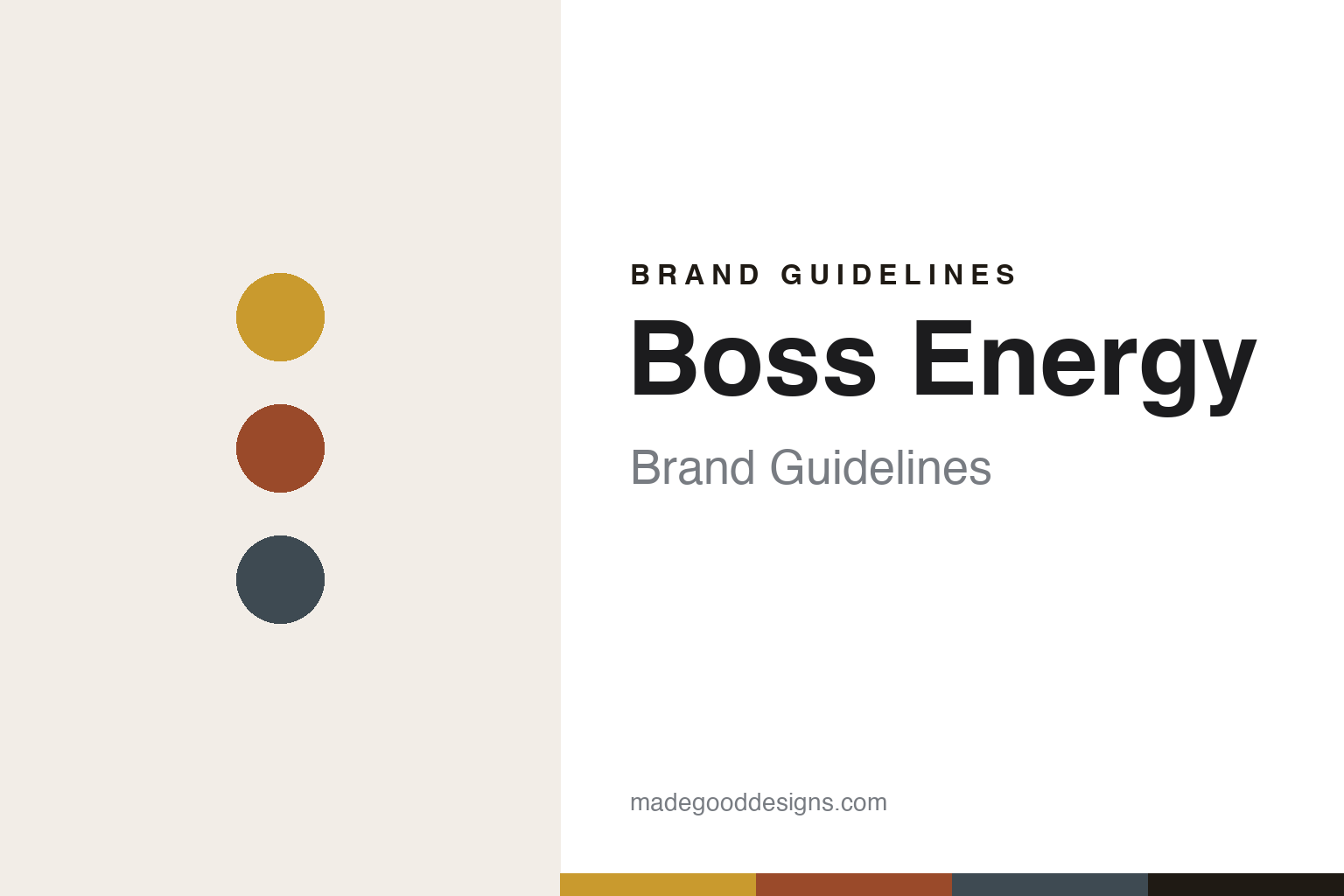
Boss Energy Brand Guidelines
A Perth uranium company built around one restarted South Australian mine.
Aa
Two constants: a yellowcake ochre, red earth and slate palette and a plain industrial sans register. Abstract homage — not a Boss Energy product or mark; no logo, drum or site image is reproduced.
Honeymoon
An idle in-situ mine, bought and restarted.
Boss Energy is a Perth-based uranium company listed on the Australian Securities Exchange under the code BOE, and it also trades in the United States on the OTCQX market. It traded as Boss Resources before taking its current name and kept the same ticker, the business site Stockhead notes. Its story turns on one asset: Honeymoon, an in-situ leach uranium project in South Australia that the company owns outright.
Honeymoon had a working life before Boss. World Nuclear News reported in June 2022 that in-situ leach operations began there in 2011 and that the then-owner, Uranium One, put the mine on care and maintenance in 2013. Boss bought the project in 2015; in an October 2023 statement quoted by the same publication, the company dated the purchase to December 2015 and said it had spent the years since on a series of technical optimisation studies.
The restart came in stages. The Boss board approved a final investment decision to redevelop Honeymoon in June 2022, World Nuclear News reported, with a planned steady-state rate of 2.45 million pounds of uranium oxide concentrate a year. Managing director Duncan Craib said at the time that the company was fully funded, fully permitted and ready to order key equipment. Wellfield pre-conditioning, the stage in which groundwater is cleaned of calcium and chloride before uranium is leached, began in October 2023, once Boss had finished its wellfields, a gypsum repository, a water-treatment plant and a reverse-osmosis plant. On 23 April 2024 World Nuclear News reported that Honeymoon had produced its first drum of uranium in more than a decade.
Colour
A Texas stake, then a reset.
Boss also looked abroad. In December 2023 World Nuclear News reported an agreement with enCore Energy under which Boss would take a 30% stake in the Alta Mesa in-situ recovery project in South Texas, with enCore keeping 70% and remaining the project manager. The deal also gave Boss an exclusive Australian licence for enCore’s Prompt Fission Neutron technology, a method of measuring uranium in drill holes in real time. Boss completed the purchase in February 2024, and the company says production at Alta Mesa restarted in June 2024.
The ramp-up at Honeymoon has not followed the original plan. In December 2025 Boss said a review of the operation pointed to a material deviation from the assumptions behind its 2021 Enhanced Feasibility Study, affecting production and costs from the 2027 financial year onwards, The Motley Fool Australia reported on 18 December 2025. The reasons it gave included less continuity of higher-grade mineralisation, lower leachability and smaller wellfields. The company withdrew the 2021 study and proposed a different approach, a wide-spaced wellfield design, which it said could lower costs by leaching for longer across a larger area.
The company’s own timeline records the steps since. Matthew Dusci, who joined as chief operating officer in September 2024, became managing director and chief executive in October 2025. In March 2026 Boss published mineral resource estimates for two satellite deposits, Gould’s Dam and Jasons, and in August 2026 it released a New Feasibility Study that resets the Honeymoon life-of-mine plan around the wide-spaced design. At a market day in September 2026, Boss says, it set out a “hub-and-spoke” ambition in which the Honeymoon plant would one day take feed from those satellite deposits, subject to studies, approvals and development decisions. Peter Botten became chair from 30 September 2026.
Boss describes Honeymoon as one of only three producing uranium mines in Australia and one of two in-situ recovery operations in the country. It says the operation now runs six producing wellfields and five NIMCIX ion-exchange columns, the vessels in which uranium is recovered from the leach solution.
Typography
How uranium companies present themselves.
Uranium companies sell a commodity that few of their audiences will ever see, so their visual material leans on the stages around it. Mining reports and investor decks in this sector commonly show drill core laid out in trays, drums of uranium concentrate, the yellowcake of the trade, and the plants where ore is milled. The product itself is a powder; the imagery is of the places and steps that produce it.
Geography does much of the work. In-situ recovery, the method Kazatomprom uses for all of its production in Kazakhstan, pumps solution through wells rather than digging a pit, so its pictures tend to be wellfields of wellheads and pipework laid across open steppe and prairie. In northern Saskatchewan, the Athabasca Basin, where Cameco mines McArthur River and Cigar Lake, appears as lakes, forest and snow, with headframes and camps in winter light.
The fuel story widens the frame. Companies that sell uranium into conversion, enrichment and fuel fabrication often finish their presentations with nuclear power plants, cooling towers and control rooms, and with the language of low-carbon, reliable electricity; when Cameco and Brookfield completed their purchase of Westinghouse in November 2023, World Nuclear News quoted Cameco’s chief executive on demand for nuclear power and energy security.
Much of this material is made for investors and for the industry itself. Producers and developers publish decks and annual reports for listings in markets such as Toronto, New York, London and Astana, and present at industry events, among them those of the World Nuclear Association, whose public information service is World Nuclear News. This guide sets out what can be checked about each company — its origins, owners and mines — and treats its colours and type as an unofficial interpretation.
Aa
A plain industrial sans for a miner’s dated milestones. (Specimen set in Archivo, a sans STAND-IN; NOT the Boss Energy logo.)
Boss Energy
A restart told as a dated timeline.
Boss Energy speaks as a listed producer. Its website leads with its two operations, its ASX and OTCQX codes and an investor centre of announcements, quarterly reports, webcasts and presentations, and its history page is a dated list of milestones that runs from the completed Alta Mesa purchase and the first Honeymoon drum in 2024 to the 2026 feasibility study and market day. Each entry pairs a month with a short headline, so the company’s record reads like a project log.
The vocabulary is technical and specific: wellfields, pre-conditioning, ion exchange, drums of uranium oxide, satellite deposits. The company lists its priorities as safe and reliable production, disciplined capital allocation, development of its organic growth pipeline and responsible supply to a market it describes as increasingly focused on energy security. Its setbacks are reported in the same register as its milestones: the December 2025 reset appears on its own timeline beside the first drum, and the new life-of-mine plan is introduced as a fresh study rather than an amendment.
For a design guide, Boss Energy shows how a single-asset miner can tell a restart story through a plain, dated public timeline, and how a reset sits in the same record as a success. Compare Paladin Energy and Deep Yellow, two other Perth-based uranium companies. For this guide we use a yellowcake ochre, red-earth brown and slate with a sans, an unofficial interpretation; no product or logo is reproduced.
Explore & save
Keep Boss Energy’s identity on hand — save it to a board in the Made Good inspiration library.
Boss Energy identity set
Pin the Boss Energy ochre, red earth and slate palette and the plain industrial sans register to your own board.