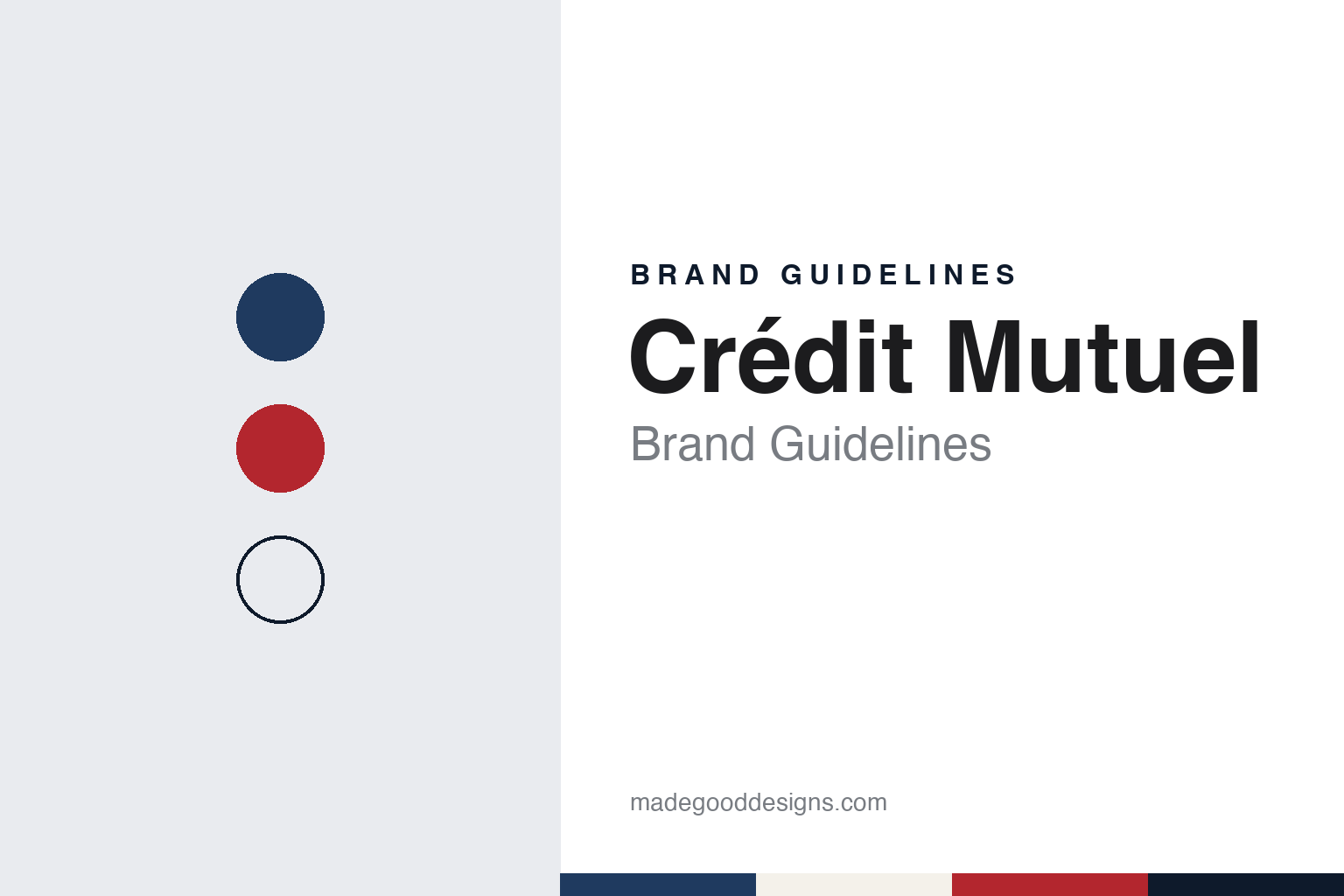
Crédit Mutuel Brand Guidelines
The Alsace cooperative bank that grew into a national mutualist group.
Aa
Two constants: a navy, brick red and paper palette and a cooperative sans register. Abstract homage — not a Crédit Mutuel product or mark; no logo, card or signage is reproduced.
La Wantzenau, 1882
A village caisse near Strasbourg.
Crédit Mutuel traces its start to February 1882, when the first local cooperative bank on the Raiffeisen model in what is now France opened in La Wantzenau, a village near Strasbourg, English Wikipedia says. Alsace was then part of the German Empire, and the idea came from the rural credit cooperatives of the Rhineland, where, from the late 1840s, members pooled their savings and stood surety for one another’s loans. The group’s own history page calls the La Wantzenau caisse the oldest Crédit Mutuel bank on that model and sets out the principles in plain terms: members share responsibility, unpaid volunteers run the boards, and each caisse serves a small, defined area.
The network grew quickly. English Wikipedia counts 127 local banks in Alsace–Lorraine in 1892 and 471 in 1914, and French Wikipedia says federal structures appeared in Alsace from 1885. Elsewhere in France, a Lyon lawyer started caisses on the same model from 1893 and grouped them in the Union des caisses rurales et ouvrières de France.
A split in 1894 shaped the French banking map. When the state offered support to rural caisses that agreed to distribute its aid for farm equipment, some accepted; those “official” caisses later formed Crédit Agricole in 1920, French Wikipedia and the group’s history page both say. Others refused in order to keep their independence and mutualist character, and became Crédit Mutuel. After Alsace–Lorraine returned to France following the First World War, some local banks there joined the Crédit Agricole network while others kept their Raiffeisen identity and took the Crédit Mutuel name; the Banque Fédérative du Crédit Mutuel was set up in Strasbourg in 1919 as a financial body for the reorganised network, English Wikipedia says.
The caisses were treated as non-profit associations from 1901 and became cooperatives under a law of 10 September 1947, according to the group and English Wikipedia. The group’s history says only that Crédit Mutuel came through the two world wars and adapted; the sources used for this guide do not say how the bank operated during the occupation of 1940–1944.
Colour
Caisses, federations and a confederation.
Crédit Mutuel is a mutualist group, owned by its members rather than by outside shareholders. Its structure has three tiers. At the base, about 2,000 local caisses are owned by their customers, English Wikipedia says; French Wikipedia gives about 2,100. The caisses belong to 18 regional federations, plus one nationwide federation for farming, and the federations sit within the Confédération Nationale du Crédit Mutuel in Paris, the group’s central body. French Wikipedia says members vote on the basis of one member, one vote, rather than in proportion to their holdings.
That structure was set in law in 1958. An ordinance of 16 October 1958 defined the status of the caisses and of the confederation, which the regional federations joined from 1959, the group says; French Wikipedia says all of them had joined by 1966. A Caisse Centrale du Crédit Mutuel, run by the confederation, handles financial functions for the whole group, and the group has been directly supervised by the European Central Bank as a significant institution since late 2014, English Wikipedia says.
Within that frame, federations form groupings with their own businesses. Since 2011 most of them have worked together in a grouping led from Strasbourg, known since 2018 as Crédit Mutuel Alliance Fédérale; English Wikipedia counted 14 of the 18 federations in it as of early 2022, with the Nord Europe federation joining on 1 January 2022. The federations of Brittany and the Sud-Ouest form Crédit Mutuel Arkéa, which has its own brand identity and owns the online bank Fortuneo, while the Maine-Anjou-Basse-Normandie and Océan federations run their own banking entities. French Wikipedia says Arkéa proposed in 2016 that the group divide in two, which the confederation refused, and that an agreement signed in May 2023 settled the dispute between Arkéa and the Alliance Fédérale.
The corporate motto, English Wikipedia says, is “La banque qui appartient à ses clients, ça change tout!” — the bank that belongs to its customers, which changes everything. The group says it belongs to about 9 million member-customers as of 31 December 2025.
Typography
How French banks present themselves.
French banks tend to present themselves through a small set of strong signals: a confident wordmark, a simple symbol and one or two colours used with discipline. Green, red and blue recur across the sector. Crédit Agricole is sometimes called “la banque verte,” the green bank, for its farming roots, while Société Générale has used a red and black square since 1990, according to French Wikipedia. The result is a high street where a colour can identify a bank before its name is read.
Many of the largest groups are mutualist or cooperative, built from local and regional banks owned by their members, and their identities often carry that structure. A national mark sits above regional names, and branch signage, city photography and local news pages speak to a particular town or département. The same brand has to work on a village branch, a city tower and a phone screen.
Online, the pages follow everyday needs: current accounts and cards, home loans, insurance, savings and investment, with separate areas for professionals, farmers and companies. Mobile apps now carry much of the relationship, and app screens, notifications and onboarding flows have become part of the visual identity as much as the logo on a branch front.
Sponsorship gives these brands a public stage. Crédit Agricole has backed football’s Coupe de France since 1974, according to English Wikipedia, and Société Générale says it has sponsored the French Rugby Federation since 1987; culture, music and disability sport also feature. Annual and integrated reports complete the picture: long documents in which the group’s colours, typefaces and photography are applied with the same care as on a campaign poster, and a useful place to study how each identity holds together.
Aa
A cooperative sans for a member-owned bank. (Specimen set in Libre Franklin, a sans STAND-IN; NOT the Crédit Mutuel logo.)
Crédit Mutuel
From bancassurance to CIC and Germany.
The group widened its business from the 1970s. In 1970 it created the Assurances du Crédit Mutuel, and the group says this was the invention of bancassurance, the selling of insurance through bank branches. The 1984 banking law set out its scope, and in 1998 the French economy minister chose Crédit Mutuel to buy 67 percent of the Union européenne de CIC, the group’s history says; English Wikipedia says CIC, a banking group older than Crédit Mutuel itself, was bought in stages between 1998 and 2017.
Expansion abroad followed. At the end of 2008 the group bought Citibank’s retail business in Germany, renamed Targobank in 2010, and in 2009 it took over the consumer lender Cofidis, the group says. Citibank’s Belgian branch, bought in 2011, became Beobank in 2013, English Wikipedia says, and French Wikipedia records that the Spanish arm of Targobank was sold to Abanca in October 2023. In March 2025 Crédit Mutuel Alliance Fédérale agreed to buy the German bank Oldenburgische Landesbank (OLB); in a statement dated 2 January 2026, OLB said the purchase of all its shares through the holding company TARGO Deutschland had been completed that day, with all regulatory approvals in place. The group also owns the regional newspaper group EBRA in eastern France, English Wikipedia says.
There have been regulatory findings. In 2010 France’s competition authority, the Autorité de la concurrence, fined eleven banks, Crédit Mutuel among them, over fees charged on cheque processing, English Wikipedia says.
For a design guide, Crédit Mutuel shows how a cooperative can keep one shared name across federations that run their own businesses. Compare Crédit Agricole, which grew from the other side of the 1894 split, and CIC, the older bank the group now owns. For this guide we use a deep navy, a brick red and warm paper with a sans, an unofficial interpretation; no product or logo is reproduced.
Explore & save
Keep Crédit Mutuel’s identity on hand — save it to a board in the Made Good inspiration library.
Crédit Mutuel identity set
Save the Crédit Mutuel navy, brick red and paper palette and the cooperative sans register to your own board.