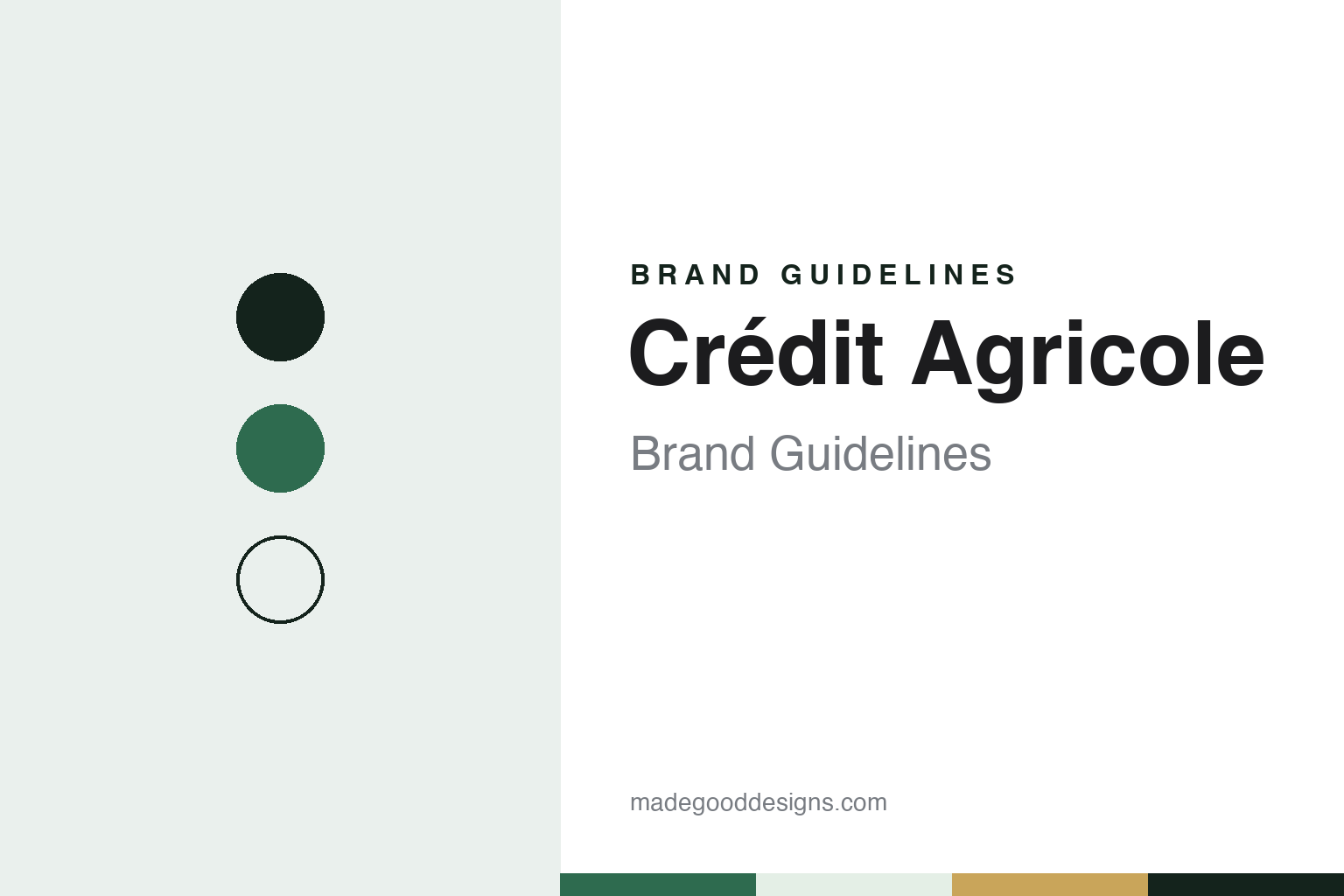
Crédit Agricole Brand Guidelines
The green bank that grew from a Jura mutual and an 1894 law.
Aa
Two constants: a field green, meadow and wheat palette and a humanist sans register. Abstract homage — not a Crédit Agricole product or mark; no logo, card or signage is reproduced.
Salins-les-Bains, 1885
A local mutual, then a national law.
Crédit Agricole traces its roots to the Jura. On 23 February 1885, English Wikipedia records, the Société de Crédit Agricole was created at Salins-les-Bains, in the district of Poligny. The group’s own history names its founders as the local entrepreneur Alfred Bouvet and the landowner Louis Milcent, and calls it the first organisation of its kind. Farmers at the time struggled to find suitable loans, and a law of 1884 on professional associations had just allowed farmers’ unions to form.
The national network followed a law. The Act of 5 November 1894 let members of farmers’ unions set up local agricultural credit banks on mutual principles, drawing, the company says, on the Salins model; each member had one vote, whatever the number of shares held. An Act of 31 March 1899 created the regional banks, which grouped the local banks of an area, and by the First World War every département had at least one, according to the company. In 1920 a public central body was set up; it was renamed the Caisse Nationale de Crédit Agricole (CNCA) in 1926.
Between the wars the bank moved beyond farm lending, into loans for rural craftsmen, the financing of rural electrification from 1923 and, the company says, its first home loans in 1928. Between 1939 and 1945, English and French Wikipedia say, the Vichy regime imposed stricter state supervision on Crédit Agricole. The group’s history describes that control as temporary, and dates the bank’s first five-year notes, which channelled rural savings to the Treasury, to the same period.
Colour
From farm credit to a universal bank.
After 1945 the regional banks opened many new offices: English Wikipedia counts about 1,000 in 1947 and 2,259 by 1967. From 1959 the bank could lend for homes to anyone living in a rural area, and the company says it was fully self-financing from 1963. In 1966 the CNCA gained financial autonomy, and the banking reform of that year let the group sell households the same savings products as other banks.
Diversification came in the 1970s and 1980s. The first foreign branch opened in Chicago in 1979; the life insurer Predica followed in 1986 and the property insurer Pacifica in 1990. French Wikipedia also records a 1984 agreement that let the bank’s own green payment card work alongside the Carte Bleue of other French banks.
The structure changed in 1988. Under a law in force from 18 January 1988, the CNCA became a public limited company, 90% owned by the regional banks and 10% by staff, and independent of the state. It was listed on the Paris stock exchange in 2001 as Crédit Agricole S.A., which gave the regional banks a listed vehicle for acquisitions. Banque Indosuez had been bought in 1996 and Sofinco in 1999, and the 2003 tie-up with Crédit Lyonnais led to the retail network’s rebranding as LCL in 2005 and to Crédit Agricole CIB in 2006. The asset manager Amundi was created in 2010.
Today the group has three tiers: local banks, 39 regional banks organised as cooperatives, and Crédit Agricole S.A., the listed holding company based in Montrouge, just south of Paris, according to English Wikipedia and the company’s list of sites. The regional banks own a majority of Crédit Agricole S.A. In 2010 France’s competition authority fined eleven banks, Crédit Agricole among them, over cheque-processing fees, English Wikipedia records.
Typography
How French banks present themselves.
French banks tend to present themselves through a small set of strong signals: a confident wordmark, a simple symbol and one or two colours used with discipline. Green, red and blue recur across the sector. Crédit Agricole is sometimes called “la banque verte,” the green bank, for its farming roots, while Société Générale has used a red and black square since 1990, according to French Wikipedia. The result is a high street where a colour can identify a bank before its name is read.
Many of the largest groups are mutualist or cooperative, built from local and regional banks owned by their members, and their identities often carry that structure. A national mark sits above regional names, and branch signage, city photography and local news pages speak to a particular town or département. The same brand has to work on a village branch, a city tower and a phone screen.
Online, the pages follow everyday needs: current accounts and cards, home loans, insurance, savings and investment, with separate areas for professionals, farmers and companies. Mobile apps now carry much of the relationship, and app screens, notifications and onboarding flows have become part of the visual identity as much as the logo on a branch front.
Sponsorship gives these brands a public stage. Crédit Agricole has backed football’s Coupe de France since 1974, according to English Wikipedia, and Société Générale says it has sponsored the French Rugby Federation since 1987; culture, music and disability sport also feature. Annual and integrated reports complete the picture: long documents in which the group’s colours, typefaces and photography are applied with the same care as on a campaign poster, and a useful place to study how each identity holds together.
Aa
A friendly, open humanist sans for a rural cooperative voice. (Specimen set in Nunito Sans, a sans STAND-IN; NOT the Crédit Agricole logo.)
La banque verte
Common sense, close to home.
The bank’s nickname works as a brand in itself: Crédit Agricole is sometimes called “la banque verte,” the green bank, for its roots in farming, both English and French Wikipedia note. Its advertising lines have stayed close to that origin. In 1976 it launched “Le bon sens près de chez vous” (common sense close to home); later lines played on the same idea, from “Le bon sens en action” in 1987 to “Le bon sens a de l’avenir” in 2011, English Wikipedia records. In 2019, the company says, it set out its raison d’être, “Working every day in the interest of our customers and society,” which English Wikipedia lists as its signature since 2020.
Sport carries the name too. Crédit Agricole has sponsored football’s Coupe de France since 1974 and was title sponsor of a professional road cycling team from 1998 to 2008, according to English Wikipedia. In June 2026 the brand had an unplanned moment: a test notification sent by mistake to all users of its Ma Banque app spread on social media, and the bank briefly renamed its social accounts “Cédric Agricole” and played with its visual identity, French Wikipedia reports.
The group is still expanding. In October 2026 it signed an agreement with Lone Star Funds to buy all of IKB Deutsche Industriebank, as the law firm Clifford Chance, which advised it, reported on 3 November 2026; the purchase was not completed at the time of writing. In November 2026 Crédit Agricole proposed talks on merging Crédit Agricole Italia with Banco BPM, in which English Wikipedia says it held a 29.3% stake from July 2026; Markets Media carried the proposal on 9 November 2026, and it was with Banco BPM’s board at the time of writing.
For a design guide, Crédit Agricole shows how a cooperative bank can keep one rural idea, common sense close to home, alive through more than a century of growth. Compare Crédit Mutuel, another mutualist network, and BNP Paribas. For this guide we use a field green, a pale meadow tint, a wheat tone and ink with a humanist sans, an unofficial interpretation; no product or logo is reproduced.
Explore & save
Keep Crédit Agricole’s identity on hand — save it to a board in the Made Good inspiration library.
Crédit Agricole identity set
Pin the Crédit Agricole field green, meadow and wheat palette and the humanist sans register to your own board.