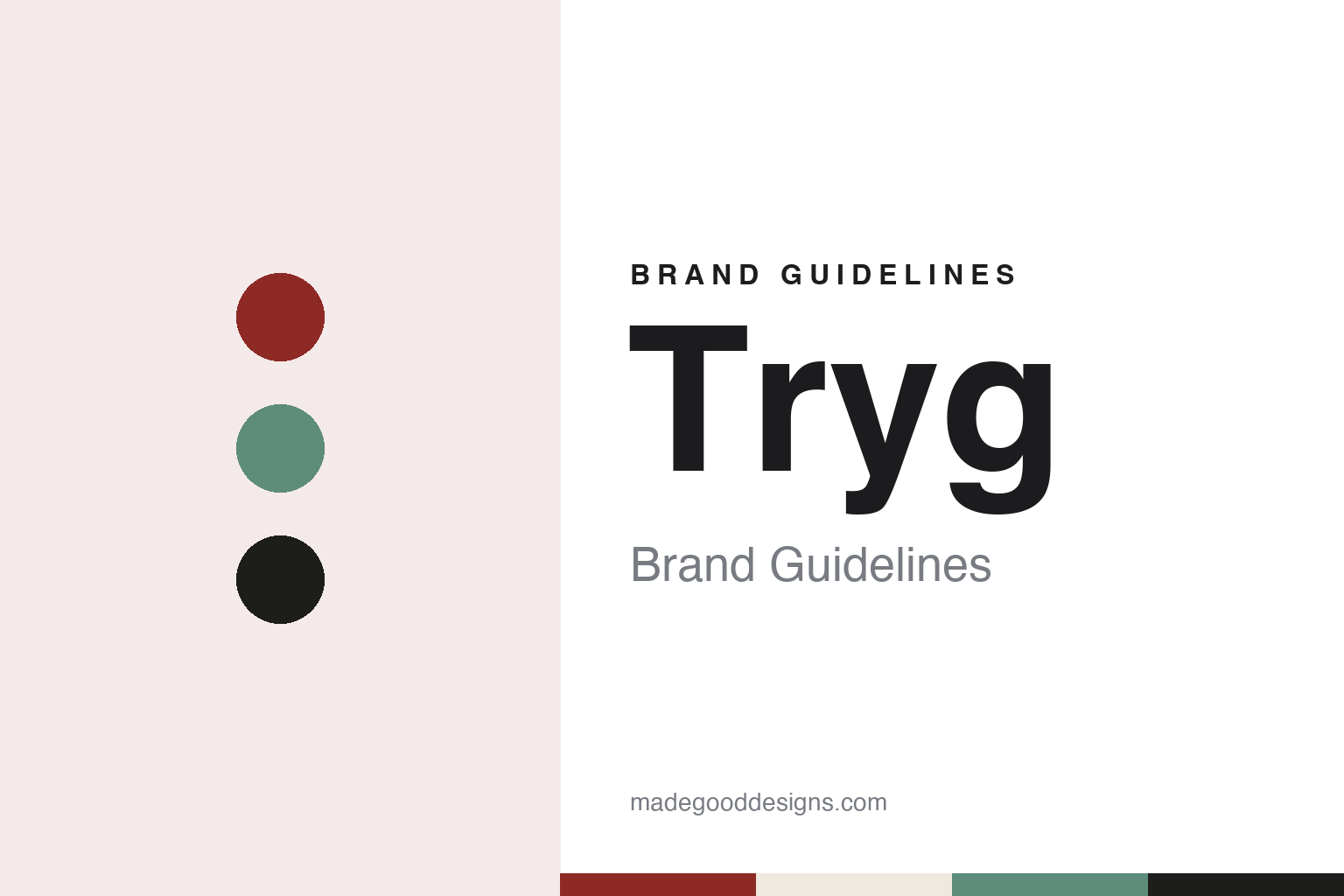
Tryg Brand Guidelines
Copenhagen’s 1731 fire insurer, gathered under a word for feeling safe.
Aa
Two constants: a Copenhagen red, ink, sand and copper green palette and a bookish serif register. Abstract homage — not a Tryg asset; no logo or mark is reproduced.
After the fire
A royal decree, three years after 1728.
Tryg traces its roots to the fire that swept Copenhagen in 1728, burning for more than 60 hours and destroying some 1,600 buildings, the company says; Danish Wikipedia puts the loss at about 28% of the city’s buildings. In its wake a number of citizens saw the need to insure themselves, and on 26 January 1731 Kjøbenhavns Brandforsikring was founded by royal decree. Danish Wikipedia calls it the first Danish insurance company, and Tryg describes it as Denmark’s first fire insurer and the oldest part of its history. The first fire policy was written on 21 December 1731, according to Danish Wikipedia.
The Tryg name is younger. Tryg says it first appeared in 1898, as Livsforsikringsselskabet Tryg A/S, a life insurer. On 26 October 1911 it was taken over by a mutual life company founded in 1903, and the combined business took the name Andels-Anstalten Tryg, a cooperative life insurer, Danish Wikipedia says. It founded the reinsurer Nerva in 1919, took over the mutual life insurer Koldinghus on 31 December 1936, and from 1938 worked closely with two cooperative non-life insurers, so that its agents could offer common kinds of property cover as well as life policies. The sources used for this guide do not say how Tryg’s predecessors operated during the occupation of 1940–1945.
In Danish, tryg describes feeling safe. Tryg says the related word tryghed covers a person’s sense of safety and finances, among other things, and the sense of being looked after even when luck runs out.
The old companies came together in the 1970s. Danish Wikipedia says Danmark, a mutual founded in 1861, Andels-Anstalten Tryg and Fremtiden, a life insurer founded in 1886, merged in 1972 and 1973 as Danmark/Tryg/Fremtiden, which in 1976 merged with Kjøbenhavns Brand and took the name Tryg Forsikring. Tryg’s own timeline dates that wave of mergers to 1974 and 1975, producing the mutual Tryg Insurance.
Colour
A cooperative owner, a bank merger and a buy-back.
In 1991 the mutual demutualised and became a limited company, owned by the cooperative Tryg i Danmark smba, which was renamed TryghedsGruppen in 2008. In 1994 Tryg took over Winterthur’s Danish insurance business, Danish Wikipedia says, and in 1995 it acquired Baltica and traded as Tryg-Baltica. In 1998 Tryg i Danmark set up TrygFonden, a charitable foundation, and the guarantee insurer Tryg Kaution joined the group. In 1999 Tryg-Baltica merged with Unidanmark, which Tryg calls Denmark’s second-largest bank group, and bought the Norwegian insurer Vesta, founded in Bergen in 1880, from Skandia. Those businesses went into the formation of Nordea in 2000 and 2001.
The insurance side did not stay in the bank. In 2002 Tryg i Danmark bought Nordea’s non-life activities and formed TrygVesta, using the Tryg brand in Denmark and Vesta in Norway; the same year the group bought Zurich’s Danish and Norwegian non-life businesses, the company says. TrygVesta was listed in Copenhagen on 14 October 2005, opened a Swedish branch in 2006 and completed its purchase of the Swedish insurer Moderna Försäkringar on 2 April 2009. In August 2010 it simplified its name to Tryg, but kept the Moderna name in Sweden because of the similarity to Trygg-Hansa, then RSA’s Swedish business. In 2012 it sold its Finnish business to If. In December 2017 it agreed to buy the Danish insurer Alka, and received final approval from the Danish Competition and Consumer Authority in November 2018.
Then came RSA. In November 2020 Tryg and Canada’s Intact Financial made a joint offer for the British insurer RSA, and Business Insurance reported on 2 June 2021 that the two had completed the acquisition, with Tryg keeping RSA’s Swedish and Norwegian operations. Tryg says it acquired Trygg-Hansa, Codan Norway and half of Codan Denmark during 2021, and that the sale of Codan Denmark to Alm. Brand closed in 2022. Trygg-Hansa, the name Tryg once stepped around in Sweden, is now one of its own brands.
Typography
How European insurers present themselves.
European insurers sell something that cannot be seen or held, so their identities do a great deal of the work. Many rely on a short wordmark or a simple symbol, often drawn in a single strong colour such as orange, blue, red or green, and repeated on offices, apps, letters and roadside-assistance vans. Several of these marks have been redrawn in recent years with softer shapes, lowercase letters or brighter tones meant to read well on small screens.
The language tends to be plain. Product pages for home, car, life and pension cover usually lead with short sentences about what is included, what a customer can expect when making a claim and how to get in touch, and campaign lines often speak directly to the reader. Photography leans towards customers, families, homes and everyday moments rather than abstract imagery, and many groups add illustration systems and short animations to explain how a policy or pension works.
Sponsorship is another common thread. Insurers attach their names to running events, football teams, sailing races, stadiums, music festivals and museums, which puts the colour and symbol in front of large audiences far from any policy document. Some also run foundations or corporate art collections that hold exhibitions under the group name.
The paperwork matters too. Listed insurers publish annual reports, sustainability reports and investor presentations that follow the same typography and colour rules as their marketing, and these documents are often the clearest public record of how a brand is applied in long-form layouts, charts and tables. For a designer, the useful lessons sit in that consistency: one mark, a short palette and a calm, readable voice used across many countries and channels.
Aa
A bookish serif for a name with nearly three centuries of predecessors. (Specimen set in Source Serif 4, a serif STAND-IN; NOT the Tryg logo.)
Tryg
A listed insurer with a cooperative owner.
Today Tryg A/S, based in Ballerup outside Copenhagen, is a non-life insurer in Denmark, Norway and Sweden, listed in Copenhagen. It describes itself as the largest player in Denmark, the third largest in Sweden and the fourth largest in Norway, and names its private-customer brands as Tryg Forsikring, Alka, Enter Forsikring in Norway and Trygg-Hansa, alongside Tryg Trade, which issues surety bonds and trade credit insurance. Its chief executive since June 2023 has been Johan Kirstein Brammer, Danish Wikipedia says. The company has partnered with Danske Bank since November 2018, and has used the international network of AXA Corporate Solutions since May 2008.
Ownership keeps a cooperative link. Tryg’s Danish policyholders are members of TryghedsGruppen, its largest shareholder, which funds TrygFonden; Danish Wikipedia puts TryghedsGruppen’s holding at 47.6% in 2023. Each March the members’ elected representatives decide whether to pay a bonus to Tryg’s Danish customers, and on 12 March 2026 they approved one for the eleventh time, Tryg says. From 1927 Tryg’s head office stood by the Copenhagen lakes, in a neoclassical building designed by Arthur Wittmaack and Vilhelm Hvalsøe that still stands, according to Danish Wikipedia.
For a design guide, Tryg shows how a short everyday word for feeling safe can gather nearly three centuries of mergers under one name. Compare Sampo, whose If business bought Tryg’s Finnish operations in 2012, and Zurich Insurance, whose Danish and Norwegian non-life businesses Tryg bought in 2002. For this guide we use a Copenhagen red, ink, sand and a copper green with a serif, an unofficial interpretation; no product or logo is reproduced.
Explore & save
Keep Tryg’s identity on hand — save it to a board in the Made Good inspiration library.
Tryg identity set
Pin the Tryg Copenhagen red, ink, sand and copper green palette and the bookish serif register to your own board.