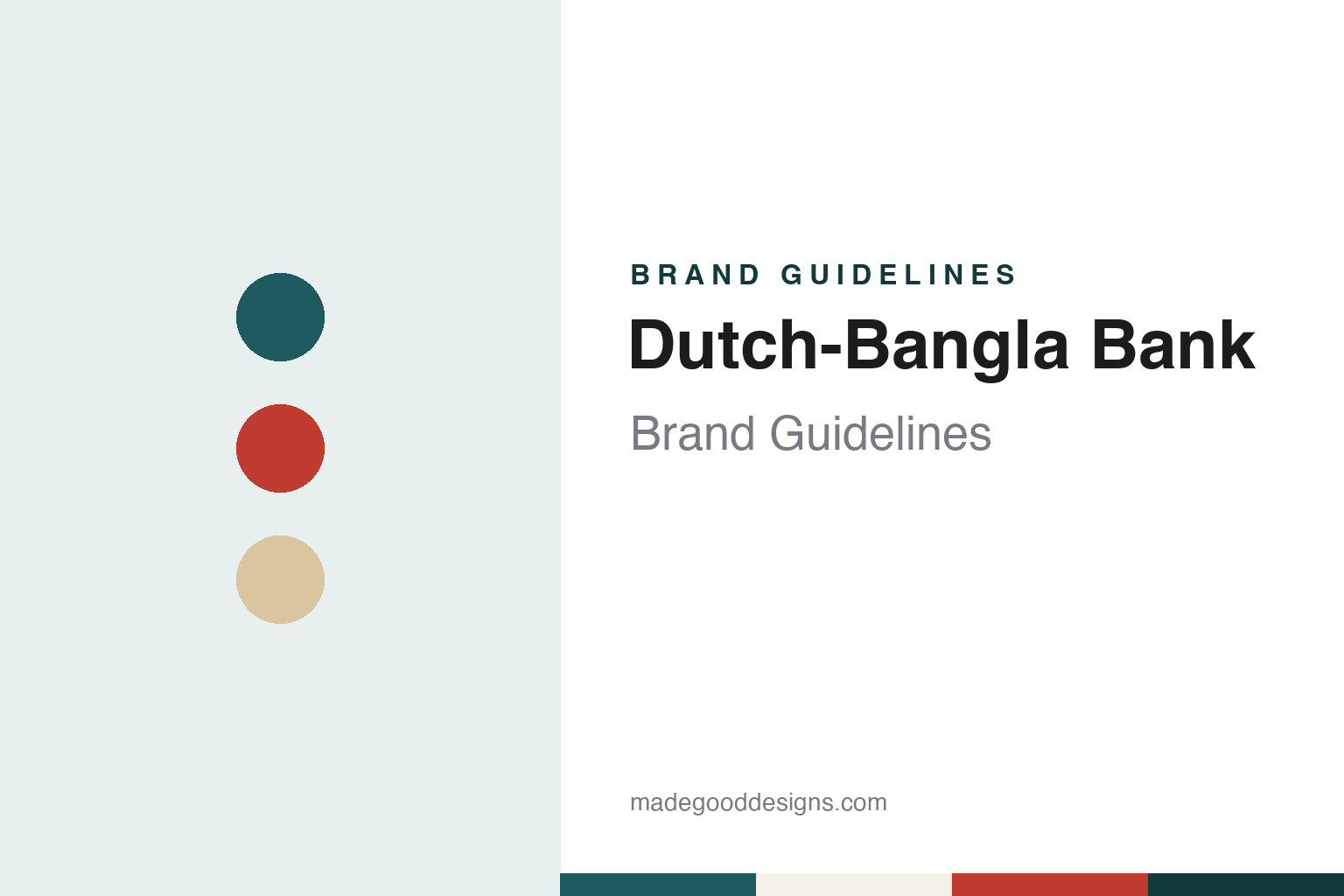
Dutch-Bangla Bank Brand Guidelines
The Dhaka bank that grew from a Dutch partnership into a card and mobile network.
Aa
Two constants: a Dutch-Bangla Bank teal, red and sand palette and a Bengali serif register. Abstract homage — not a Dutch-Bangla Bank product or mark; no card, logo or app screen is reproduced.
Dutch and Bangla
A joint venture written into the name.
Dutch-Bangla Bank was incorporated in Bangladesh as a public limited company in June 1996 and began formal operations on 3 June 1996, according to English Wikipedia. Its name records its origin. The bank was set up by local shareholders led by M Sahabuddin Ahmed, its founder chairman, together with FMO — the Nederlandse Financierings-Maatschappij voor Ontwikkelingslanden, or Netherlands Development Finance Company. The bank calls itself Bangladesh’s first joint venture bank, and Wikipedia describes it as the first European–Bangladeshi joint venture bank in the country.
From the start, the bank says, its lending focus was high-growth manufacturing industries, on the reasoning that the sector sells Bangladeshi products worldwide. It is listed on the Dhaka Stock Exchange and the Chittagong Stock Exchange, Wikipedia notes, and trades today as Dutch-Bangla Bank PLC, often shortened to DBBL.
The bank places what it calls “social responsibility” alongside banking. Its brief history says it preferred that plain term to “CSR,” and it channels its giving through a foundation; English Wikipedia lists a regular scholarship programme among its long-running initiatives.
Colour
Automation, Nexus and Rocket.
Dutch-Bangla Bank’s public story rests on technology as much as on branches. It set up an Electronic Banking Division in 2002 and says it completed full automation in 2003, becoming the first fully automated bank in Bangladesh and bringing plastic cards to a mass market. In 2004, according to English Wikipedia, it introduced real-time “Any Branch Banking,” internet banking, a centralised data centre, debit cards, ATMs and point-of-sale terminals; credit cards followed in 2007, and “Fast Track” self-service centres in 2008.
Its card and payment network carries the Nexus name. On 3 June 2010 the bank announced its internet payment gateway, which it describes as the first e-payment gateway introduced by a bank in Bangladesh; the gateway lets merchants accept Visa, Mastercard and DBBL Nexus cards online, and a buyer does not need to hold a DBBL account. In 2018 the bank launched NexusPay, an app for card-based and QR payments and fund transfers.
NexusPay has since become the bank’s main digital front door. English Wikipedia describes it as a cardless banking app that brings Nexus, Visa, Mastercard and Rocket accounts, agent banking and other banks’ cards into one place, with QR and NFC merchant payments, bill payments, cardless ATM withdrawals, temporary virtual card numbers for online shopping and transfers to other banks through Bangladesh’s national payment switches. The bank reported more than 9.45 million active NexusPay users in March 2026, Wikipedia says. The bank’s own brief history adds that it operates the country’s largest ATM fleet and that many local banks joined its infrastructure rather than build their own; both are the bank’s claims.
The same year that the gateway opened, Bangladesh Bank approved the bank’s plan for mobile financial services, Wikipedia says, and in 2011 it launched the service later branded Rocket. The bank describes Rocket as the country’s first mobile financial service, built to bring banking to unbanked people without a branch visit: cash-in and cash-out at agent points, person-to-person transfers, merchant and bill payments, salary payments and foreign remittances. English Wikipedia, citing the bank’s 2025 annual report, gives 39.63 million Rocket accounts and 9.1 million NexusPay users, and places Rocket third among Bangladesh’s mobile financial services by market share in the 2022 financial year.
Typography
Banks of Pakistan, Bangladesh and Sri Lanka.
Banks in Pakistan, Bangladesh and Sri Lanka present themselves to customers who may read in more than one script. A bank’s name can appear in English on one line and in Urdu, Bengali or Sinhala on another, on branch signs, cards, forms and apps. Short initials such as HBL or MCB travel well across those scripts, and several of the banks in this group have turned long founding names into letters that work on a cash machine, a cricket broadcast or a phone screen.
Colour does a lot of the work. Green, red and blue wordmarks are common across the region’s banking signage, and each colour has to hold up in strong sunlight on a shopfront, at small sizes in a mobile app and in print on a passbook or statement. The palettes in these guides are our own interpretations, chosen to show how a dark accent and a pale ground can carry a name in all of those places.
The product range shapes the website as much as the logo does. Islamic-banking and conventional ranges often sit side by side: MCB Bank, for example, runs its Islamic business through a separate subsidiary, MCB Islamic Bank, with its own product names and its own app. Pages on savings accounts, remittances from workers abroad, mobile wallets and lending to small and medium-sized businesses appear next to branch-locator maps and photographs of branch interiors and staff.
Formal documents complete the picture. Listed banks publish annual reports, and some also issue sustainability reports, with the same typefaces, colours and photography carried into long financial tables. For a designer, the useful lesson from this category is consistency across scripts, channels and formats, from a stadium board to a page of notes to the accounts.
Aa
A Bengali serif — a name that joins two countries with a hyphen. (Specimen set in Noto Serif Bengali, a serif STAND-IN; NOT the Dutch-Bangla Bank logo.)
Dutch-Bangla Bank
Infrastructure as identity.
The bank kept adding channels: agent banking in 2017, prepaid cards in 2020, cash recycler machines at branches from 2022 and bancassurance in 2023, English Wikipedia says, citing the 2025 annual report for a network of 243 branches, 334 sub-branches and 5,631 agent banking outlets. In November 2026 The Business Standard reported that Dutch-Bangla Bank and Pragati Insurance had signed a corporate agent agreement on 2 November to offer non-life policies — motor, travel and crop cover among them — through the bank’s bancassurance service.
Running that much infrastructure has its own logistics. In December 2024 The Daily Star reported that the bank had received approval to suspend some services temporarily while it moved to a new core banking software system: core banking was unavailable from 1 to 5 January 2025, and agent banking from 30 December 2024 to 5 January 2025.
The name remains the brand’s plainest design fact. “Dutch” and “Bangla,” joined by a hyphen, still record the 1996 partnership with FMO three decades on, while the products carry names of their own — Nexus for cards and payments, Rocket for mobile money — so the bank’s identity reaches customers through machines, cards and phones as often as through branch fronts.
For a design guide, Dutch-Bangla Bank shows how a bank can build its public face from infrastructure — ATMs, card networks and a mobile wallet — as much as from branches. Compare BRAC Bank, the Dhaka bank whose group includes bKash, and Visa, one of the card networks its payment gateway accepts. For this guide we use a deep teal, a signal red and a river sand with a serif, an unofficial interpretation; no product or logo is reproduced.
Explore & save
Keep Dutch-Bangla Bank’s identity on hand — save it to a board in the Made Good inspiration library.
Dutch-Bangla Bank identity set
Pin the Dutch-Bangla Bank teal, red and sand palette and the Bengali serif register to your own board.