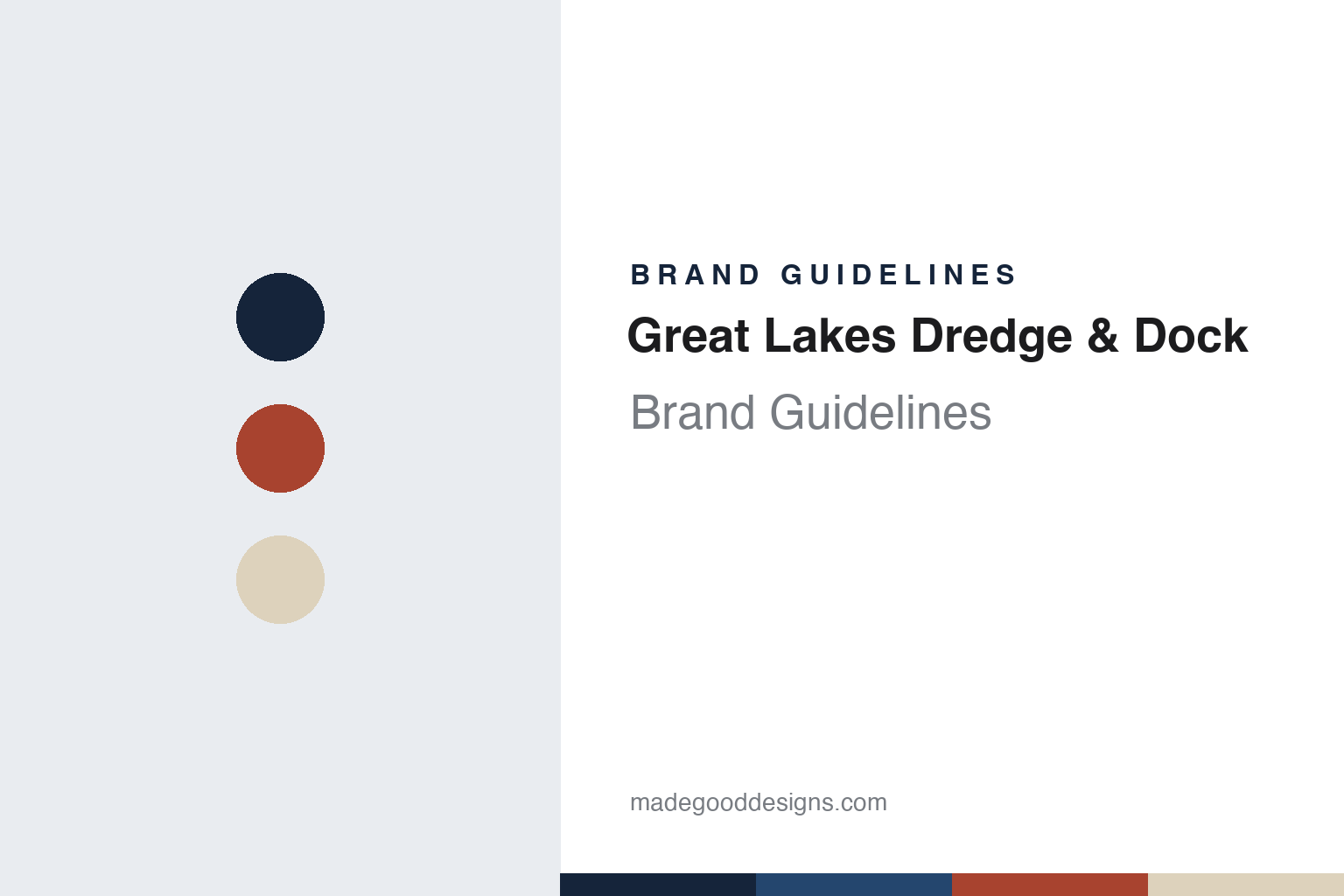
Great Lakes Dredge & Dock Brand Guidelines
The Chicago dredging partnership that became a Saltchuk company.
Aa
Two constants: a lake navy, dredge red and fill sand palette and an Industrial sans register. Abstract homage — not a Great Lakes Dredge & Dock vessel or mark; no dredge, logo or livery is reproduced.
Lydon & Drews
Two partners, a water crib and the Chicago lakefront.
Great Lakes Dredge & Dock began in Illinois in 1890 as a partnership between William A. Lydon and Fred C. Drews, trading as Lydon & Drews. The company’s own history says its first job was an offshore tunnel that carried the Chicago Avenue water intake out to a new crib farther from the shore, and that in the 1890s it built shoreline structures for Chicago’s Columbian Exposition and the foundations of what is now Navy Pier. Within that decade it had opened satellite operations in other cities on the Great Lakes, English Wikipedia says.
In 1905 the partnership took the name Great Lakes Dredge & Dock Company; the company says its fleet then counted thirteen dredges and ten tugboats. Its work at the time ran well beyond dredging, to pile-driving, foundations, bridges, breakwaters and lighthouses around the lakes. By 1920 it was working in New York City, Philadelphia, Boston and Albany, and it opened an Atlantic Division office in the Whitehall Building in lower Manhattan.
Much of the Chicago lakefront rests on its fill. English Wikipedia and the company both list reclamation between 1900 and 1950 for the ground where the Adler Planetarium, Soldier Field and the Field Museum now stand, along with the Sabin Lock at Sault Ste. Marie and the straightening of part of the Chicago River’s South Branch. The company adds landfill for Lincoln Park, Jackson Park and Grant Park, and the foundations and approaches of the Michigan Avenue Bridge.
During the Second World War it built the MacArthur Lock at Sault Ste. Marie, English Wikipedia says; the company says the job earned it the US Navy “E” award. After the war it took on extensive oil-related dredging in the Gulf of Mexico, along with bridge and other marine construction work around the country.
Colour
Islands for the hoppers, states for the cutters.
The company presents itself first through its fleet. Its website lists about 200 specialised vessels, which it calls the largest and most diverse fleet in the US dredging industry; The Maritime Executive, reporting in February 2026, described Great Lakes as the largest provider of dredging services in the United States. The website sorts the fleet by type: trailing suction hopper dredges, cutter suction dredges, mechanical dredges and river and lake dredges, followed by boosters, a drillboat, and support tugs, workboats and multicats.
The names follow a clear pattern. The hopper dredges are named after islands, among them Ellis Island, Liberty Island and Galveston Island, while the cutter suction dredges carry the names of states, among them Texas, Ohio and Carolina. Each vessel gets its own specification panel on the website, giving length, breadth, digging depth, pipe diameters, hopper capacity and installed power. Ellis Island is the longest of the hopper dredges listed, at 480 feet.
Overseas work grew from the 1970s, when, the company says, the US Army Corps of Engineers cut its own dredging fleet back and private contractors took on more of the work. Great Lakes says it set up a Middle East division in 1990 after building the harbour at Jebel Ali in Dubai, won reclamation and harbour work in Doha in 1993, and carried out excavation and reclamation for the Øresund Fixed Link between Denmark and Sweden. English Wikipedia records a port at Hidd in Bahrain; the company adds new land for Diyar al Muharraq and Durrat al Bahrain.
At home, the company says it carried out much of the port deepening that followed the Water Resources Development Act of 1986; from December 2014 it built dunes and berms along 22 miles of the Jersey Shore after Hurricane Sandy, English Wikipedia says. In 2021 it formed an Offshore Energy business. Its subsea rock installation vessel Acadia, built at the Philly Shipyard, now Hanwha Philly, was launched in July 2025, The Maritime Executive reported; the company calls it the first and only Jones Act–compliant vessel of its kind. With Van Oord, under a 2022 agreement, it has placed rock for the Empire Wind 1 offshore wind farm off New York, the company says.
Typography
Design and documentation.
Towage, salvage and dredging firms present themselves first through their ships. A tug, a salvage vessel or a dredger is the most visible thing such a company owns, and the hull, the superstructure and the funnel carry much of the identity: reds, oranges and yellows, deep navies and blacks, painted to be read at a distance across a working harbour. Funnel marks are an old shorthand. In Rotterdam, Dutch Wikipedia notes, Smit’s ocean tugs once wore a blue band on a black funnel and its harbour tugs a red one, until a single emblem of two yellow chain links on light blue replaced both in 1971.
Names do similar work. A vessel name on the bow identifies a ship and its owner, and naming rules can be traced in the record: Smit named its early ocean tugs after seas before switching to the prefix “Smit,” and Svitzer’s tugs carry the company name first, as with Svitzer Barrington. For a designer, the bow is a lettering problem with a fixed format, repeated across hundreds of hulls.
Behind the ships sits a printed and online register. Fleet lists and specification sheets give each vessel’s length, beam, draught and bollard pull in a consistent grid; project pages describe port works, land reclamation, wreck removal and offshore wind installations with dates, places and the vessels used; and annual and sustainability reports set out ownership, fleets and results year by year.
The guides in this group read each firm through that record: founding, ownership changes, named vessels and dated projects, taken from encyclopaedias, company pages and trade press. Each pairs the history with an unofficial palette and a Google Fonts stand-in; no logo, funnel mark or livery is reproduced.
Aa
An industrial sans for a fleet of named dredges. (Specimen set in Archivo, a sans STAND-IN; NOT the Great Lakes Dredge & Dock logo.)
Great Lakes Dredge & Dock
From Chicago partnership to Saltchuk subsidiary.
Ownership changed many times. English Wikipedia says a holding company, Great Lakes International, was formed in 1979, and that between 1985 and 1998 the business passed through owners including ITEL Corporation, Blackstone Dredging Partners and Vectura Holding before Madison Dearborn Partners bought it in 2003. In 2006 it merged with Aldabra Acquisition Corp, a special-purpose acquisition company, and became a public company on Nasdaq; Madison Dearborn sold the last of its shares in 2009. In October 2020 Great Lakes moved its headquarters from Oak Brook, Illinois, to Houston, Texas.
One episode reached the US Supreme Court. In 1992 the Chicago River flooded a freight tunnel under the city and the basements of many buildings, months after Great Lakes had driven piles from a barge in the river; in 1995 the Court held that federal admiralty jurisdiction applied to the company’s suit under the Limitation of Vessel Owner’s Liability Act.
On 11 February 2026, The Maritime Executive reported, Saltchuk Resources, the private, family-owned Seattle group whose companies include TOTE and Foss Maritime, agreed to buy Great Lakes in an all-cash tender offer. The deal closed on 1 April 2026: Saltchuk said Great Lakes had become a wholly owned subsidiary, run as a stand-alone business unit under its existing leadership, and its shares were delisted from Nasdaq. Its website now carries the name Great Lakes Dredge & Dock Company, LLC.
For a design guide, Great Lakes Dredge & Dock shows how a fleet can carry an identity through its names: islands for the hopper dredges, states for the cutters, each with its own specification panel. Compare Crowley, another American marine-services company, and Van Oord, its partner on Empire Wind 1. For this guide we use a lake navy, a channel blue, a dredge red and a fill sand with a sans, an unofficial interpretation; no product or logo is reproduced.
Explore & save
Keep Great Lakes Dredge & Dock’s identity on hand — save it to a board in the Made Good inspiration library.
Great Lakes Dredge & Dock identity set
Pin the Great Lakes Dredge & Dock lake navy, dredge red and fill sand palette and the Industrial sans register to your own board.