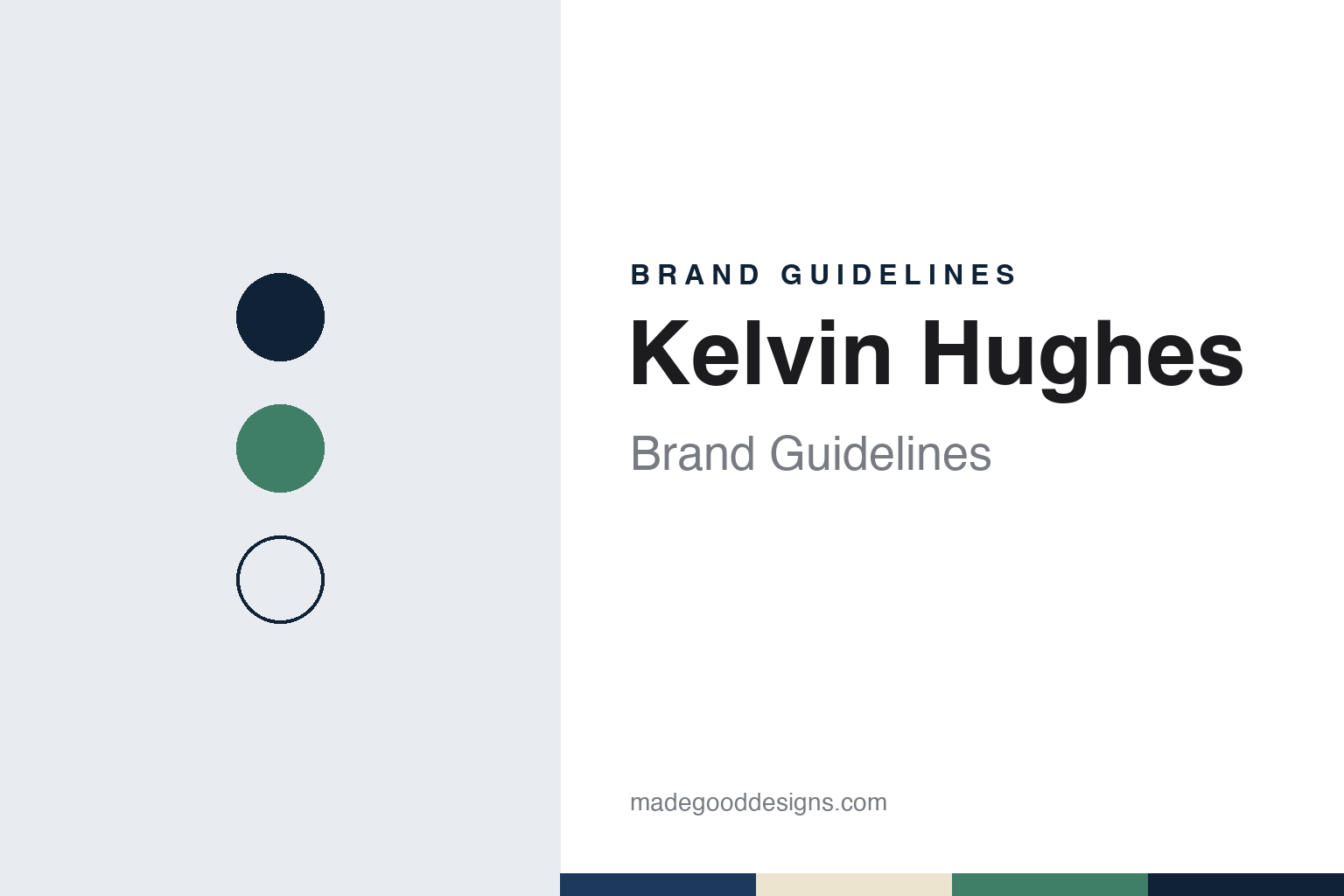
Kelvin Hughes Brand Guidelines
A Glasgow compass works and a London instrument maker, merged in 1947.
Aa
Two constants: a chart navy, buff and sweep green palette and an instrument sans register. Abstract homage — not a Kelvin Hughes or Hensoldt product or mark; no instrument, logo or nameplate is reproduced.
Kelvin and Hughes
A Glasgow compass works and a London instrument maker.
Kelvin Hughes joins two instrument businesses, one from Glasgow and one from London. English Wikipedia traces the Glasgow side to James White, an optician and philosophical instrument maker who set up in the city in 1850 and supplied apparatus to William Thomson, the Glasgow professor later raised to the peerage as Lord Kelvin. From 1876 White made compasses for iron and steel ships to Thomson’s design, and the Admiralty adopted the patent compass as a Royal Navy standard in 1889. In 1900 the business became Kelvin & James White Ltd, with Lord Kelvin as a director, and in 1913 it was renamed Kelvin Bottomley & Baird, maker of “Kelvite” binnacle compasses and sounding machines at the Kelvin Works in Hillington, Glasgow.
The London side is older. Wikipedia describes the Hughes family as East End clockmakers who moved into sextants and marine chronometers for ships on the Thames, and dates Henry Hughes & Sons to 1838, on Fenchurch Street in the City of London, as a maker of chronographs and scientific instruments. The firm was incorporated in 1903, bought a site at Hainault, on the eastern edge of London, in 1915 and opened the first part of a factory there in 1917. Wikipedia credits it with the first practical recording echo sounder, in 1923. In 1935 S. Smith & Son, the instrument group later known as Smiths, took a controlling interest, which led to new marine and aircraft instruments and a larger Hainault works.
The war years brought the two firms together. Both lost their London offices in the Blitz of 1941, Wikipedia says, and in 1942 they set up a joint company, Marine Instruments Ltd, on Fenchurch Street. In 1947 Henry Hughes & Son and Kelvin Bottomley & Baird merged as Kelvin & Hughes Ltd, in effect part of Smiths Industries. That same year, according to Wikipedia, the company produced the first type-approved commercial radar.
Colour
Radar, charts and the Smiths years.
For most of the next six decades Kelvin Hughes sat inside Smiths. Kelvin & Hughes Ltd was wound up as a company in 1966, Wikipedia says, but the name carried on as the Kelvin Hughes division of Smiths. The division grew by acquisition. In 1990 it took over Lokata, adding that firm’s NAVTEX receivers, EPIRB beacons and SART transponders; in 1994 it strengthened its chart and maritime business with the chart agents Brown and Perring in London and Observator in Rotterdam, and in August that year it bought QUBIT, a maker of integrated navigation and data systems. Wikipedia also credits Kelvin Hughes with the first paper chart tracing service, in 1971.
Charts were part of the trade as much as instruments. Alongside radar, the company supplied navigational data to commercial shipping and to government customers, according to Wikipedia, and its later bridge products tied the two together. In September 2017 the trade site MarineLink reported a new Kelvin Hughes ECDIS, the electronic chart display used on ship bridges, built for commercial ships as well as patrol vessels. It could run on its own or as one position in a networked multifunction bridge display, and used a software architecture the company called InstaCHART to load electronic chart cells faster. The company said it was type approved to current hydrographic and IMO standards.
Radar stayed at the centre. The company’s solid-state SharpEye radar family, with Doppler processing, is the product most often named in its releases of the last decade. When Hensoldt agreed to buy the company in 2017, its announcement described Kelvin Hughes as having about 200 employees and designing, producing and marketing radar sensors mainly for maritime and security uses, alongside command-and-control software that brought several radar and camera feeds into one display.
Typography
Bridge equipment and documentation.
Marine equipment makers sell to shipyards, shipowners and operators rather than to the public, and their identities reflect that. Their marks have long histories of their own: Schottel’s square S has been in use since the 1980s, its centenary history says, and Becker Marine Systems introduced its present logo with its new name in 2001, by the company’s account. The palettes in this guide are our own interpretation, in sea-going blues with warm accents, and none is taken from a company’s files.
The products themselves carry much of the visual weight. Thrusters, rudder propellers, rudders, deck machinery and bridge systems appear in this guide only as the companies publish and describe them, and their scale is part of the story: a regional magazine described one Schottel drive in Wismar in 2021 as twelve metres long once assembled.
Products are presented by vessel type as well as by name. Schottel says its RudderPropeller is used in more than 120 vessel types, from harbour tugs to ferries and offshore ships, and Becker presents rudders, nozzles and steering gear as parts of a single manoeuvring system for a given ship. Service matters as much as sale: both companies describe networks of subsidiaries and offices across Europe, Asia and the Americas, and German Wikipedia lists fourteen Schottel sales and service companies, from Brazil to South Korea.
Newer pages cover data. Schottel lists condition monitoring and data platforms among its products, and Becker sells monitoring systems for steering and rudder bearings. Trade fairs remain a fixed point in the calendar: Becker’s own history records a meeting at Nor-Shipping in Oslo that changed its management in 2001, and in 2022 Schottel’s holding company announced an agreement there, a trade paper reported.
Aa
An instrument sans for a chart-room register. (Specimen set in IBM Plex Sans, a sans STAND-IN; NOT the Kelvin Hughes or Hensoldt logo.)
Hensoldt UK
A heritage name kept on the product.
Ownership changed twice in a decade. In November 2007 Kelvin Hughes was bought out of Smiths Group and ran as an independent company, part-owned by the private equity firm ECI Partners, according to Wikipedia. On 29 June 2017 the German sensor company Hensoldt, formed from electronics activities that Airbus spun off that year, announced that it had agreed to buy Kelvin Hughes from ECI and the management. On 28 September 2017 Hensoldt said the purchase had taken effect once the legal requirements were met.
The company now trades as Hensoldt UK. A Hensoldt release dated July 2020 already described Hensoldt UK as the maker of Kelvin Hughes SharpEye radar systems, and a March 2024 release placed the company in Enfield, north London. Kelvin Hughes lives on as a product name. In that March 2024 release Hensoldt UK announced type approval, issued by TÜV SÜD BABT under the Marine Equipment Directive, for its Manta NEO X-band radar for commercial shipping, a system that includes the Kelvin Hughes radar display and software. The company said the radar built on the heritage of the Kelvin Hughes Manta series and suited vessels from workboats to large tankers and cruise ships.
Readers looking for the company online should note that the former kelvinhughes.com address now shows an unrelated website; Hensoldt’s own site carries the releases quoted here.
For a design guide, Kelvin Hughes shows how a nineteenth-century instrument name can outlast two changes of owner by living on the product rather than the company. Compare Furuno, the Japanese marine electronics maker, and Sperry Marine, another bridge-equipment name built from older brands. For this guide we use a chart navy, a buff paper tone and a sweep green with a sans, an unofficial interpretation; no product or logo is reproduced.
Explore & save
Keep Kelvin Hughes’s identity on hand — save it to a board in the Made Good inspiration library.
Kelvin Hughes identity set
Pin the Kelvin Hughes chart navy, buff and sweep green palette and the instrument sans register to your own board.