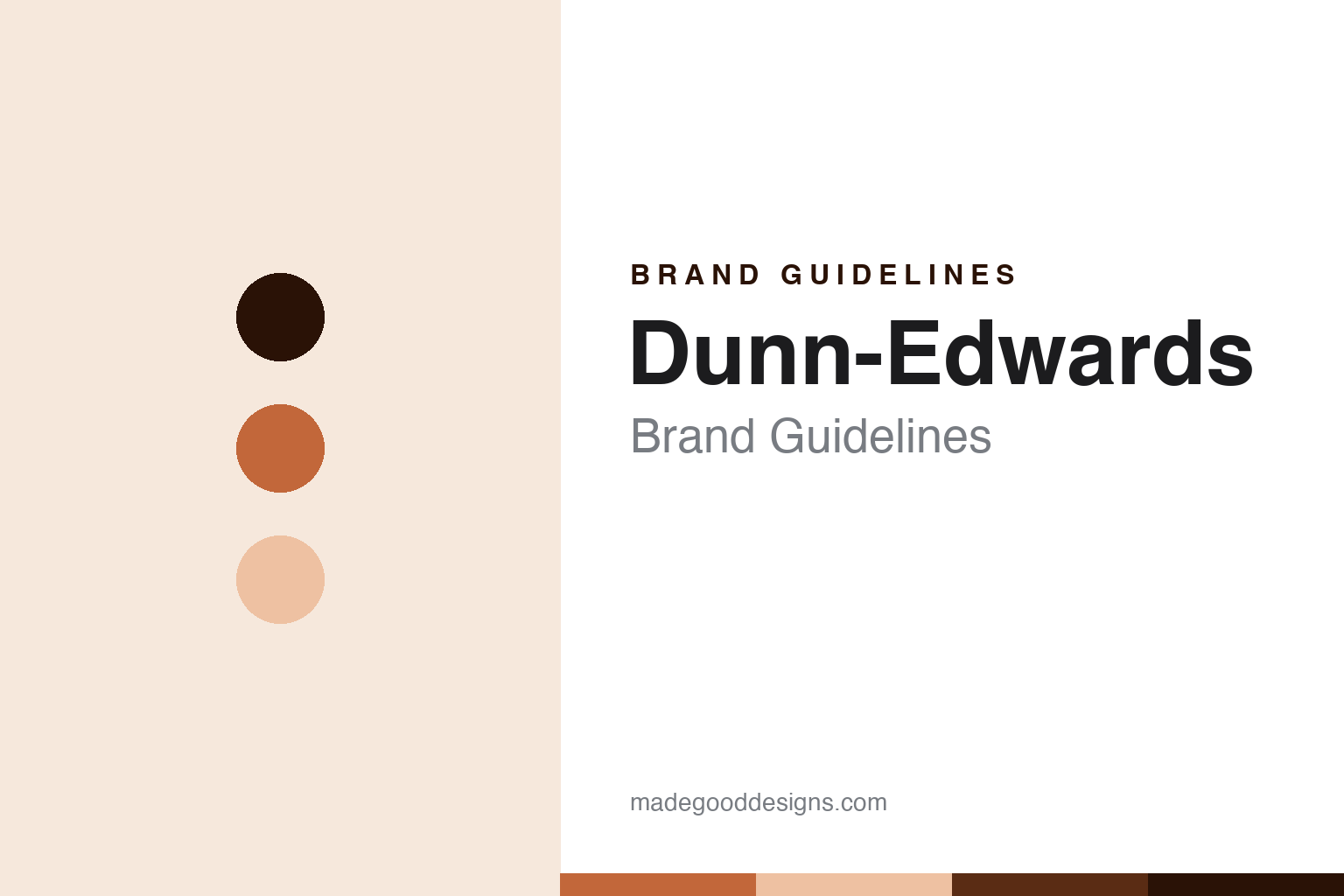
Dunn-Edwards Brand Guidelines
Californian paint, Japanese-owned.
Aa
Two constants: a desert-terracotta palette and a Western-sans register. Abstract homage — not a Dunn-Edwards product or mark; no paint tin, colour card or logo is reproduced.
Californian paint, Japanese-owned
Dunn-Edwards is the 1925 Los Angeles paint maker of the American Southwest — now owned by Japan’s Nippon Paint and made in a LEED-Gold Phoenix plant.
Dunn-Edwards follows Benjamin Moore as the round’s Southwest node — a Los Angeles paint maker that began in wallpaper, grew into the paint of the American West, is now owned by a Japanese group, and manufactures in a green-certified Arizona plant. Its answer to a round about who owns the paint and where it is made is a heritage-and-foreign-ownership one: a 1925 American maker under a Japanese parent, made at home.
Its identity is Californian paint, Japanese-owned. The wallpaper origin, the Phoenix making and the Nippon ownership are the story here. American West, Japanese owner. Californian paint, Japanese-owned.
(Honest notes, so the founding, the ownership and the making are framed accurately, with the origin nuanced. Dunn-Edwards sells paint as its heroes — the Perfect Palette colour system, Evershield and Aristoshield; we report its language as the brand’s own. On origin, nuanced: Dunn-Edwards was founded in 1925 in Los Angeles by Frank Dunn, but originally as a wallpaper business, with paint added around 1927, and the Dunn-Edwards name dates to 1938 when Frank Dunn partnered with Arthur C. Edwards, so we credit 1925 and Frank Dunn while noting Edwards joined in 1938. On headquarters: Los Angeles. On ownership: Dunn-Edwards is owned by Nippon Paint Holdings of Osaka, Japan, which agreed the deal in 2016 and closed it on 28 February 2017, and before that it was family-owned by the Edwards lineage for decades. On where it is made: genuine US manufacturing at its Phoenix, Arizona plant, opened in 2011 and marketed as the first LEED Gold-certified paint manufacturing plant, though we keep the distinction that the LEED Gold applies to the plant, not to the paint itself. On certifications, corrected and attributed: the relevant certification is Green Wise, at the Gold level, not GREENGUARD, and zero-VOC colorants are available. On a dated, precise sensitive point: a roughly 2011 California Proposition 65 settlement concerned a phthalate, DEHP, in the grips of hand tools Dunn-Edwards sold, not the paint, which we attribute precisely. Its product and collection names are IP we describe but do not reproduce; there is no official brand hex; these tones are an unofficial interpretation.)
Colour
Dunn-Edwards lives in a desert terracotta. Click a swatch to copy the hex.
Dunn-Edwards’ identity is Southwest-rooted, Japanese-owned and genuinely US-made — a desert terracotta, an ink, a pale clay, a deep clay, and a paper. The palette leans desert terracotta and deep clay: a warm, Southwestern register that nods to the American West and to pigment rather than a loud logo colour. It signals Californian paint, Japanese-owned — Southwest-rooted, Japanese-owned and genuinely US-made. The honest caveat: with no official brand hex, these values are a desert, unofficial interpretation, not first-party colours.
The lesson is a desert terracotta signals a Southwestern, pigment identity. Dunn-Edwards’ world is the paint of the West. For designers, it is a reminder that a warm terracotta and a pale clay can carry a Southwestern, made-here brand — a desert tone held as an accent, not a reproduced swatch. Because a warm hue can fail as small text, keep type dark and let the colour live in the accents, palette and band. The takeaways: date the founding to 1925 and Frank Dunn, noting the wallpaper origin and that Edwards joined in 1938; name Nippon Paint as owner since 2017; credit the Phoenix plant while keeping LEED Gold to the plant not the paint; correct the certification to Green Wise; and keep the Prop 65 matter about tool grips, not paint.
Typography
The register is a Western sans — Southwest-rooted, Japanese-owned, genuinely US-made.
Dunn-Edwards’ identity carries a Southwest-rooted, Japanese-owned, genuinely US-made spirit — a Western maker under a Japanese parent. A Western sans captures the mood: clean, sturdy and modern, the register of a contractor-trusted brand. Set in a desert-terracotta palette, the Western sans feels warm and grounded — exactly the personality Dunn-Edwards carries. It behaves like a made, dependable thing rather than a loud logo, mirroring a pigment-grind and a colour-chip. (Dunn-Edwards’ real products and names are things we describe but do not reproduce, and the exact typeface is not ours to use.) Because it is not ours to use, the honest description is “a Western-sans brand,” shown here in a stand-in. The type behaves like the brand: Southwest-rooted, Japanese-owned and genuinely US-made.
Aa
A Western-sans brand — warm and grounded. (Specimen set in Space Grotesk, a Western-sans STAND-IN; NOT the Dunn-Edwards logo or products.)
The paint node
Dunn-Edwards stands for Californian paint, Japanese-owned.
Dunn-Edwards sits third in the round as its Southwest node. A desert-terracotta palette, a Western sans and a 1925 founding make one thing — Californian paint, Japanese-owned — the whole identity: Southwest-rooted, Japanese-owned and genuinely US-made. The wallpaper origin is the pitch, the Phoenix plant is the pride, and the Nippon ownership is the twist. The point is a 1925 American maker under a Japanese parent, in a round about who owns the paint and where it is made.
Put to work, the identity is the brand told straight, the ownership named and the certification corrected. A brand in this spirit would date the founding to 1925 and Frank Dunn with the wallpaper origin and Edwards from 1938, name Nippon Paint as owner since 2017, credit the Phoenix plant while keeping LEED Gold to the plant, and correct the certification to Green Wise. A reader in this spirit would keep the facts right: Dunn-Edwards sells the Perfect Palette, Evershield and Aristoshield; it was founded in 1925 in Los Angeles by Frank Dunn as a wallpaper business, the Dunn-Edwards name from 1938; it is owned by Japan’s Nippon Paint since 2017; it makes paint in a LEED Gold-certified plant in Phoenix; and its relevant certification is Green Wise, not GREENGUARD. Dunn-Edwards sits after Benjamin Moore and before Ressource. The honest editorial moves are to date the founding, to name the owner, to credit the plant precisely, and to correct the certification.
For designers and brand-builders, Dunn-Edwards carries the paint node: name a foreign owner — and keep a green claim precise. The lessons: a brand can be a regional American icon under a foreign parent, here Dunn-Edwards under Japan’s Nippon Paint; a founding is dated to 1925 and Frank Dunn, with the wallpaper origin noted and Arthur Edwards joining in 1938 rather than at founding; an ownership is named as Nippon Paint Holdings since 2017, with the prior family ownership kept; a making is credited as a LEED Gold-certified plant in Phoenix, with the careful distinction that the certification is for the plant, not the paint; a certification is corrected to Green Wise Gold rather than GREENGUARD; and a dated Proposition 65 matter is kept precise, about a phthalate in tool grips rather than the paint. It is also a reminder to stay precise: Dunn-Edwards is the Nippon-owned, US-made Southwestern paint brand — with the palette here an unofficial interpretation and the claims attributed. The hook is that arc: Dunn-Edwards is the paint of the American Southwest, a 1925 Los Angeles firm that began in wallpaper, now owned by Japan’s Nippon Paint, still made in a LEED-Gold plant in Phoenix. Read that way, Dunn-Edwards is less a single paint than Californian paint, Japanese-owned: Southwest-rooted, Japanese-owned, genuinely US-made. The lesson for a brand is that naming the foreign owner and keeping the green claim precise reinforce each other, and dating the founding keeps the story earned. Dunn-Edwards made Californian-paint-Japanese-owned the identity — proof that a precise green claim can anchor a node.
Explore & save
Keep Dunn-Edwards’s identity on hand — save it to a board in the Made Good inspiration library.
Dunn-Edwards identity set
Pin the desert-terracotta palette and the Western-sans register to your own board.