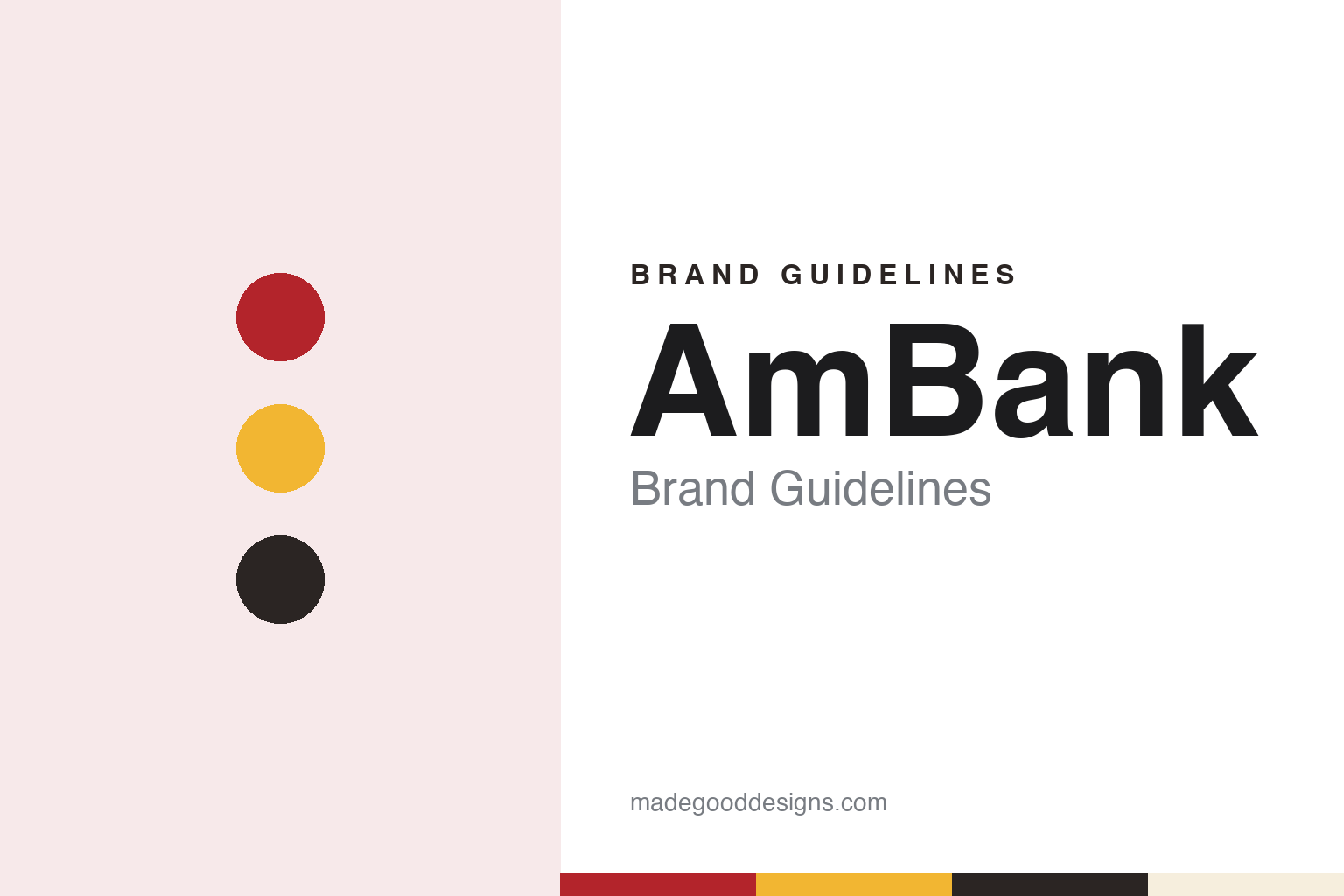
AmBank Brand Guidelines
The Arab-Malaysian merchant bank that became AmBank in red and yellow.
Aa
Two constants: a red and yellow palette and a sturdy grotesque register. Abstract homage — not an AmBank asset; no logo, mascot or signage is reproduced.
Arab-Malaysian
A 1975 joint venture.
AmBank began as Arab-Malaysian Development Bank Berhad, incorporated on 5 August 1975. The group’s own timeline describes it as a joint venture between Malaysian Industrial Development Finance, with 55%, Arab Investments for Asia of Kuwait, with 33%, and the National Commercial Bank of Saudi Arabia, with 12%. English Wikipedia names the banker Hussain Najadi as its founder and dates the start of operations to 1 April 1976.
In 1977 the group bought 70% of Malaysian Industrial Finance, later renamed Arab-Malaysian Finance. In 1982 Azman Hashim acquired the whole group, the company says, and in 1983 it was renamed Arab-Malaysian Merchant Bank, or AMMB. The company says AMMB became the first merchant bank listed on the Kuala Lumpur Stock Exchange in 1988, and in 1991 AMMB Holdings Berhad became the holding company. In 1993 it launched Tabung Ittikal Arab-Malaysian, which it describes as the first Islamic unit trust fund.
Commercial banking came in 1994, when the group bought the Malaysian operations of Security Pacific Asian Bank from Bank of America (Asia) and began trading as Arab-Malaysian Bank Berhad. Earlier, in 1986, the group had moved its corporate headquarters to Jalan Raja Chulan in Kuala Lumpur, and that December Antah Holdings and Japan’s Tokai Bank each took a 20% shareholding, the company says. AmBank and AmFinance merged in 2005 to form AmBank (M) Berhad, and the Islamic banking business moved into a separate subsidiary in 2006, the timeline says.
Colour
From Arab-Malaysian to AmBank.
The present name dates from 2002, when, according to the company, the “Arab-Malaysian Banking Group” was rebranded as “AmBank Group,” with new corporate colours: red, representing prosperity and good fortune, and yellow, representing commitment and unity. The “Am” prefix now runs across the group’s brands, which English Wikipedia lists as including AmBank, AmInvestment Bank, AmInvest, AmBank Islamic and AmMetLife. In 2014 the group unveiled new logos for AmMetLife and AmMetLife Takaful after a share sale to MetLife, and in 2015 the AmIslamic Bank brand became AmBank Islamic, the company says.
For seventeen years the group had an Australian partner. The company dates the entry of Australia and New Zealand Banking Group (ANZ) as strategic partner and major investor to 2007, and says ANZ raised its holding to 23.91% in 2009. The Star reported on 6 June 2024 that ANZ had sold a 16.5% stake in March 2024 and disposed of its remaining 5.17% that June, leaving the Employees Provident Fund as the largest shareholder at that date. Reporting the sale in May 2024, The Business Times noted that the exit came three years after ANZ said it would write down its investment, following AMMB’s settlement of a claim linked to the state fund 1MDB.
Today AMMB Holdings is listed on the Main Market of Bursa Malaysia, and the group describes its work as wholesale, retail, business and investment banking, with Islamic banking, insurance, takaful, broking and asset management alongside.
Its sub-brands follow the same two-letter pattern. The company’s timeline lists AmSignature Priority Banking and the AmKasih community platform, both launched in 2012, the year AMMB Holdings changed its stock short name to AMBANK, and a customer-service virtual assistant called AMY, introduced in 2019. Its annual reports have drawn notice of their own: the company says AMMB Holdings won the overall award for the most outstanding annual report at the NACRA awards for six consecutive years, from 1991 to 1996, and that The Banker named it Bank of the Year in Malaysia for 2013.
Typography
How Malaysian and Vietnamese banks present themselves.
Banks in Malaysia and Vietnam tend to present themselves through a bold wordmark or a short set of initials, often set in a single strong colour. Red, green, blue and orange recur across the sector, and many names work in two languages at once: a Malay or Vietnamese name for home customers and an English form or abbreviation for markets, filings and overseas branches. Several of the banks in this guide are known chiefly by initials that began as the names of older holding companies or merged institutions.
In Malaysia, Islamic banking usually sits beside the conventional bank as a range of its own, often run through a separate subsidiary with Shariah-compliant deposits, financing and cards. Public Bank, for example, says it began Islamic banking in 1993 and moved that business into Public Islamic Bank in 2008, while RHB offers its Islamic products through RHB Islamic Bank. RHB’s Sinar Credit Card-i, launched in November 2026, shows the “-i” suffix some Malaysian banks use for Islamic products.
Bank websites in both countries are organised around everyday tasks: deposits and savings accounts, home and vehicle loans, cards, QR payments and mobile apps. In Malaysia the national QR standard, DuitNow QR, was launched by PayNet in July 2019, according to Public Bank, whose own site lists DuitNow QR and its MyPB app under mobile banking. Photography tends to show branches, city skylines, head-office towers and customers at counters or on phones rather than abstract imagery.
Much of how these banks describe themselves appears in formal documents. Listed banks publish annual reports and, increasingly, sustainability reports, and their corporate websites group these with investor pages, milestone timelines and anniversary campaigns. This guide draws on those pages, on encyclopedia entries and on dated press reports, and marks where a fact rests on a bank’s own word.
Aa
A sturdy grotesque for a two-letter prefix. (Specimen set in Archivo, a sans STAND-IN; NOT the AmBank logo.)
AmBank
A camel, a skyline and a cafe counter.
The brand’s most familiar character is older than its name. In April 2025 Marketing-Interactive reported that AmBank had lit the glass front of its 26-storey Kuala Lumpur headquarters, Bangunan AmBank Group on Jalan Raja Chulan, with an LED reworking of its long-time camel mascot by the Malaysian cartoonist Lat. Lat’s camel had first been commissioned for the group’s product campaigns between 1984 and 1991, when it still traded as Arab-Malaysian. The new version marked the group’s 50th anniversary, which the company dates to 5 August 2025, under the campaign theme “Malaysia Kita.” The bank also promised new Lat illustrations on themes of unity, diversity and togetherness, and ran a photo contest from 3 to 18 May inviting people to pose in front of the building, Marketing-Interactive reported.
Branches have been reworked too. In March 2023 Vulcan Post reported a “bank-in-a-cafe” concept with Bask Bear Coffee at three AmBank branches in the Klang Valley, Penang and Kedah, with the two brands side by side in adjoining lots and plans for 47 more. The group’s current line is “This is Your Bank. Malaysia’s Bank. AmBank.”, alongside “Banking your way, since 1975” and the purpose statement “Winning Together.”
For a design guide, AmBank shows how a group can keep a documented red-and-yellow colour story and a decades-old mascot through a change of name. Compare CIMB and RHB Bank, two other Kuala Lumpur banking groups. For this guide we use a warm lantern red, a sunflower yellow and a deep charcoal with a sans, an unofficial interpretation; no product or logo is reproduced.
Explore & save
Keep AmBank’s identity on hand — save it to a board in the Made Good inspiration library.
AmBank identity set
Pin the AmBank red and yellow palette and the sturdy grotesque register to your own board.