China Minsheng Bank Brand Guidelines
The Beijing bank founded on private shareholders in 1996.
Aa
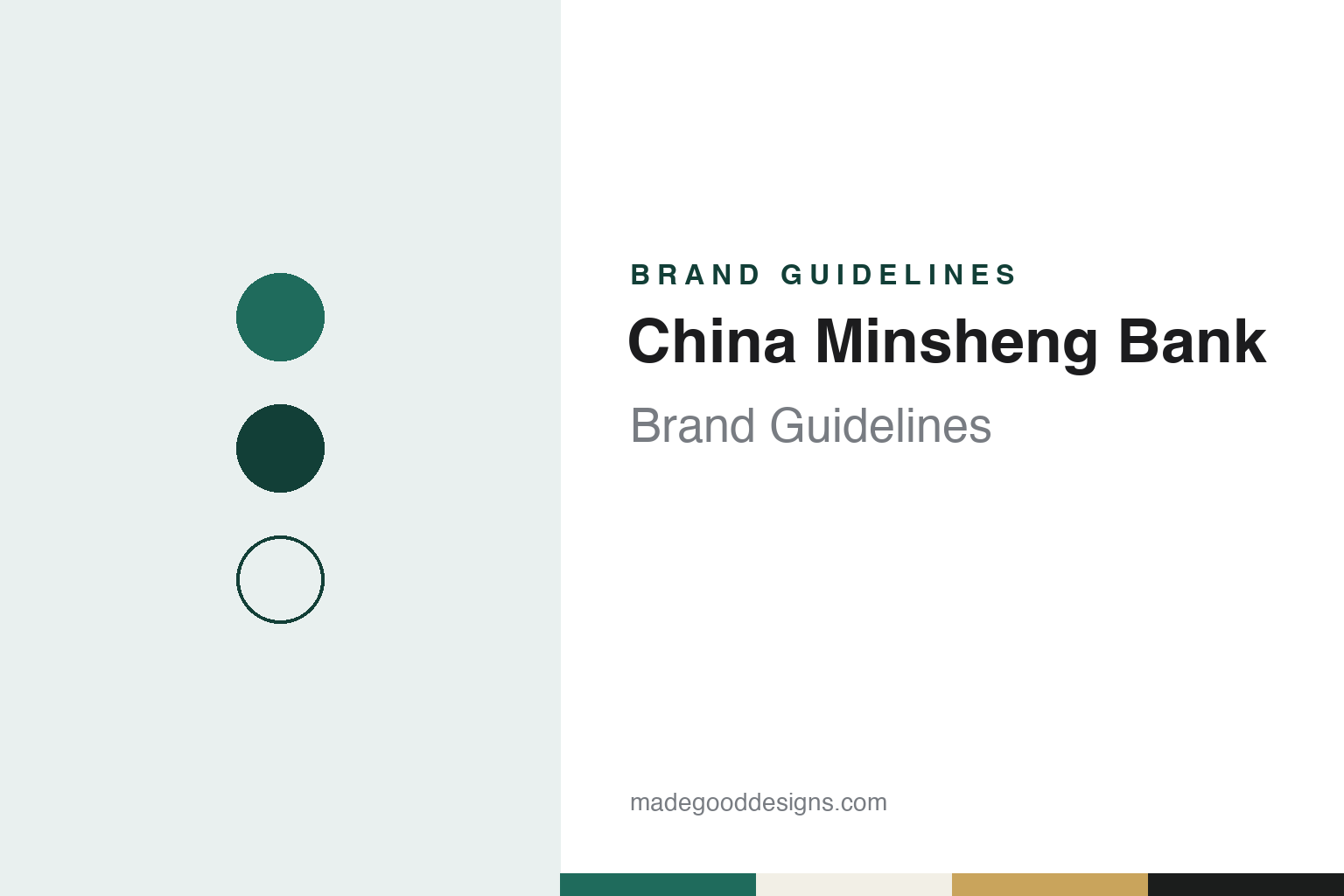
Two constants: a jade, rice paper and ink palette and a humanist serif register. Abstract homage — not a China Minsheng Bank product or mark; no logo, card or signage is reproduced.
A bank of private shareholders
Beijing, 12 January 1996.
China Minsheng Bank opened in Beijing on 12 January 1996, according to English and Chinese Wikipedia. The bank describes itself as China’s first national joint-stock commercial bank set up mainly by private enterprises, and English Wikipedia, citing the company’s own profile, calls it the first bank established with an ownership base of private-sector shareholders. English Wikipedia names its founder as the lawyer and businessman Jing Shuping.
Its first home was a historic building. English Wikipedia, citing James Stent’s 2017 book China’s Banking Transformation, says the bank’s seat from its founding until the early 2000s was the former Yokohama Specie Bank building in Beijing’s old Legation Quarter. Its head office today is the China Minsheng Bank Building on Fuxingmennei Avenue in Xicheng district, Chinese Wikipedia says.
The start was not smooth. English Wikipedia says the bank set out to lend mainly to non-state, high-tech and large enterprises, ran into difficulties by 1999 and changed its management in April 2000, with Jing Shuping staying on as chairman; it describes further organisational change in 2007, and a 2009 restatement of strategy around private, small and medium-sized and technology companies.
The bank listed early in its life. Its A shares began trading on the Shanghai Stock Exchange on 19 December 2000, Chinese Wikipedia says, and the bank itself gives 2000 as the year of its Shanghai listing.
Colour
Leasing, funds and a Hong Kong float.
Expansion beyond lending came in the late 2000s. The groundwork for a fund business was laid in October 2006, when the Royal Bank of Canada signed a joint-venture agreement with Minsheng to create a Chinese fund management company, English Wikipedia says, citing Investment Executive. In April 2008, according to English and Chinese Wikipedia, Minsheng won approval to set up Minsheng Financial Leasing, with Tianjin Bonded Zone Investment as a minority partner, and in November 2008 it formed Minsheng Royal Fund Management in Shenzhen with the Royal Bank of Canada and Three Gorges Finance.
Not every move worked out. In October 2007 the bank announced a plan to buy 9.9 per cent of UCBH Holdings, the parent of United Commercial Bank in the United States, with the option to go to 20 per cent. On 6 November 2009 the US Federal Deposit Insurance Corporation took over United Commercial Bank, and Minsheng wrote off the investment, saying it had already made provisions for it, both Wikipedias report. A planned stake in Shaanxi International Trust was cancelled after market conditions changed.
The bank’s H shares listed in Hong Kong on 26 November 2009, English Wikipedia says, citing Reuters; the public tranche of the offer was oversubscribed 157 times. Its first overseas branch, in Hong Kong, opened formally on 30 March 2012, Chinese Wikipedia says, and the bank now lists two overseas branches, in Hong Kong and London, alongside 41 tier-one branches on the mainland covering 142 cities.
Ownership shifted in the 2010s. By July 2016 Anbang Insurance Group was the bank’s largest shareholder, The Business Times reported on 19 July 2016, and Chinese Wikipedia dates Anbang’s position as largest shareholder to 2015. Chinese Wikipedia says regulators took over Anbang from 2018 and that its assets passed to the newly formed Dajia Insurance; in its 2022 data, Dajia Life Insurance accounts appear among the largest holders of the bank’s shares.
Typography
Design and documentation.
China’s large banks present themselves to two audiences at once. Most carry a Chinese name and an English one, and many shorten the English to initials, so a single identity has to work in Chinese characters, in Latin letters and in a short acronym on cards, apps and branch fronts. Red and blue dominate the sector’s colours, and marks are often built around Chinese characters or around round forms that recall coins and seals, though the meaning of a particular mark should be checked against the bank’s own account rather than assumed.
Much of the visual record comes from the banks’ own channels. Their websites set out a mission, a motto and a list of values, usually in both languages, and divide services into retail or personal banking, corporate banking, inclusive finance for small businesses and wealth management. Branch photography, with signage over glass frontages and service halls, is a staple of annual reports and investor pages.
The phone has become a second front door. The big banks run mobile-banking apps and, in several cases, separate lifestyle or payments apps, and they report online user numbers alongside branch counts. Many also link their cards to UnionPay, the national card network.
The paper trail is long and dated. Banks listed in Shanghai and Hong Kong publish annual reports, interim results and ESG reports in Chinese and English, and several issue green bonds or publish separate green-finance reports. For design research, those documents give dated, citable evidence of how an identity is applied, from cover design to typography and photography, and they are the most reliable place to check a claim about a bank’s name, history or scale.
Aa
A humanist serif for a bank that speaks of livelihoods. (Specimen set in Noto Serif, a serif STAND-IN; NOT the China Minsheng Bank logo.)
China Minsheng Bank
Small firms, neighbourhoods and a livelihood slogan.
The bank frames its identity around customers outside the state sector. It says it shares its roots with private enterprise and treats serving private companies as a strategic priority, that it began its small-and-micro-business finance programme in 2008, and that in 2013 it opened what it calls the country’s first community sub-branch, a network it now puts at more than 1,100 community outlets.
Regional press tells the same story locally. A Sina Shaanxi report of 28 August 2026, marking 25 years of the bank’s Xi’an branch, said the branch opened in August 2001, began offering small-and-micro-business finance in Shaanxi in 2009, and uses the bank’s Minsheng e-Home digital platform to give small firms business-management services.
The words in its name carry the message. Chinese Wikipedia lists among the bank’s slogans a line that translates roughly as “serving the public, caring for people’s livelihood,” and the same line closes the bank’s own profile. The bank says it has been named repeatedly to the list of domestic systemically important banks drawn up by the People’s Bank of China and the National Financial Regulatory Administration, and that MSCI rated it AAA on ESG for 2024, 2025 and 2026.
Online, the bank’s site offers simplified Chinese, traditional Chinese and English versions, an accessibility mode and page-zoom controls, and its menus are organised around personal, small-business, corporate, interbank and credit-card customers.
For a design guide, China Minsheng Bank shows how a bank founded on private shareholders built its public message around small firms, neighbourhood branches and the idea of livelihood. Compare it with China CITIC Bank, another Beijing-based national joint-stock bank, and China Merchants Bank, one of the same group of joint-stock commercial banks. For this guide we use a deep jade, rice paper and ink with a humanist serif, an unofficial interpretation; no product or logo is reproduced.
Explore & save
Keep China Minsheng Bank’s identity on hand — save it to a board in the Made Good inspiration library.
China Minsheng Bank identity set
Save the China Minsheng Bank jade, rice paper and ink palette and the humanist serif register to your own board.